Per- and Polyfluoroalkyl Substances (PFAS) Testing in a Laboratory

Regulatory compliance R&D support Quantitative analysis of 20 to 36 PFAS Detection of polymeric PFAS
More than 140 people
More than 140 people at your service
5200 m² laboratory
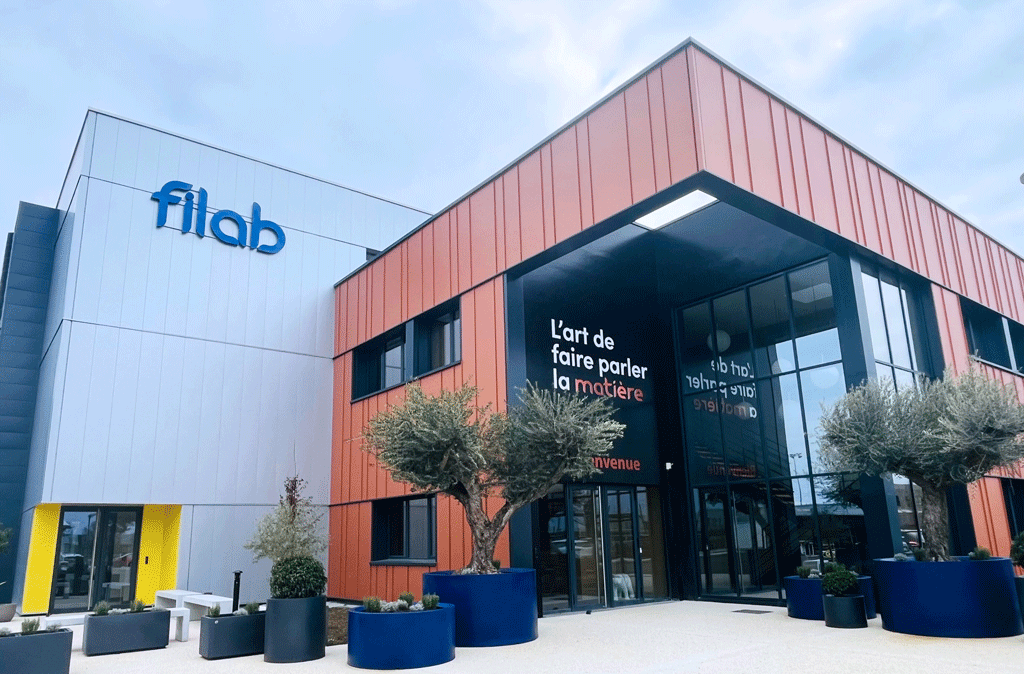
5200 m² laboratory + 99% of services are provided in-house

PFAS Analysis : regulatory compliance and chemical characterization

What are PFAS?

PFAS (Per- and PolyFluoroAlkyl Substances) are a large family (several thousand) of molecules containing at least one highly fluorinated carbon motif (C–F bonds), which are very stable. This stability explains their persistence in the environment and often in the body, hence their nickname “forever chemicals”. These are chemical compounds with non-stick, waterproofing and heat-resistant properties.

Per- and polyfluoroalkyl substances (PFAS) are now subject to major regulatory restrictions in France and Europe, impacting many industrial sectors: cosmetics, textiles, plastics, coatings, technical materials, industrial equipment, etc.

FILAB’s PFAS expertise

FILAB is an independent laboratory specialzing in analytical chemistry and material characterization, with particular expertise in the analysis of regulated substances, especially in complex matrices.

Our approach is not limited to simple dosing : we combine several complementary analytical techniques to identify, quantify and interpret the presence of PFAS, including in their polymeric forms.

Supporting your regulatory compliance and delivering actionable scientific interpretation of your results.

Our PFAS Analysis Services

Services

Targeted PFAS analysis: 20 substances

Regulatory screening.
Quantitative analysis of 20 PFAS representative of the most commonly regulated substances.
Techniques : LC-MSMS
Limits of quantification (LoQ)

1 to 10 ppb depending on the matrix

For what purposes ?
  • Regulatory overview
  • Product compliance verification
  • Supplier control
  • PFAS pre-audit
Services

Advanced PFAS analysis: 36 substances

Cosmetics & complex matrices
Extensive quantitative analysis of 36 PFAS, suitable for complex matrices (cosmetics, polymers, coatings, technical materials).
Techniques : LC-MSMS, GC-MSMS, HC-GCMS

Analysis by LC-MSMS, GC-MSMS, HC-GCMS


Limits of quantification (LoQ)

1 to 20 ppb depending on the matrix

Specific features: Multi-technical methodology and possibility of analytical optimisation in the event of matrix effects
Services

Total Fluorine Testing

Overall indicator of fluorinated compounds
Total fluorine analysis allows the assessment of the overall presence of fluorinated compounds, including non-target PFAS.
Approach
Regulatory interest
  • Comprehensive evidence in the event of an inspection by the authorities
  • Guidance tool for further analysis
  • Demonstration of compliance with ‘fluorine-free’ requirements

Critical case : Polymeric PFAS

Total fluorine > 50 ppm & targeted PFAS < 25 ppb ?

This suggests the probable presence of polymeric PFAS that cannot be detected by conventional targeted methods.

Our solution : Qualitative screening by Pyrolysis GC/MS (Py-GCMS)

This technique makes it possible to :

  • identify signatures of fluorinated polymers

  • differentiate between polymeric PFAS and non-PFAS

  • provide scientific evidence in the event of an audit or inspection
This situation is common in polymeric materials, coatings, membranes, seals and technical textiles.

Why choose FILAB ?

With a wide range of cutting-edge analytical equipment (GC-MS, LC-MSMS, IC, Py-GCMS, etc.), the FILAB laboratory adapts its methods for analysing per- and polyfluoroalkyl substances according to the matrix to be studied (liquid, solid, powders)...

PFAS testing in finished cosmetic products (emulsions, make-up products, lotions, etc.) and cosmetic raw materials.

Total fluorine testing by IC after combustion

Quantification of fluorinated molecules by LC-MS

Search for traces of elemental impurities (contamination, pollution, residues)...

Analysis can be validated according to ICH Q2

Analysis of APIs, excipients, raw materials, reagents and solvents in the pharmaceutical sector

pfas

PFAS : what is the current status of regulations ?

Since French Law No. 2025-188 of 27 February 2025 (Environmental Code, Art. L.524-1), the use of products containing PFAS has been gradually banned, with key deadlines :

  • Since 1 January 2026: ban on the marketing of certain products containing PFAS (including cosmetic products).
  • From 2030: extension to textiles and other industrial uses (with exemptions for essential uses).
  • REACH Regulation (EU) : a ‘universal’ PFAS restriction is currently being evaluated by ECHA, strengthening control and traceability requirements in supply chains.
  • Firefighting foams : gradual ban in the EU, with a regulatory threshold of 1 mg/L for the sum of PFAS.

Please contact us to find out the thresholds applicable to your product and to discuss their interpretation with our experts in relation to your matrix 📞📧.

Our FAQ

What is a PFAS analysis in laboratory ?

A PFAS analysis aims to detect and quantify per- and polyfluoroalkyl substances present in a matrix (liquid, solid, powder, polymer, etc.) using chromatography techniques coupled with mass spectrometry (LC-MS/MS).

Where are PFAS found ?

These substances are used for their non-stick, waterproof and heat-resistant properties in :

  • non-stick coatings (kitchen utensils, technical textiles);
  • cosmetics and food packaging;
  • industrial additives (paints, varnishes, lubricants).

What types of samples can be tested for PFAS ?

The FILAB laboratory analyses PFAS in pharmaceuticals, cosmetics, solvents, food packaging and polymer materials.

What techniques are used for PFAS analysis ?

Analysis are mainly performed by LC-MS/MS or combustion ionisation (IC) for total fluorine determination. These methods enable detection at thresholds of 1 to 10 ppb depending on the matrix.

Which PFAS are measured by the laboratory ?

The FILAB laboratory offers analysis of 36 PFAS, including the 20 substances mentioned in the European Water Directive, such as PFOA, PFOS, PFHxA, PFNA and PFDA.


What are the regulatory developments concerning PFAS ?

Since February 2025, French law has provided for the gradual ban of PFAS in cosmetics, clothing textiles and ski waxes from 1 January 2026.

Why carry out a PFAS analysis ?

In the event of regulatory non-compliance, process improvement or product failure, manufacturers may be required to carry out analyses of per- and polyfluoroalkyl substances.

Subject to significant regulatory constraints, monitoring their presence is therefore essential.

Performing these substance checks requires precise tools, capable of measuring at the ppm or even ppb level. At FILAB, they are performed using LC-MSMS, and we are able to achieve a quantification limit of 1 to 10 ppb depending on the matrices.

The filab advantages
A highly qualified team
Responsiveness in responding to and processing requests
A COFRAC ISO 17025 accredited laboratory
(Staves available on www.cofrac.com - Accreditation number: 1-1793)
A complete analytical facility of 5,200m²
Tailor-made support
Tailor-made support
Video debriefing available with the expert
Anaïs DECAUX Customer Support Manager
Ask for your quote