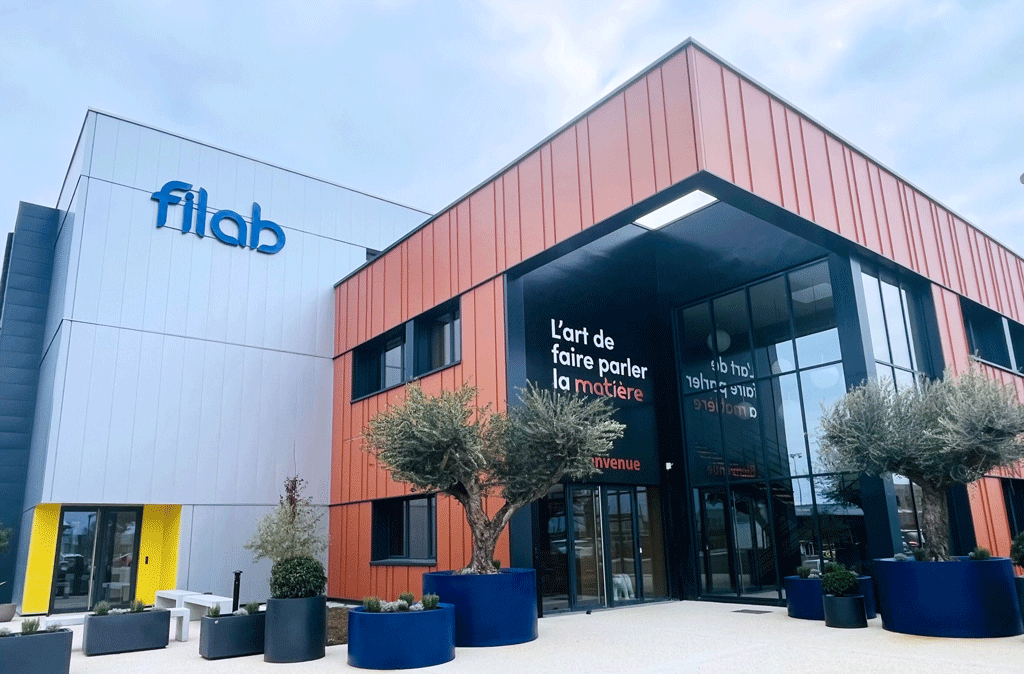
Metallurgy, Steelmaking and Foundry Analysis and Expertise Laboratory
As an industrial manufacturer, you are looking for a laboratory capable of carrying out metallurgical, steelmaking, or foundry analysis
From the design stage to bringing a product with metal components to market, you face several types of challenges, relating to:
- The control of raw materials
- The substitution of metal alloys
- The understanding and anticipation of material behavior in their operating environment
- The performance of surface treatments
- The optimization of manufacturing and machining processes to reduce the risk of failure.
To support you in solving these challenges, the backing of a reliable laboratory with strong technical added value enables you to better understand the changes taking place in the metals industry and improve the efficiency of your business.
To support you in addressing these challenges, the backing of a reliable laboratory with strong technical added value enables you to better understand the changes in the metallurgical sector and improve the efficiency of your operations.
The FILAB laboratory supports industrial companies in metallurgy and steelmaking analysis
FILAB, a laboratory made up of experts in metallurgy and steelmaking analysis and failure characterization, offers its analytical services, from design to manufacturing and implementation of a product with metallic components. Drawing on its experience and state-of-the-art analytical equipment, FILAB laboratory has a wide range of tools specific to the metallurgical sector, enabling it to provide the following services:
Our metallurgy and steelmaking analyses
FILAB laboratory carries out chemical composition analysis of metal alloys, mainly using dedicated analyzers and ICP.
The surface of a material, crucial to its interactions and performance, influences the product’s reliability and strength. Understanding these properties helps adapt manufacturing and processing methods.
Characterization of metal powders according to the Ma-0015 standard for additive manufacturing.
additive.
A ferroalloy is a metallic alloy composed mainly of iron and one or more chemical elements (such as chromium, manganese, silicon, vanadium or molybdenum).
Steelmaking slags are solid residues generated during metal smelting processes (steelworks, foundries, etc.).
Our metallurgy and steelmaking expertise
Analyzing imperfections in your metal alloys makes it possible to determine their origins and impacts. We carry out detailed failure analyses for a thorough understanding of their nature and scope.
Understanding the microstructure of materials is crucial for the development and manufacturing of a new product or for improving an existing product that shows new anomalies.
Assessing material compatibility between a container and its contents is essential to prevent contamination and related issues.
Laboratory metallography is the method used to analyze the structure of a metal alloy by examining it under an optical microscope (OM) following dedicated preparation.
As an approved training organization, FILAB supports your teams in learning new analysis and characterization methods. Whatever your industry, FILAB supports you in analytical chemistry training.
Examples of application standards
Reference standard
Standards
Standards
Standards
Standards
Our technical capabilities
Organic chemical analyses
LC-ORBITRAP, GPC, RMN, IRTF
Elemental Analysis Techniques
ICP-AES and ICP-MS
Elemental Analysis
C/S, N/O, H
Powder Analysis
XRD, SEM-FEG EDX, BET
Spark Spectrometry
SEO
Surface analysis
SEM-FEG EDX, XPS, TOF-SIMS
Did you know?
FILAB holds numerous accreditations and client approvals
for the metallurgy industry, such as:
ISO 17025
accredited by COFRAC
for physico-chemical analyses of metallic materials
Approved by
SAFRAN
for analyses of metal powders according to the Ma-0015 criteria
Approved by
FRAMATOME
for analyses of metal alloys
FILAB explains the stainless steel rouging phenomenon for a client
Learn moreOur FAQ
A metallurgy laboratory is an expert center specializing in the study, testing, and characterization of metals and alloys. Its role is to analyze chemical composition, microstructure, and mechanical properties in order to assess material quality, identify potential failures, and ensure compliance with industry standards.
Manufacturers turn to a metallurgy laboratory when they need to understand a fracture or corrosion on a part, or when they are developing new alloys. These analyses provide essential quality assurance for demanding sectors such as aerospace, automotive, energy, steelmaking, and medical devices.
When a metal part breaks, cracks, or corrodes, the metallurgy laboratory carries out a full investigation. This includes metallographic examination, inclusion analysis, hardness testing, verification of surface treatments, and composition analysis. The goal is to determine whether the failure is due to a material defect, an unsuitable treatment, or extreme service conditions.
A metallurgy expertise laboratory relies on a comprehensive analytical platform: ICP-AES for chemical composition, spark spectrometry, gas analysis (C, H, N, O, S), X-ray diffraction, scanning electron microscopy (SEM-EDX), as well as advanced techniques such as TOF-SIMS or XPS for surface characterization.
Metallurgical analyses are based on ISO standards (e.g., ISO 5832), ASTM standards (E1447, E2594, E2371), and NF/EN standards depending on the requirements, with specific references such as Ma-0015 for powders in additive manufacturing.
Yes, FILAB is COFRAC-accredited according to ISO 17025, guaranteeing technical competence, impartiality, and the validity of the methods used for physicochemical analyses of metallic materials.
The laboratory accepts metal parts (steel, stainless steel, special alloys), metal powders, steelmaking slags, and coated surfaces requiring characterization.
Yes, FILAB experts advise on method selection, carry out failure investigations, and offer training to strengthen the internal skills of teams. We also schedule video debriefs on request with our experts.
to contact our team.