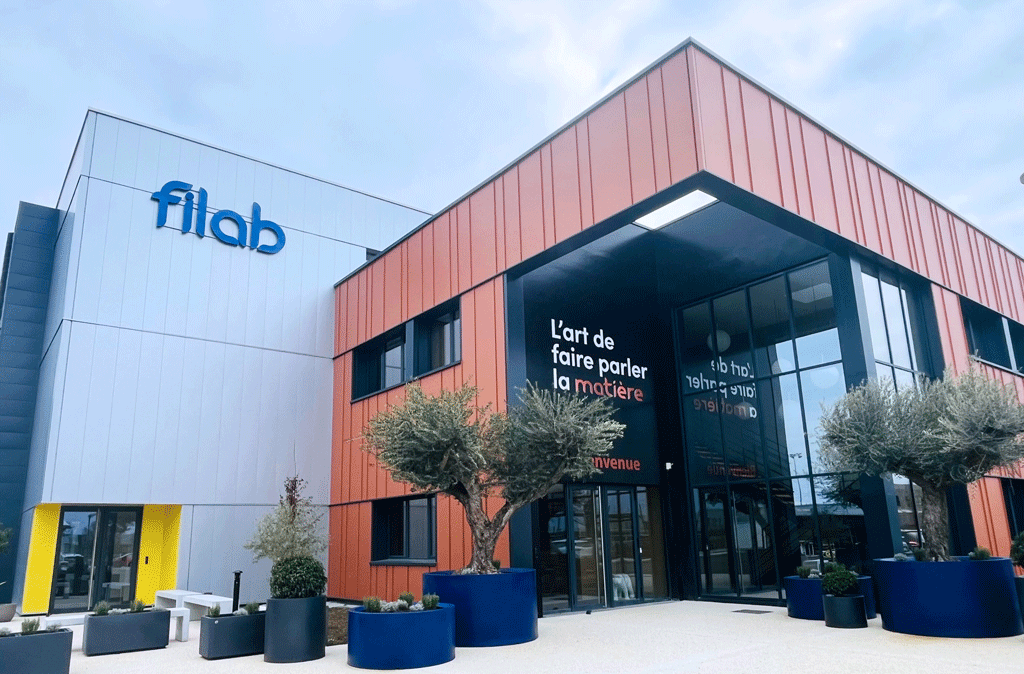
Analytical Laboratory Serving the Pharmaceutical Industry

More than 140 people
More than 140 people at your service
5200 m² laboratory
5200 m² laboratory + 99% of services are provided in-house
Accredited laboratory
Accredited laboratory COFRAC ISO 17025

Chemical and Materials Analysis and Expertise Serving the Pharmaceutical Industry

The pharmaceutical sector is a world of its own, with its own rules and codes. FILAB’s laboratory fully understands this exceptional dimension. Our PhD scientists and engineers are therefore trained to meet your specific pharmaceutical analysis needs, thanks to our expertise in the pharmaceutical industry,

such as:
  • Setting up an analysis method specific to your products, validated according to the ICH Q2 guideline
  • Identifying an impurity or particle
  • Investigating an issue with the behavior of one of your products (degradation, color change, odor, etc.)
  • Deformation of an API or an existing product

From the development of new dosage forms to the control of your production, FILAB laboratory offers you high-level human expertise and state-of-the-art analytical equipment to provide tailor-made services, all within a quality environment meeting GMP criteria.

FILAB carries out analysis and expert assessments for the pharmaceutical industry

As an extension of your in-house laboratories, the laboratory offers pharmaceutical manufacturers the following services:

Analysis

Our quality control analysis for the pharmaceutical industry

Nitrosamine analysis

Nitrosamines are classified by the IARC and the WHO as harmful compounds and are considered potentially carcinogenic to humans. In addition, the ANSM closely monitors them.

Elemental impurity testing according to ICH Q3D

Le guide ICH Q3D établit la procédure pour évaluer les impuretés élémentaires dans les produits pharmaceutiques, y compris ceux destinés à l'humain

Residual solvent analysis according to USP 467 (ICH Q3C context)

ICH Q3C provides guidance on acceptable toxicological thresholds for patient safety regarding concentrations of residual solvents (or residual volatile impurities) in pharmaceutical products.

Solid-state analysis
Stability study of pharmaceutical products and medicines
Expertise

Our expertise and R&D support

Particulate contamination

Particle counting is a crucial method for measuring and quantifying contaminants in various media, such as air, water, and raw materials, and is vital in many scientific and industrial sectors. This technique provides detailed information on particle size, shape, and distribution, which is particularly important for the pharmaceutical industry in controlling contamination in powders and injectable products.

Degradation studies

A forced degradation study tests the stability of pharmaceutical products/APIs to assess their behavior, purity, and compliance over time.

ICH Q2 analytical validation and analytical development

The ICH Q2 guideline guides the validation of analytical methods, developed by ICH experts and submitted to regulatory consultations.

Quality control
Training in analytical method validation

Filab supports you with training in analytical method validation for your teams

Cofrac

The FILAB laboratory is notably the only laboratory in France accredited ISO 17025 by COFRAC (www.cofrac.fr: accreditation no. 1-1793) for elemental impurity analysis in pharmaceutical matrices.

Our techniques

Organic chemical analysis

GC/MS, Py-GCMS, UPLC-MSMS, LC-QTOF-MS, LC-QTOF-MS, LC-ORBITRAP, GPC, NMR, FTIR

Powder analysis

XRD, SEM-FEG EDX, BET, Laser particle size analysis

Inorganic chemical analysis

ICP, DRX, CI

Thermal analysis

ATG, ATG-FTIR, DSC

Surface characterization

SEM-FEG EDX, XPS, TOF-SIMS

Discover our case study

Unknown particles in your pharmaceutical products

Learn more

Our FAQ

What types of analysis are carried out in a pharmaceutical analysis laboratory?

As a pharmaceutical testing laboratory, we carry out analyses to ensure the safety, efficacy, and quality of pharmaceutical products. These analyses cover a wide range of aspects, from raw material characterization to finished product evaluation, including stability studies.

Here are some examples of commonly performed analyses:

  • Physicochemical Analysis and Chemical Analyses: Includes the determination of purity, chemical structure, solubility, pH, viscosity, and surface tension of substances. These analyses make it possible to characterize the physical and chemical properties of compounds.
  • Chromatographic analysis: Techniques such as high-performance liquid chromatography (HPLC) and gas chromatography (GC) are used to separate, identify, and quantify the components of a mixture.
  • Spectroscopy: Includes techniques such as infrared spectroscopy (IR), mass spectrometry (MS), and nuclear magnetic resonance (NMR), used to study the molecular structure of compounds.
  • Drug Dissolution Tests: Measure the rate at which a drug dissolves in liquids that simulate body fluids, which is crucial for assessing its efficacy and bioavailability.
  • Drug Stability Tests: Evaluate how the quality of a drug changes over time under the influence of environmental factors such as temperature, humidity, and light. These tests are essential for determining product shelf life.
  • Pharmaceutical Quality Control: Covers all the previous tests to ensure that finished products meet regulatory standards and internal specifications before being placed on the market.

These analyses are fundamental to new drug development, quality assurance, and regulatory compliance, ensuring that pharmaceutical products are safe and effective for use.

  • Catalyst analysis: vis intended to characterize the catalysts used in pharmaceutical synthesis processes. It makes it possible to analyze the chemical composition, the state of the active phases, the specific surface area, and the dispersion of catalytic sites in order to ensure the efficiency, reproducibility, and control of chemical reactions.

Why perform an Extractables & Leachables (E&L) analysis in the pharmaceutical industry?

Extractables & Leachables analysis make it possible to identify substances likely to migrate from materials, packaging, or equipment into a medicine. They help control contamination risks, ensure patient safety, and meet regulatory requirements.

What is the difference between extractables studies (USP <1663>) and leachables studies (USP <1664>)?

USP <1663> concerns the identification of extractables, meaning compounds that may be released under forced conditions. USP <1664> focuses on leachables, corresponding to substances actually transferred to the pharmaceutical product under its normal conditions of use or storage.

Which standards govern Extractables & Leachables analysis?

E&L studies rely on several recognized standards such as ICH Q3E, USP <1663>, USP <1664>, as well as BPOG recommendations, in order to assess the risks associated with materials in contact with pharmaceutical products.

Which laboratory should you choose to carry out Extractables & Leachables (E&L) analysis?

The choice of an E&L laboratory should be based on several criteria: mastery of regulatory frameworks (ICH Q3E, USP <1663>, USP <1664>, USP <661>, USP <665>), expertise in materials characterization, advanced analytical capabilities (GC-MS, LC-MS, ICP-MS), and support with pharmaceutical compliance challenges.


Specialist in chemical and materials analysis, FILAB supports pharmaceutical manufacturers in their extractables and leachables studies. The laboratory carries out analysis in particular according to USP <1663>, USP <1664>, BPOG, USP <661.1> / <661.2>, USP <665> / <1665>, in compliance with the ICH Q3E guideline. FILAB relies on a multi-technique analytical platform, COFRAC ISO 17025 accreditation, and recognized expertise in chemistry and materials characterization.

The filab advantages
A highly qualified team
Responsiveness in responding to and processing requests
A COFRAC ISO 17025 accredited laboratory
(Staves available on www.cofrac.com - Accreditation number: 1-1793)
A complete analytical facility of 5,200m²
Tailor-made support
Tailor-made support
Video debriefing available with the expert
Contact us
To find out more about these services, don't hesitate
to contact our team.
Anaïs DECAUX Customer Support Manager
Ask for your quote
Pharmaceutical Industry
Our blog posts
Case study
Chemical Analysis

Unknown particles in your pharmaceutical products: from emergency to continuous monitoring

02/12/2025
Analytical Techniques
Health

What is the best technique for analyzing nitrosamines in pharmaceutical products?

02/12/2025
Health
News

Study of Extractables and Leachables (E&L) - Interview

02/12/2025
Analytical Techniques
Health

Quantitative analysis of polysorbate 20/80 in biopharmaceuticals by HPLC-MS

02/12/2025
Health

Peptide Identification in Biopharmaceuticals: How to Ensure Reliable and Regulatory-Compliant Analysis?

02/12/2025
Health
News

Ensuring the compliance of your medical device (ISO 10993-18) for successful export to the United States (FDA guidelines)

24/11/2025
Health
News

ICH Q3D Analysis (Elemental Impurities) - Interview

24/11/2025
Around this topic