The problem?
A shipyard is designing a new service vessel with a steel hull and aluminum superstructure to lighten the structure. These two metals are joined using a specific welding technique. The design office is concerned about the risk of accelerated galvanic corrosion at the joint, which will be constantly exposed to seawater.
A failure at this critical point could compromise the structural integrity of the ship. The customer asked FILAB to solve this problem by conducting a galvanic coupling study.
To assess this risk, we conducted a galvanic coupling study in accordance with ASTM G71.
Galvanic corrosion risk assessment
Objective:
The main objective of this study is to provide the shipyard with a quantitative and predictive assessment of the risk of galvanic corrosion associated with the steel hull/aluminum superstructure assembly, in order to ensure the structural integrity of the new service vessel,& nbsp;while avoiding high post-construction maintenance and downtime costs.
Our technical approach
To assess this risk, we conducted a galvanic coupling study in accordance with ASTM G71.
Step 1: Setting up the electrochemical cell
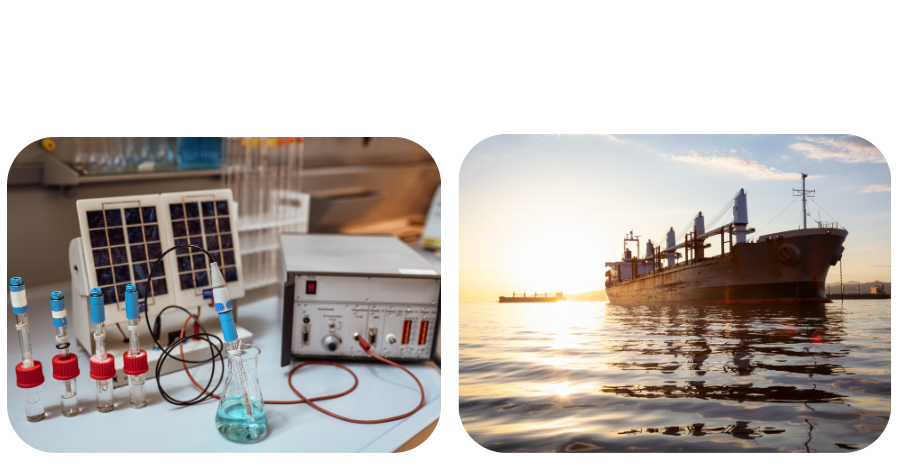
The first step was to prepare the sample. Plates of steel (representing the hull) and aluminum (representing the superstructure) were assembled and electrically connected within an electrochemical cell. The cell was then filled with artificial seawater to accurately replicate the operating environment and initiate the corrosion reaction.
Step 2: Initial measurement and monitoring
Next, we proceeded to the measurement phase. The coupling current and coupling potential were measured continuously. The coupling current is the key indicator of the corrosion rate of the least noble metal (aluminum, in this case), providing a direct reading of the deterioration of the material.
Step 3: Observation of the system's evolution
Finally, the test was maintained over several days. This extended duration made it possible to observe the evolution of the system over time, and more specifically to detect and analyze the possible formation of protective layers (a phenomenon known as passivation) that could modify the kinetics of corrosion.
The benefits of this analysis for the client
The test confirmed that aluminum would behave as a sacrificial anode, corroding preferentially to protect the steel, with an initially very high corrosion rate at the junction.
This data enabled the shipyard to:
• Anticipate a major corrosion phenomenon even before construction began.
• Make informed design decisions by incorporating a cathodic protection system (sacrificial zinc anodes) precisely sized to protect the weld area.
• Ensure the safety and durability of the ship, avoiding extremely high maintenance costs and the risk of downtime.
Conclusion of the stud
The study of galvanic coupling conducted in accordance with ASTM G71 standard has transformed a theoretical uncertainty into critical quantitative data for naval design. Continuous measurements of coupling current and coupling potential confirmed the existence of a strong electrochemical interaction between the steel hull (cathodic) and the aluminum superstructure (anodic) in seawater.
Ultimately, this preventive approach, validated by applied electrochemistry, guarantees the safety and durability of the ship. It has enabled the shipyard not only to technically validate its design, but also to provide assurance of structural reliability to the ship operator, avoiding considerable financial and operational risks.
