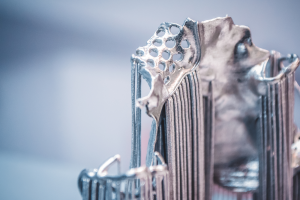
Additive manufacturing of metal parts
Additive manufacturing first appeared in the 1980s, but it was in the 1990s that various techniques and materials were developed, making it more accessible and practical for industrial use.
Discover the incredible versatility of additive manufacturing
Additive manufacturing (AM), also known as 3D printing, allows three-dimensional parts to be manufactured from a digital file. The first step in additive manufacturing is to create a 3D model of the object using software, which then cuts it into thin horizontal layers. In a second step, the 3D printer builds the object by stacking successive layers. The different layers of material can be deposited by fusion, sintering, or polymerization.
The main materials used by manufacturers in additive manufacturing are metals, but ceramics and polymers are also used in the form of powders, ribbons, or wires.
The advantages of using additive manufacturing for the production of metal parts
Now at a high level of maturity, this technology offers unparalleled design freedom and has found numerous applications in demanding markets such as aeronautics, space, medical, automotive, …
Inspection of metal powders and finished products from additive manufacturing.
The importance of quality control for metal powders in additive manufacturing
The quality of metal powders is crucial in additive manufacturing. At the heart of the material-laser interaction, powders must comply with specific requirements in terms of chemical composition, morphology, particle size, and minimum intra-particle porosity.
To guarantee the quality of the parts produced, controlling metal powders is a major challenge in achieving the expected performance. The parameters that are regularly analyzed are:
- the chemical composition determined by ICP-AES, ICP-MS, and elemental analyzers (C/S, N/O, and H).
- the granulometry, generally performed by laser granulometry in accordance with ISO 13320,
- flowability characterized by a flow time, it can be measured using a calibrated cone-type funnel:
- Hall according to ISO 4490 and ASTM B 213
- Carney cone according to ASTM B 964 (the latter cone being of interest for aluminum powders, for example)
- apparent density and tapped density used to characterize, through mechanical effects, the ability of a powder to organize itself by expelling air between the grains.
- the true density determined by pycnometry in accordance with ISO 12154 or ASTM B 923.
- the morphology characterized by Scanning Electron Microscopy (SEM-FEG) and Optical Microscopy.
- the microstructure characterized by a metallographic examination.
- evaluation of the removal of additive manufacturing residues in medical devices according to ASTM F3335-20
X-ray tomography: a leading analysis technique for inspecting metal additive parts
X-ray tomography is an analysis technique used by the FILAB laboratory that allows for the precise localization of any heterogeneity, singularity, or inclusion present in a material or finished product. It also allows for the verification of the assembly and positioning of complex mechanical assemblies.
This non-destructive technique provides a diagnosis that allows defects in a component to be visualized in three dimensions and high value-added parts to be inspected.
The inspection of parts produced using additive manufacturing can also be carried out using cutting-edge tools such as the FEG-EDX MEB, DRX, or BET measurements.
In conclusion

The FILAB laboratory offers its customers characterization services for metal powders used in additive manufacturing and for metal parts produced using additive manufacturing.