

Comparison of surface passivation processes using XPS
Objective :
The objective of this study is to verify the effectiveness of a new passivation process (paste, Sample 2) in comparison with the old one (bath, Sample 1).
- The quantification and oxidation state of iron and chromium elements are characterized for each sample.
- The contribution of oxidized species within the oxygen element is also observed.
Approach :
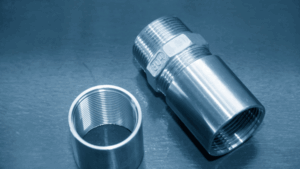
The study of the effectiveness of the two passivation processes for 316L stainless steel TIG welds is based on a nanoscale surface analysis using FILAB's analytical equipment. For this passivation study, FILAB drew on its dual expertise in materials and chemistry to determine the elemental composition of the 316L stainless steel TIG welds.
Here, an XPS spectroscopy study of the two passivation processes (paste and bath) determined that the outer surface of the two samples has essentially the same elemental composition.
In fact, they are composed mainly of oxygen, as well as iron and chromium. Other elements present in trace amounts are also observed.
Results :
XPS analysis therefore indicate that the surfaces of the two samples are well passivated. They also seem to indicate that these passivations are equivalent in terms of surface area.
Study of the passivation depth of the two types of processes using XPS
Objective:
Create a profile of the evolution of elemental concentrations present on the surface and at depth using several successive pulverizations through precise bombardment for each sample.
Approach :
The XPS analysis previously performed on the surface were repeated after each spraying process. The profiles of the evolution of the elemental composition according to depth in the sample for both processes were obtained. The following results were obtained.
Results :
Despite very similar passivation quality on the surface, the two processes appear to produce different passivation thicknesses.
Sample 2 (paste) has a thicker passivation layer (~15 nm vs. 8 nm for sample 1=bath), indicating better resistance to oxidation.
Higher chromium concentration in sample 2 (17-18% versus 10%), suggesting a difference in the composition or treatment of the material.
Oxygen diffusion is greater in sample 1, whereas it is severely limited at depth in sample 2.


Laboratory specializing in analysis and expertise for industrial companies


