

Nanomaterials: why not see the glass as half full?
Author: Thomas Gautier
When I started my career in analytics, my goal was to find characterization methods that would enable the classification of powders at the nanoscale. Many regulations, particularly those governing cosmetics and food, incorporated (and still incorporate!) this concept of nanomaterials.
The glass half empty...

In this context, nanomaterials have rather negative connotations. They are subject to declarations for the purpose of tracking their use (when intentional). Even today, we do not clearly understand their harmful potential. These declarations therefore make perfect sense in the context of the precautionary principle and the need for rapid and effective corrective action.
However, although the objective is honorable, it is not always a good idea from a marketing perspective to label a component as [nano]. This is the dark side of nanomaterials.
Personally, I always look on the bright side of things. So I tend to focus on all the applications that nanotechnology can bring to our daily lives, especially in terms of concrete challenges with high stakes, such as medicine.
…The glass half full: nanomedicine
Indeed, I haven’t forgotten that I had the opportunity to work in a research team that was working on the use of titanium nanotubes as a means of delivering therapeutic agents [1].
The use of nanoparticles for the delivery of therapeutic agents can significantly improve the effectiveness of medical treatments. For example, nanoparticles can be used to treat cancer by delivering drugs directly to cancer cells (targeted therapy).
This reduces the undesirable side effects of traditional treatments, such as chemotherapy.
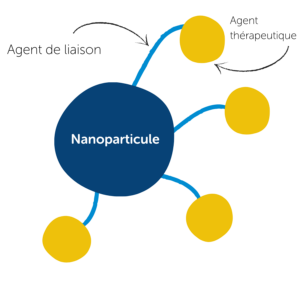
Similarly, USPIO (Ultra-Small Superparamagnetic Iron Oxide) nanoparticles can be used as contrast agents in medical imaging to improve observation results, particularly in MRI (Magnetic Resonance Imaging). They can also serve as a complementary targeted therapy when pre-grafted to a therapeutic agent.
As proof of this potential, drugs based on nanoparticles are already available on the market, particularly for cancer treatments. These drugs use different types of nanoparticles: liposomes, albumin nanoparticles, and metal oxide nanoparticles. All of these nanoparticles improve the effectiveness and safety of treatment.
How can these "nanomedicines" be properly characterized?
When it comes to medicine, robust quality control is essential!
In this context, it is true that we are moving away from the traditional quality controls that laboratories may use with chromatographic techniques to confirm the purity, concentration, or composition of their drugs…
When we enter this world of the infinitely small, we encounter complex issues that require the use of sophisticated techniques, among other things:
- Electron Microscopy: size and shape control
- Atomic Force Microscopy: thickness control and grafting verification (AFM coupled with FTIR)
- X-ray photoelectron spectroscopy (XPS) and/or ToF-SIMS: grafting verification and atomic bond analysis
In conclusion, I am excited about the potential that nanoparticles offer us in this field. I am certain that they will advance science and solve some major health-related issues, which have always been and will continue to be of great public interest. Of course, this will also require the implementation of qualified, validated, and recognized methods to better characterize and control these new technologies.
[1] The enhancement of radiotherapy efficacy with docetaxel-titanate nanotubes as a new nanohybrid for localized high risk prostate cancer; C. Mirjolet, J. Boudon, A. Loiseau, S. Chevrier, T. Gautier, R. Boidot, J. Paris, N. Millot, G. Crehange – 2014

Thomas GAUTIER
Head of the Materials Department
Tel: 03 80 52 32 05
Email: contact@filab.fr