

The art of making the extreme surface speak by Cédric THOMAS
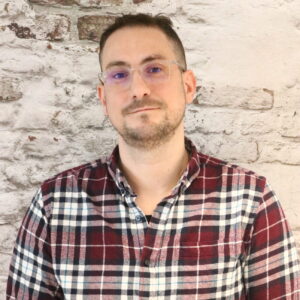
Cédric THOMAS, R&D and Industrialization Project Manager, is one of our PhD engineers who has the ability to make materials speak by analyzing their extreme surface. Cédric joined the FILAB laboratory over a year ago and shares some insights into his skills, the applications, and the technical resources used in the laboratory.
What is Extreme Surface?
“The extreme surface is everything that surrounds us! Why extreme? Because we are dealing with very small surface scales… When we touch an object, when it sticks, clings or rusts… it’s not necessarily visible, and these are often extreme surface issues. In fact, 99% of physical and chemical issues are like this, without us even being aware of it!”
Thanks to his training and previous professional experience, Cédric THOMAS oversees and conducts analysis using various cutting-edge techniques such as AFM (Atomic Force Microscopy), XPS (X-ray Photoelectron Spectroscopy), TOF–SIMS (Time-of-Flight Secondary Ion Mass Spectrometry),
He brings his expertise in surface analysis to FILAB’s clients, regardless of the application of the material. He helps them better understand the physical and chemical phenomena they observe (which are often problematic).
During my thesis, I had the opportunity to work on the development of new surface characterization methods and, among other things, the optimization of multiple AFM characterization methodologies: acoustic coupling AFM, microwave coupling AFM, and even RAMAN and infrared techniques.
Passionate about new technologies...
Passionate about new technologies, Cédric is one of a handful of experts in France who understand how these cutting-edge techniques work. Beyond understanding them, he uses them wisely in concrete contexts applied to the industrial world, regardless of the sector of activity and the issues encountered.
“We have had many cases where customers have encountered corrosion issues with their materials. All their products tended to rust easily. Going beyond electron microscopy in terms of precision and sensitivity, extreme surface analysis regularly allows us to verify that a problem occurred during the final stage of the manufacturing process, for example during the application of surface treatment.”
Cutting-edge techniques for common problems
“& nbsp;Beyond that, extreme surface analysis is very useful in many situations, for example, in the medical sector, where AFM is useful in many cases: evaluating the quality of orthopedic implants on a nanometric scale, analyzing the interface areas between an implant and biological tissues, etc.,” , explains Cédric.
“More generally, the roughness of a material’s surface can have a significant impact on its performance in terms of durability!”
Combined with other specific surface characterization techniques, such as TOF-SIMS or XPS, AFM provides important information for studying the surface of any type of material, both from a topographical and a physicochemical perspective.
A world of acronyms...
Le TOF-SIMS est une méthode de spectrométrie de masse à ions secondaTOF-SIMS is a secondary ion mass spectrometry method that can be used to obtain detailed information about the chemical and structural properties of a surface at the nanometer scale.
As for XPS, this is another common method for analyzing surfaces using X-rays in order to obtain information about the chemical composition and structure of the surface and coating layers.
“In addition to AFM, we can identify complex molecules and organic impurities that may potentially be found on the surface of materials. It’s really powerful! And today, our real strength lies in offering our customers these extreme surface characterization skills, in addition to our existing areas of expertise…”
Regardless of the industry (medical devices, nuclear, pharmaceutical, aerospace, automotive, etc.), FILAB has developed a unique offering in France, combining chemical analysis and material characterization. It supports manufacturers in solving a wide range of problems, which may be related to extreme surfaces.
The art of making matter speak on a nanometric scale which can be used to obtain detailed information on the chemical and structural properties of a surface, at the nanoscale.
As for XPS, it is another common method for analyzing surfaces using X-rays to obtain information on the composition and chemical structure of the surface and coating layers.
“In addition to AFM, we can identify complex molecules and organic impurities that can potentially be found on the surface of materials. It’s incredibly powerful! And today, our real strength lies in offering our clients these extreme surface characterization skills, complementing our existing areas of expertise…”
Regardless of the sector (Medical Devices, Nuclear, Pharmaceutical, Aeronautics, Space, Automotive, etc.), the FILAB laboratory has developed a unique offering in France, combining chemical analysis and materials characterization. It supports manufacturers in resolving their various challenges, which may be related to extreme surfaces.
The art of making matter speak at the nanoscale.