

What is the best technique for analyzing nitrosamines in pharmaceutical products?
Phamaceutique
In the pharmaceutical context, nitrosamines are potentially dangerous and toxic contaminants. They can form during the manufacture, storage, or packaging of pharmaceutical products. These contaminants may pose a risk to human health due to their carcinogenic potential.
It was in 2018 that major concerns were raised about the presence of nitrosamines in certain drugs. As a result, regulatory agencies have implemented strict standards for detecting and quantifying them in pharmaceutical products.
GC-MS/MS or LC-MS/MS (Orbitrap, QTOF): which technique should be used?
Firstly, the specific nitrosamines to be analyzed in pharmaceutical products depend on the type of drug and the production conditions. The nitrosamines most commonly monitored in the pharmaceutical industry include:
- N-Nitrosodimethylamine (NDMA)
- N-Nitrosodiethylamine (NDEA)
- N-Nitrosomethylisopropylamine (NMIPA)
- N-Nitrosodiisopropylamine (NDIPA)
- N-Nitrosomethylaminobutyric acid (NMBA)
- …
Secondly, these nitrosamines can form during chemical reactions involving nitroso compounds and amines. They may be present in raw materials, solvents, reagents, or production conditions. Detecting these nitrosamines in pharmaceutical products is essential to ensuring the safety and efficacy of medicines.
What do the regulations say?
The analysis of nitrosamines in pharmaceutical products must comply with current regulatory guidelines, such as those issued by the FDA in the United States and the EMA in Europe.
Pharmaceutical manufacturers are required to conduct regular tests to check for nitrosamines in their products and take corrective action if necessary to ensure compliance with safety standards.
What is GC-MS/MS?
GC-MS/MS (gas chromatography-tandem mass spectrometry) is an advanced analytical technique that combines gas chromatography (GC) with tandem mass spectrometry (MS/MS). This technique is used to analyze and identify chemical compounds in complex samples.
It is a powerful and versatile technique that has applications in various scientific and industrial fields. It enables precise, sensitive, and selective analysis of volatile and semi-volatile chemical compounds, making it an essential tool for research and the quantification of chemicals in many fields.
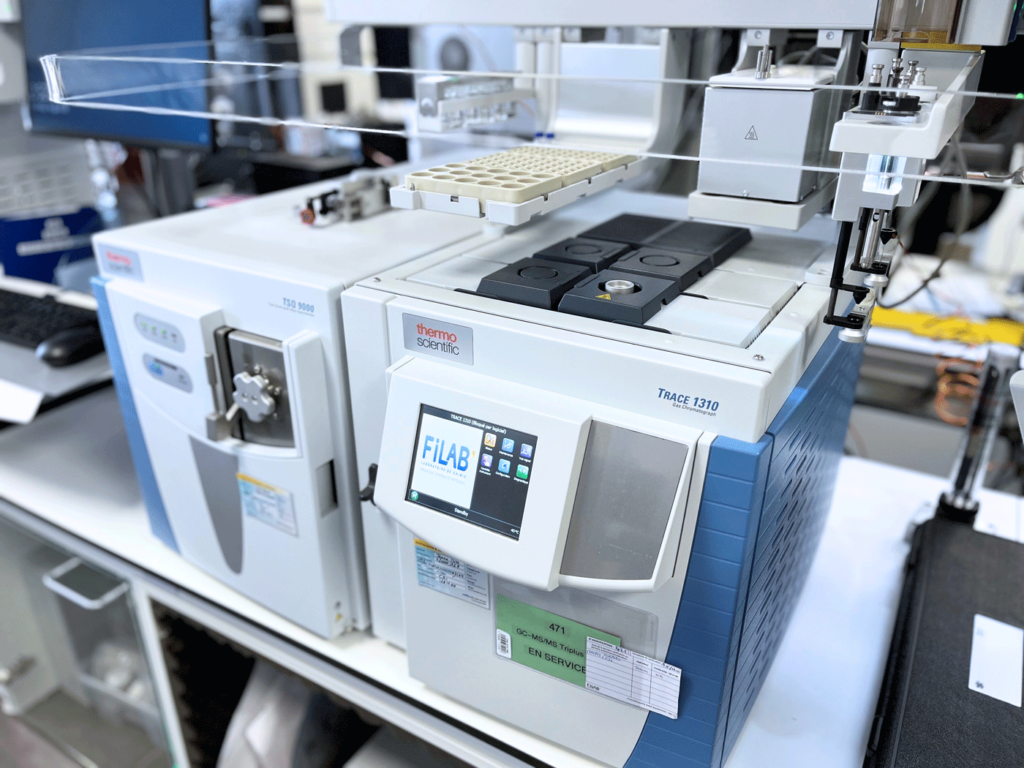
GC-MS/MS goes even further than GC/MS by adding a step of ion fragmentation before detection. This additional ion fragmentation provides more detailed structural information about the organic compounds present in the sample.
- Increased selectivity
- More accurate identification
- Interference reduction
- More accurate quantification
An example of a nitrosamine sought after in pharmaceuticals: NDMA
Analysis of N-Nitrosodimethylamine (NDMA) can be performed using several analytical techniques. The choice of technique depends on several factors, including the required sensitivity, the type of sample, etc.
Two of the most commonly used techniques for NDMA analysis are GC-MS/MS (gas chromatography-tandem mass spectrometry) and LC-MS/MS (liquid chromatography-tandem mass spectrometry).
So which technique should you choose?
The decision depends on specific industrial requirements and sample characteristics.
If there are constraints in terms of volatility, GC-MS/MS may be a more appropriate choice. If the sample matrix is more complex, LC-MS/MS may be an option to consider.
The specifications to be met are also important to consider when deciding which method and technique to adopt.
In summary:
GC-MS/MS (Gas Chromatography - Tandem Mass Spectrometry):
Advantages:
GC-MS/MS is often used for the analysis of volatile compounds such as NDMA. It offers effective separation of compounds, high sensitivity, and high specificity thanks to tandem mass spectrometry. Since NDMA is volatile, GC-MS/MS can be very suitable.
Limitations :
Some matrices may require more complex preparation steps. In addition, NDMA may degrade during GC heating processes.
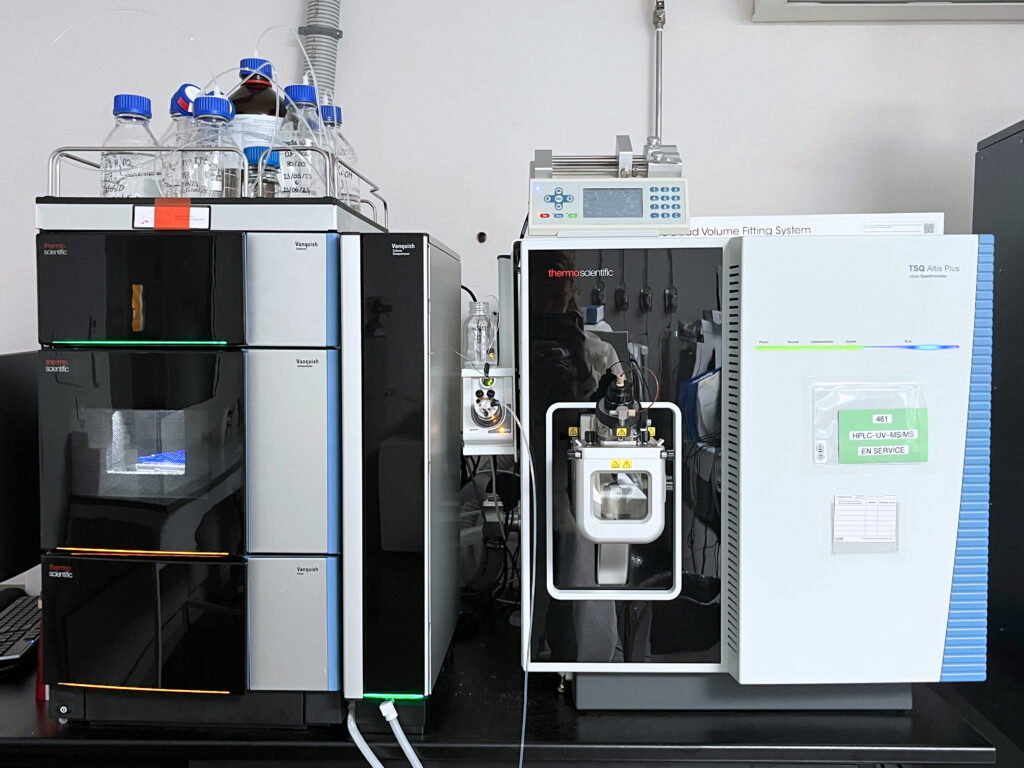
LC-MS/MS (Liquid Chromatography - Tandem Mass Spectrometry):
Benefits
LC-MS/MS is versatile and can be used to analyze a wide range of compounds, including less volatile compounds. It may be better suited to certain matrices, particularly more complex samples.
Limitations :
Since NDMA is volatile, LC-MS/MS may require specific conditions for the analysis of this compound. In addition, solvents and LC conditions may need to be optimized to achieve effective separation.
Here are some reasons why GC-MS/MS might be preferred over LC-MS/MS in this context:
- Volatility of nitrosamines: Nitrosamines are often volatile and can be easily separated in a GC column. GC is particularly suitable for analyzing volatile or semi-volatile compounds, while LC is more suitable for less volatile compounds.
- Effective separation: GC generally provides more effective separation for compounds with short and precise retention times. This can be advantageous when nitrosamines need to be separated cleanly and accurately.
- Complex matrices: If the pharmaceutical sample contains complex matrices, GC may offer better separation and reduced interference, which can simplify the detection and quantification of nitrosamines.
- Sensitivity: GC can offer high sensitivity, which can be important for detecting traces of nitrosamines in pharmaceutical samples.
- Selectivity: Ion fragmentation in GC-MS/MS can provide increased selectivity and specificity in the identification of nitrosamines.
However, it is important to note that the choice between GC-MS/MS and LC-MS/MS depends on several factors. Indeed, it will depend on the specific properties of the nitrosamines being analyzed, as well as the instrumental resources and expertise available.
Nitrosamines can also be successfully analyzed using LC-MS/MS methods, particularly if they are less volatile or if the matrix is better suited to LC.
Ultimately, the decision must be made based on the advantages and disadvantages of each technique for your specific application.
What factors should be taken into account when analyzing nitrosamines using GC-MSMS or LC-MSMS?
- Sample preparation: this may include grinding, extraction, or dissolution in a suitable solvent.
- Extraction: If nitrosamines are present in very low quantities, an extraction step may be necessary to concentrate the analytes. Extraction can be performed using methods such as solid-phase extraction (SPE) or liquid-liquid extraction (LLE).
- Detection and Quantification: Specific analytical methods are required to detect and quantify nitrosamines. Tandem mass spectrometry (MS/MS) is one of the most commonly used detection methods. Tandem mass spectrometry provides high sensitivity and allows nitrosamines to be specifically identified based on their molecular masses and fragmentation transitions. Furthermore, nitrosamines may be present at very low levels, so it is important to determine the limits of detection (LOD) and quantification (LOQ) of the analytical method to ensure its sensitivity.
- Method validation: Before performing routine analysis, the method must be validated to ensure its accuracy, sensitivity, specificity, and robustness. This generally involves studies of accuracy, linearity, sensitivity, specificity, and stability.
In conclusion, the choice between GC-MS/MS and LC-MS/MS for nitrosamine analysis depends on several factors, such as the chemical properties of nitrosamines, sample characteristics, and analysis objectives.