Case study

Comparison of the quality of a metal oxide coating on a ski mask using AFM

The customer wants to compare the quality of metal oxide for his ski mask.
Accueil Blog Comparison of the quality of a metal oxide coating on a ski mask using AFM

The problem?

The ski goggle manufacturer wants to develop a new generation of high-end goggles (#R&D) incorporating innovative features to improve the user experience. In particular, these goggles must be equipped with a transparent conductive coating that allows:

  • fog management
  • increased resistance to scratches and wear to meet the demands of outdoor sports activities
  • A lightweight and flexible design adapted to ergonomic constraints, while maintaining excellent optical quality.

However, the choice of base materials, particularly between rigid substrates (such as mineral glass) and flexible substrates (such as PET), strongly influences the quality of the metal oxide coating used for these features.

Objectives : Compare the quality of a metal oxide coating on two types of substrates: mineral glass and PET (polyethylene terephthalate) glass. This comparison is performed using topographic and electrical analyses to characterize the homogeneity and conductive properties of the coating.

Summary

01
Methodological approach
02
Results
03
Conclusion
01

Methodological approach

  1. Sample preparation

Metal oxide deposits are applied to two substrates:

Mineral glass: this type of glass is chosen for its rigid and stable surface, providing an ideal base for the uniform application of a thin coating.

A PET glass: PET, a flexible polymer material, is widely used in applications where lightness and strength are required, but it presents constraints for the uniformity of thin deposits.

Three distinct areas are studied for each substrate to ensure that the results are representative. These areas are chosen at random, avoiding the edges, to minimize bias due to non-homogeneous conditions.

  1. Atomic force microscope (AFM) analyses

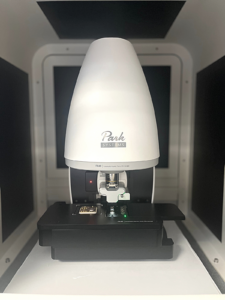
caractérisation de nanomatériaux par AFM

Non-contact mode: this mode provides accurate 3D mapping of the sample surface. These images are used to assess the homogeneity of the metal oxide deposit on each substrate. Topographical parameters such as average roughness and local variations are analyzed.

Electrical mode: this mode allows the electrical conductivity properties of metal oxide coatings to be measured. Since metal oxide is a conductive material, differences in electrical response between samples can reflect variations in deposit quality.

02

Results

1. Topographic analysis

The 3D maps obtained in non-contact mode revealed the following differences:

Mineral glass: the metal oxide deposit is very homogeneous, with the continuous presence of grains measuring around 100 nanometers in diameter. Average roughness measurements give similar results. This indicates that the coating is of good quality on this substrate.

PET glass: defects are observed on the surface of the coating, indicating reduced homogeneity. The defective areas include irregularities in the thickness of the deposit, which can be attributed to stresses related to the flexibility of the substrate.

2. Electrical analysis

Electrical measurements show significantly higher conductivity for the deposit on mineral glass compared to PET glass. This difference is attributed to:

  • The structural continuity of the deposit on mineral glass
  • Irregularities present on PET glass, which can cause local breaks in the metal oxide conductor network.

3. Summary of observations

Topographic and electrical analyses agree and indicate that:

  • The metal oxide deposit is more uniform and has better conductive properties on mineral glass.
  • The coating on the PET glass has structural defects and resembles holes, which negatively impact its overall quality. These holes could be reduced by adjusting the deposition parameters or pre-treating the PET substrate.
03

Conclusion

This study highlights the significant differences in quality between metal oxide coatings applied to two types of substrates, mineral glass and PET glass, in the context of developing high-end ski goggles.

Topographic and electrical analyses performed using atomic force microscopy (AFM) show that:

  • Mineral glass provides a rigid and stable surface that promotes uniform and smooth deposition. This structural uniformity results in high electrical conductivity, which is essential for ensuring coating performance, particularly in anti-fog heating applications.
  • Although PET glass is lightweight and flexible, it has irregularities in the metal oxide coating. These defects, which resemble holes, affect both homogeneity and electrical conductivity, making this substrate less effective in its current state.

Implications for the development of ski goggles

The results show that mineral glass is the optimal choice for ensuring high-quality coating, but its weight and rigidity may limit its use in ski goggles. On the other hand, improvements to PET glass, such as surface treatments or optimizations of deposition parameters, could make it a viable candidate.

In conclusion, this study guides manufacturers in their strategic choices and highlights the need for a compromise between technical performance and the ergonomic constraints specific to high-performance sports equipment.

If you have any questions about this case study, please contact us directly at contact@filab.fr

Need help? Contact our team

Other studies that may be of interest to you

Produits pharmaceutiques

L’un de nos clients a détecté la présence de particules inconnues dans ses produits pharmaceutiques lors des contrôles de qualité Find out more

XPS coating

Comparative study of multilayer coatings on zirconium tubes using XPS Find out more

Optimization of the coating of a can

One of our clients wants expertise and optimization of the coating used on the cans it uses to market its beverages. Find out more

Services associated with the case study

Laboratory characterization of nanomaterials by AFM

Laboratory analysis of PET

Analysis of the surface topography

Laboratory analysis of surface condition

Laboratory specializing in analysis and expertise for industrial companies

More than 140 people
More than 140 people at your service
5200 m² laboratory
5200 m² laboratory + 99% of services are provided in-house
Accredited laboratory
Accredited laboratory COFRAC ISO 17025
+2200 clients
+2200 clients in France and abroad

Contact us

Our services are reserved for professionals.