Measuring the surface tension of a liquid in the laboratory

Chemical analysis Problem solving R&D support
More than 140 people
More than 140 people at your service
5200 m² laboratory
5200 m² laboratory + 99% of services are provided in-house
Your need: to measure the surface tension of a liquid

What is the surface tension of a liquid?

Surface tension is also known as surface tension. It refers to the surface energy that is created by the interaction of molecules on the surface of a liquid. This surface energy is due to the forces of electrical attraction that hold adjacent molecules together.

Measuring the surface tension of a liquid is an essential procedure for characterising the physical properties of fluids. It is particularly useful in sectors such as chemistry, pharmaceuticals and materials.

What is liquid surface tension measurement?

Measuring the surface tension of a liquid is an important parameter that reflects the intensity of the forces of attraction between the molecules on the surface of a liquid. The surface tension of a liquid allows water, for example, to form drops.

This tension is defined as the force per unit length required to increase the surface area of a liquid. It is generally expressed in newtons per metre (N/m) or dynes per centimetre (dyn/cm).

FILAB: laboratory for measuring the surface tension of a liquid using a goniometer

Why choose FILAB to measure the surface tension of a liquid?

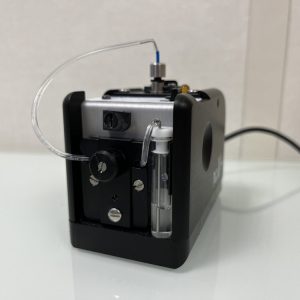
In order to support manufacturers in the development and quality control of their products, the FILAB laboratory provides state-of-the-art analytical equipment enabling surface tension analyses to be carried out using a goniometer. This equipment can be used in conjunction with other analytical techniques.

Goniometer and liquid surface tension measurement

tension superficielle liquide
Goniometer
goniomètre
Measuring the surface tension of a liquid

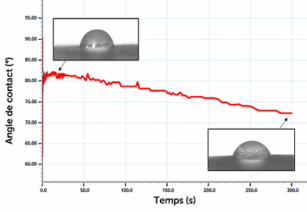
Dynamic contact angle measurement provides information about how quickly a material disperses or absorbs a liquid. In this process, as with static measurements, a drop is placed on the surface of the material. The contact angle of the drop is then continuously monitored, capturing an image every millisecond, over a period of up to 10 minutes.

FILAB's surface tension analysis lab utilizes state-of-the-art goniometry to deliver precise, reproducible contact angle and surface energy data. 

Static contact angle measurements reveal the intrinsic wettability of a solid surface, while dynamic measurements capture how a liquid spreads or absorbs over time —critical for evaluating coating uniformity and adhesion kinetics. 

Our experts also perform surface free energy calculations using Owens-Wendt and van Oss methods, enabling you to predict how different liquids will interact with your materials. All measurements are conducted under controlled temperature and humidity conditions to ensure compliance with ISO and ASTM standards.

Our associated services

Measuring drop size using laser granulometry

Surface energy measurement

Drop angle measurement

Static and dynamic drop angle measurements

Characterisation of droplet distribution by SEM-FEG-EDX

Measuring the surface wettability of a material

Measurement of adhesion between a liquid and a solid

FAQ

What properties are analysed during a goniometer analysis?
L'un des outils les plus couramment utilisés pour mesurer la tension superficielle est le goniomètre. Cette méthode est utilisée pour évaluer les propriétés des liquides et des solides en termes de mouillage et d'adhésion principalement. Ce sont des informations essentielles sur les propriétés de surface des matériaux. Le goniomètre peut être utilisé pour déterminer la mouillabilité de la surface, évaluer la rugosité de surface, l'étalement, et même la viscosité des liquides, en corrélation avec d’autres techniques.
What methods are used to measure the surface tension of a liquid?

Pour mesurer la tension superficielle d'un liquide, il existe plusieurs méthodes techniques, dont l'analyse de l'angle de contact. Il s’agit d’une méthode scientifique utilisée pour comprendre l'interaction entre une surface solide et un liquide par divers moyens techniques : goutte suspendue, fil mobile, de Wilhelmy et des tests d'encres. Pour cela, ce sont les tensiomètres et goniomètres qui sont utilisés. 

What are the differences between a blood pressure monitor and a goniometer?

Le tensiomètre est utilisé pour mesurer la tension de surface d'un liquide, tandis que le goniomètre est utilisé pour mesurer l'angle de contact d'un liquide avec une surface. Les tensiomètres mesurent la tension interfaciale entre deux phases, souvent entre un liquide et l’air ou un liquide et un solide, tandis que les goniomètres sont utilisés pour mesurer l'angle de contact d'un solide avec un liquide.

Les tensiomètres sont souvent utilisés en chimie pour mesurer les propriétés physiques des mousses, des émulsions, tandis que les goniomètres sont utilisés en physique pour mesurer les propriétés des surfaces solides.

What is surface tension analysis used for?

Surface tension analysis is used to characterize the interfacial behavior of liquids and solids. It helps manufacturers optimize formulations, ensure coating adhesion, evaluate cleaning efficiency, and predict emulsion stability. Industries such as pharmaceuticals, cosmetics, coatings, and electronics rely on surface tension data to control product quality and performance.

How accurate is goniometer-based surface tension analysis?

Goniometer-based surface tension analysis achieves high accuracy when performed under controlled environmental conditions. Typical contact angle precision is within ±2°, and surface tension resolution can reach ±0.1 mN/m. FILAB calibrates instruments regularly and follows ISO and ASTM protocols to ensure reproducible, traceable results for R&D and quality control applications.

Can surface tension analysis help with coating adhesion problems?

Yes. Poor coating adhesion often stems from inadequate surface energy or contamination on the substrate. Surface tension analysis measures contact angle and surface free energy to identify wetting issues. Based on these results, FILAB can recommend surface treatments, primer selection, or formulation adjustments to improve adhesion and eliminate defects such as peeling or blistering.

The filab advantages
A highly qualified team
Responsiveness in responding to and processing requests
A COFRAC ISO 17025 accredited laboratory
(Staves available on www.cofrac.com - Accreditation number: 1-1793)
A complete analytical facility of 5,200m²
Tailor-made support
Tailor-made support
Video debriefing available with the expert
Anaïs DECAUX Customer Support Manager
Ask for your quote