Your needs: characterize a material through thermal analysis for validation, optimization, or quality control purposes
Thermal analysis is essential for industrial companies wishing to characterize and optimize the thermal performance of their materials.
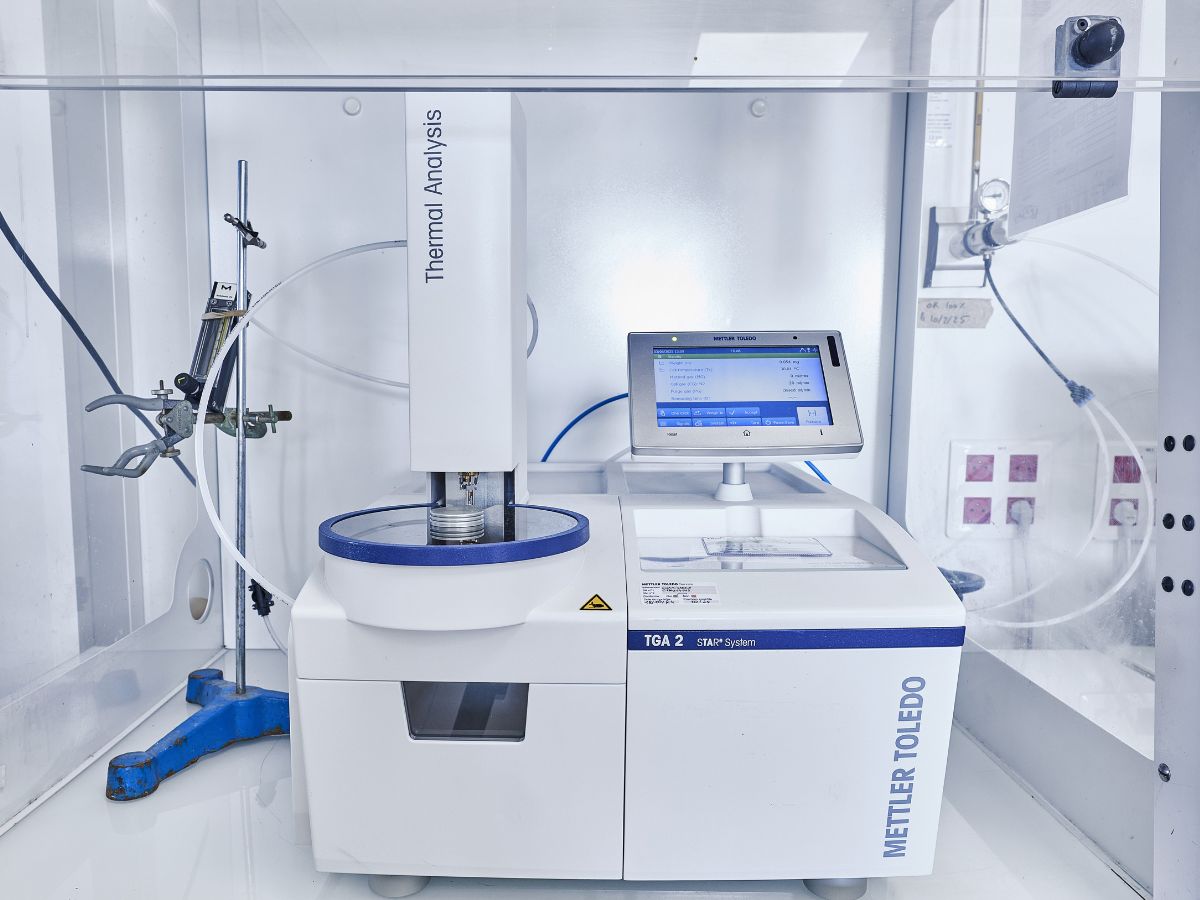
Using techniques such as TGA and DSC, the FILAB laboratory addresses the challenges of the most demanding sectors, from aerospace to chemistry and plastics processing.
What is thermal analysis?
Thermal analysis of a material makes it possible to characterize the physicochemical properties of a material when it is subjected to external thermal stress (temperature).
This laboratory analysis makes it possible to assess the thermal stability and transition behavior of a material throughout its lifecycle, from formulation to industrial processing and final use.
Types of materials concerned
Thermal analysis applies to a wide range of materials used in industry:
Polymers and plastics : to study their thermal stability, degradation behavior, or phase transitions.
Metals and alloys : to analyze thermal expansion and prevent failures under extreme conditions.
Composites : to assess their resistance to high temperatures in applications such as aerospace or automotive.
Ceramics : to study their behavior in high-temperature environments, particularly in the energy sector.
Why perform thermal analysis on your material?
Thermal analysis is an essential technique for characterizing the thermal properties of materials. Using this analysis, the FILAB laboratory can measure the thermal response of your materials when exposed to a source of heat or cooling.
It is used to characterize the response of a material subjected to temperature variations by identifying key properties such as:
- phase transitions (melting, vitrification),
- thermal stability,
- heat capacity
- and chemical degradation.
At the FILAB laboratory, these analysis, which use various techniques including DTA, DSC and TGA, are used to:
Discover them all Our Accreditations – Client Qualifications

AIRBUS
Qualification
Our solutions: offering you reliable thermal analysis services and support in interpreting the results
For over 30 years, our FILAB laboratory has had the experience and specific analytical resources needed to meet our clients’ thermal analysis needs. FILAB supports companies in the characterization of their materials through reliable, tailored analysis.
Our thermal analysis services in the laboratory
From analysis to R&D, FILAB laboratory offers multisector services addressing several types of thermal analysis requests such as:
Our technical capabilities for material thermal analysis
There are several thermal analysis techniques that make it possible to highlight the physico-chemical characteristics of a material as a function of temperature:
Thermogravimetric
TGA technique, TGA coupled with FTIR infrared
Differential thermal
DTA technique
Differential scanning calorimetric
DSC calorimeter technique - Differential Scanning Calorimetry
Thermo-desorption
TDU thermo-desorber coupled with GCMS gas chromatography
Pyrolysis coupled with GC-MS (py-gcms)
TGA coupled with DSC
VICAT/HDT
The types of failures prevented thanks to thermal analysis
Thermal analysis makes it possible to prevent or diagnose several types of failures critical to industry:
Thermal degradation: loss of mass or chemical modification of materials under the effect of heat.
Chemical instability: unexpected thermal reactions that may compromise product safety or effectiveness.
Excessive thermal reactivity: risks of ignition or dangerous decomposition in chemicals.
Uncontrolled phase transitions: melting, crystallization or vitrification affecting product performance.
Cracking or deformation: resulting from unplanned thermal expansion or contraction, particularly in metals and composites.
Thermal analysis in industry
Thermal analysis is used in many industrial sectors to address specific issues related to material performance and safety.
- To determine the thermal stability of medicines and the compatibility of components in pharmaceutical formulations. Thermal analysis, through techniques such as DSC, helps ensure the effectiveness, safety, and longevity of pharmaceutical products, thereby meeting the industry’s strict regulations.
- Ensuring the resistance of materials to extreme temperatures, especially in the aerospace industry. Thermal analysis helps select materials that can withstand extreme temperature variations and high thermal conditions.
- Managing heat dissipation in electronic devices to prevent electronic components from overheating. The use of infrared thermography and thermal conductivity measurement makes it possible to design more efficient circuits and suitable cooling systems. Optimizing thermal management is essential to extend the lifespan of electronic devices and minimize the risk of heat-related failure.
FAQ
Thermal analysis is a scientific technique used to evaluate the thermal properties of various materials. This laboratory method is used to analyze the physical and/or chemical changes that occur during temperature variation. Materials commonly subjected to thermal analysis include polymers, composites, metals, alloys, and ceramics. This technique is very useful for determining material properties such as thermal conductivity, heat capacity, and thermal diffusivity.
Thermogravimetric analysis (TGA) is a technique that measures the change in mass of a sample as a function of temperature or time. It detects phenomena such as decomposition, dehydration and oxidation by heating the sample under a controlled atmosphere. TGA is used to study the chemical composition, thermal stability and decomposition temperatures of materials, making it essential in research and development as well as in quality control across many industrial sectors, such as polymers and ceramics.
Thermal analysis and thermogravimetric analysis are two very common material characterization techniques. Although both techniques focus on measuring the thermal properties of materials, they differ in their approach.
Thermal analysis is a technique that measures thermal properties in response to temperature variations, whereas thermogravimetric analysis measures the change in mass of the same material in response to temperature changes.
In other words, while thermal analysis focuses on the physicochemical changes induced by temperature changes, thermogravimetric analysis examines the changes in mass resulting from these changes. These techniques provide an in-depth understanding of the thermal properties of materials and are used in many fields, from industry to research.
A correct interpretation of the results of a thermal analysis depends on a thorough understanding of the underlying physical principles.
The results of a thermal analysis are often presented in the form of curves showing the evolution of temperature over time or the amount of energy absorbed or released by the sample.
In general, changes in temperature and energy indicate phase transitions or molecular rearrangements in the sample. Understanding these results is essential for optimizing material properties.
During a thermal analysis, several thermal properties of materials are studied to understand their behavior under various temperature conditions. Here are the main properties analyzed:
> Heat capacity (Cp): This is the amount of heat required to raise the temperature of one unit of mass of the material by one degree Celsius, helping to understand how a material absorbs and stores thermal energy.
> Thermal transition: This includes the detection of transition points such as melting points, crystallization points, and glass transitions, indicating at which temperatures a material changes phase or structure.
> Thermal stability: This property describes a material’s ability to retain its physical and chemical characteristics at high temperatures. Thermal decomposition or degradation can be analyzed to determine at what temperature a material begins to break down.
> Thermal conductivity: This is a measure of a material’s ability to conduct heat. This property is essential for applications where heat management is critical, such as in insulating materials or electronic components.
> Coefficient of thermal expansion: It quantifies the expansion or contraction of a material in response to temperature changes, for applications requiring high dimensional precision.
> Decomposition temperature: The temperature at which a material begins to chemically decompose, especially under high-temperature conditions.
> Thermal expansion: This measures dimensional changes in response to temperature. For materials used in construction or in the manufacture of components that undergo temperature fluctuations, this property is vital to ensure structural integrity and material compatibility.
Analyzing these properties helps industries choose, design, and manufacture materials suited to specific applications, ensuring performance, safety, and durability.
It makes it possible to identify phenomena such as thermal degradation, unexpected phase transitions, or cracking due to temperature variations, thereby avoiding performance or safety issues.
It is used in aerospace, automotive, chemicals, plastics processing, pharmaceuticals, and energy, for applications ranging from material characterization to validation of manufacturing processes.
Thermal analysis measures key parameters such as degradation temperature, thermal stability, transition enthalpy, thermal expansion coefficients, and mass loss.
The results include thermal behavior curves (TGA, DSC) or precise data on expansion, critical temperatures, mass loss, and material-specific thermal transitions.
A specialized laboratory offers state-of-the-art equipment, qualified experts, and guarantees analysis that comply with industry standards (ISO, COFRAC), which are essential for meeting the requirements of complex industrial projects.
Why trust the FILAB laboratory for thermal analysis in the lab?
Industry experience
- Aerospace, energy, defense, metallurgy
- Chemicals, healthcare, medical devices
Our references:
- SAFRAN
- FRAMATOME
- EDF
- DASSAULT AVIATION
- Aubert & Duval
- Airbus Defence & Space
- Liebherr
An expert at your side
Materials and metallurgy expert
Thomas Gautier supports materials analysis, failure analysis, and metallurgy projects.
What our clients say
"I used Filab for a chemical analysis. Very satisfied with the service. Responsive team, deadlines met, and a clear analysis report. I recommend them."
"Very responsive laboratory, with excellent analysis quality and deadlines met. Communication is smooth, the technical explanations are clear, and the team knows how to adapt to specific needs. I recommend them for their professionalism and reliability!"
"Clear and precise deliverable, delivered on time. I recommend them."
Transparency & contact Dernière vérification : juillet 2026
Where to find us and how to contact us
FILAB Laboratory
Ecoparc Dijon Bourgogne
80 rue Jean-Louis Auguste Petitjean
21850 Saint-Apollinaire, France
Tél. +33 (0)3 80 52 32 05
Request a quote