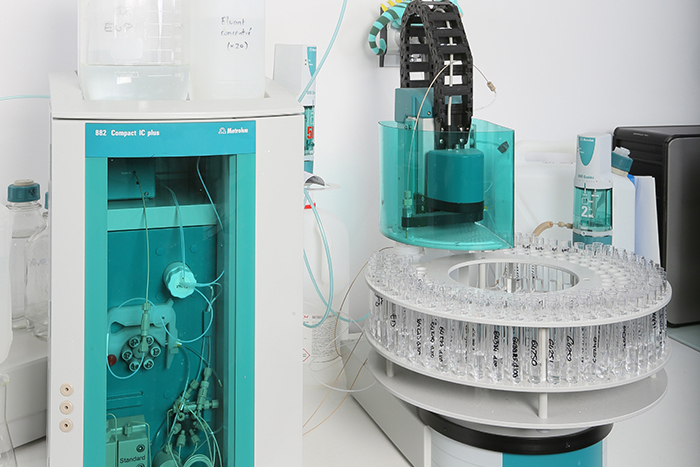
Halogen analysis in laboratory

Chemical analysis Problem solving
More than 140 people
More than 140 people at your service
5200 m² laboratory
5200 m² laboratory + 99% of services are provided in-house
Accredited laboratory
Accredited laboratory COFRAC ISO 17025

Your needs: to analyze and quantify halogens in your samples

What is a halogen?

Halogens are chemical elements from group 17 of the periodic table, including fluorine, chlorine, bromine, and iodine. These elements are commonly analyzed in various materials and products due to their corrosion potential and environmental impact.

A halogenated compound is a chemical substance in which one or more halogens are bonded to other elements.

List of halogenated compounds to analyze

Halogenated compounds are used in various industrial applications, including as solvents, cleaning agents, flame retardants, refrigerants, and in the manufacturing of plastics.

Halogenated compound analysis is commonly performed on:

Halogenated hydrocarbons, organic compounds where one or more hydrogen atoms have been replaced by halogens (fluorine, chlorine, bromine, iodine). They are often used as solvents and cleaning agents.

  • Carbon tetrachloride (CCl₄)
  • Methylene chloride (CH₂Cl₂)
  • Chloroform (CHCl₃)
  • Tetrachloroethylene (C₂Cl₄)

Fluorocarbons and fluorinated polymers, compounds where carbon atoms are bonded to fluorine atoms. Fluorinated polymers, such as Teflon, are used for their non-stick properties and chemical and thermal resistance.

  • Teflon (PTFE – Polytetrafluoroethylene)
  • CFC (Chlorofluorocarbons)

Other halogenated compounds: this category includes various halogen-containing compounds used in organic synthesis, pharmaceutical manufacturing, and as fumigation and sterilization agents in agriculture.

  • Methylene iodide (CH₂I₂)
  • Ethylene dibromide (C₂H₄Br₂)

Why check halogen content (Fluorine, Chlorine, Bromine, Iodine)?

Materials are sensitive to halogens mainly due to their high chemical reactivity. These elements can interact with materials, causing chemical reactions that lead to corrosion, degradation, and structural weakening.

For example, halogens can cause rapid oxidation of metals, weakening their integrity. In polymers, halogens may lead to depolymerization and deterioration of mechanical properties, compromising durability and safety in industrial applications.

Therefore, verifying halogen content helps prevent material failure. Additionally, many industries such as aerospace, automotive, and nuclear energy require specific halogen levels to meet safety standards.

In what context should halogens be analyzed and quantified?

Whether you are a professional in aeronautics, plastics, automotive, finished chemicals or energy, these analysis may concern you. 

Halogen analysis can be necessary in different contexts:  

Development of a new product
Study of corrosion phenomena on a material
Entry in nuclear power plant of a product (PMUC context)
Study of the conformity of an SDS

How does FILAB help you with the analysis and quantification of halogens?

Our technical capabilities for halogen determination

Accurate determination of halogens in materials is essential for corrosion prevention and regulatory compliance. FILAB uses advanced techniques such as ion chromatography and ICP to provide reliable analysis.

Our FAQ

In which industries are fluorocarbons and fluorinated polymers used?

Fluorocarbons and fluorinated polymers, such as Teflon and CFCs, play a key role in various industries.

  • Aerospace uses Teflon parts for their non-stick properties and high-temperature resistance
  • Automotive applies Teflon coatings to improve durability and performance
  • CFCs are used as refrigerants, although their use is now restricted due to environmental concerns
What are the differences between Halogens, Halides, and Halogenated Compounds?

Halogens are chemical elements from group 17 of the periodic table, such as fluorine (F), chlorine (Cl), bromine (Br), and iodine (I). They are highly reactive and must be analyzed to prevent corrosion and ensure safety compliance.

Halides are compounds formed when halogens bond with other elements, typically metals (e.g., sodium chloride NaCl). Their analysis is necessary to prevent unwanted reactions in materials and products.

Halogenated compounds are molecules where halogens are bonded to carbon atoms or other elements in organic or inorganic compounds (e.g., carbon tetrachloride or PCBs). They must be analyzed to detect toxic substances and ensure product safety.

What are the main technical challenges in halogen quantification in industry?

Organo-halogen compounds, such as DDT and PCBs, are essential in several sectors. Agriculture uses pesticides like DDT to protect crops. In electronics, PCBs are used in capacitors and transformers for their chemical stability. Water treatment uses organo-halogen compounds for disinfection and drinking water treatment.

How to get a quote from FILAB?

To obtain a quote for halogen analysis, you can contact our team via our contact form, by phone, or by email.

Simply tell us your requirements (type of material, desired analysis, applicable standards, urgency, number of samples, etc.). We will then send you a personalized technical and pricing proposal within 24-48 hours.

What is the typical duration of the analysis?

Turnaround times vary depending on the nature of the analysis and the complexity of the expert assessment project.

However, FILAB is committed to providing fast turnaround times tailored to your industrial constraints and urgent needs.

The filab advantages
A highly qualified team
Responsiveness in responding to and processing requests
A COFRAC ISO 17025 accredited laboratory
(Staves available on www.cofrac.com - Accreditation number: 1-1793)
A complete analytical facility of 5,200m²
Tailor-made support
Tailor-made support
Video debriefing available with the expert
Anaïs DECAUX Customer Support Manager
Ask for your quote