Fractographic analysis laboratory
A broken part, an unexplained crack, a failure during operation… Behind every breakage lies a precise mechanism. Fractographic analysis makes it possible to identify the origin of the break and trace it back to the root cause.
As an industrial, you would like to carry out a fractographic analysis
Fractographic analysis: what is it?
Fractographic analysis allows us to locate the initiation point of a material’s rupture, identify the fracture mode, and highlight the presence of material defects that could be the cause of the break.
A component failure can have significant consequences for production or the installation in which it is located. In this context, fractographic analysis helps to understand and determine the causes of a failure. Indeed, these causes can be numerous:
violent impact (fragile rupture)
Cyclic stress on a part (fatigue rupture)
raw material not conforming to the expected shade
corrosion problem
mechanical deformation of a part (ductile rupture)
hydrogen embrittlement
unsuitable environment for the material used
Fractographic analysis: a specific expertise of the FILAB laboratory
With significant experience in implementing fractographic analysis, FILAB supports you in understanding and resolving your rupture problems through fractographic analysis.
For failure analysis, the FILAB laboratory provides its comprehensive analytical equipment and the expertise of its engineers to address your fracture problems in metallic parts.
Our technical resources for fractographic analysis
Why perform a fractographic analysis?
Fractographic analysis involves studying the fracture surfaces of a material to determine:
- The mode of fracture (brittle, ductile, fatigue, stress corrosion cracking, etc.)
- the origin of the crack initiation
- the propagation conditions
- the aggravating factors (material defects, stresses, environment, etc.)
It is generally used in the following contexts:
- breakage of parts in production or service
- product non-conformity
- disputes or technical expert assessments
- continuous improvement initiatives
Why choose the FILAB laboratory for your fractographic analysis?
Our teams are ready to listen to your needs and support you with the fractographic analysis of your metal parts. The FILAB laboratory offers its knowledge and expertise to conduct audits at your production sites to understand the issues you are facing. We provide customized support tailored to your fractographic analysis needs following a metal part breakage, in order to provide you with concrete and lasting solutions.
Example applications
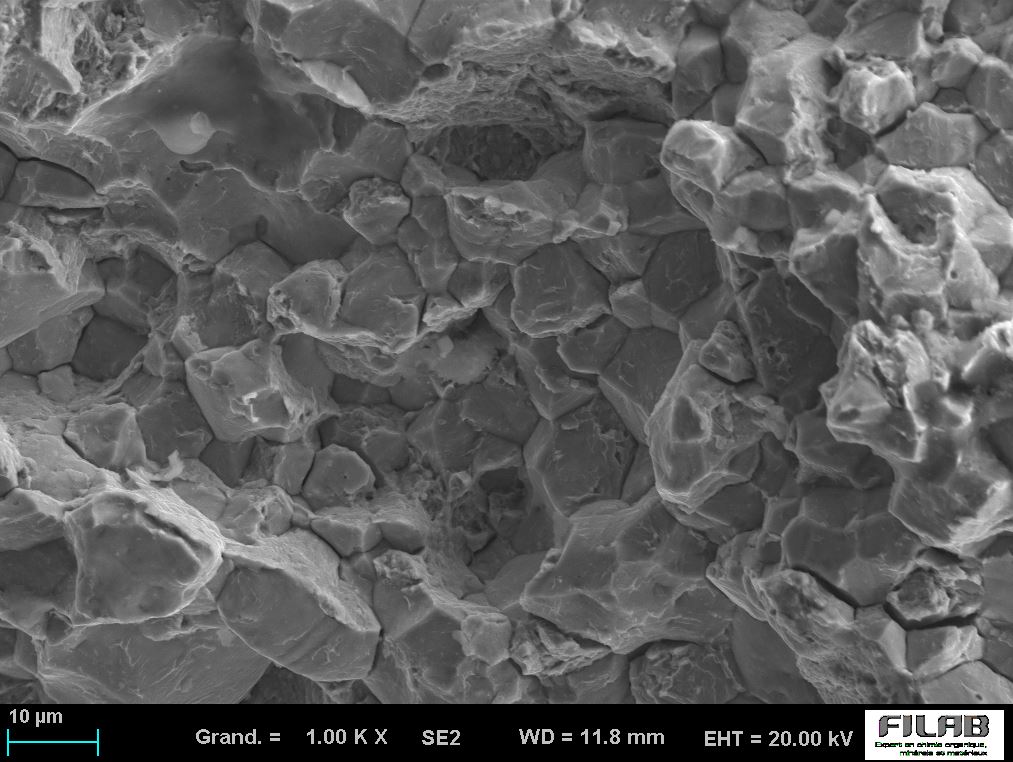
Fragile rupture
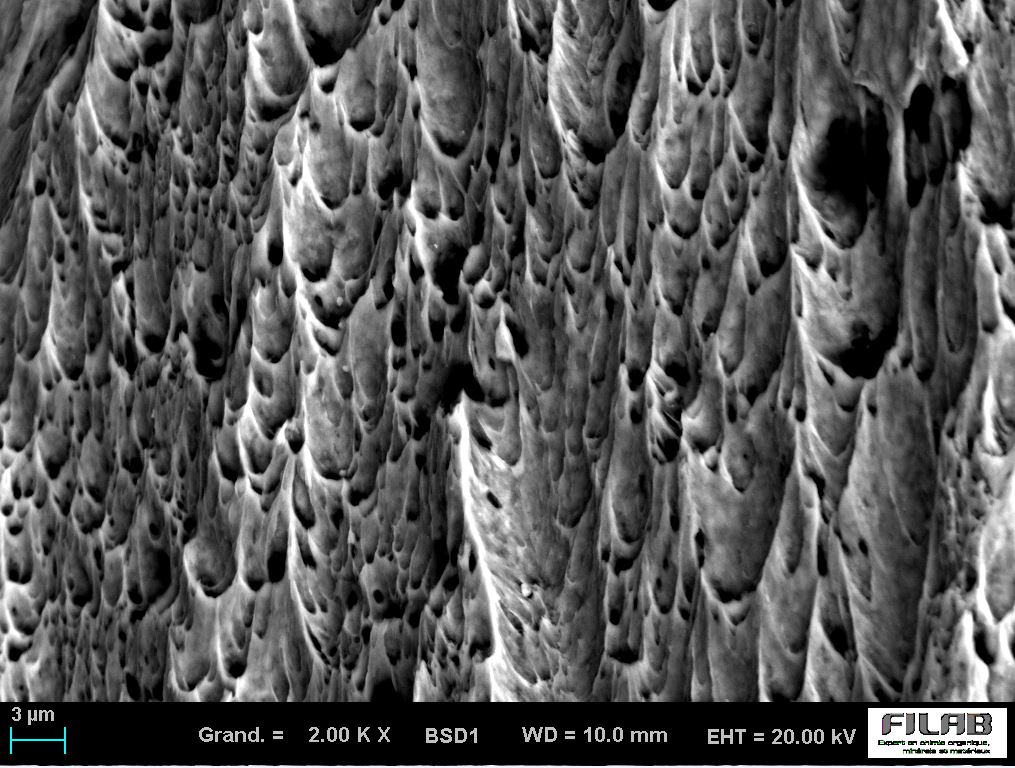
Ductile rupture
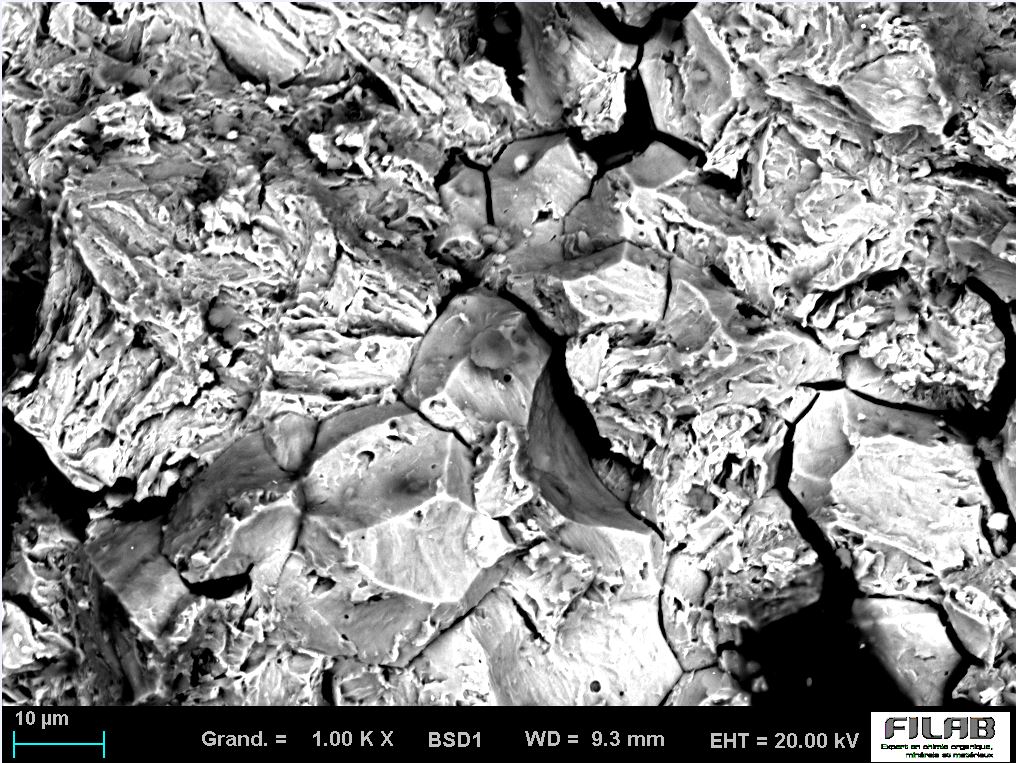
Hydrogen embrittlement
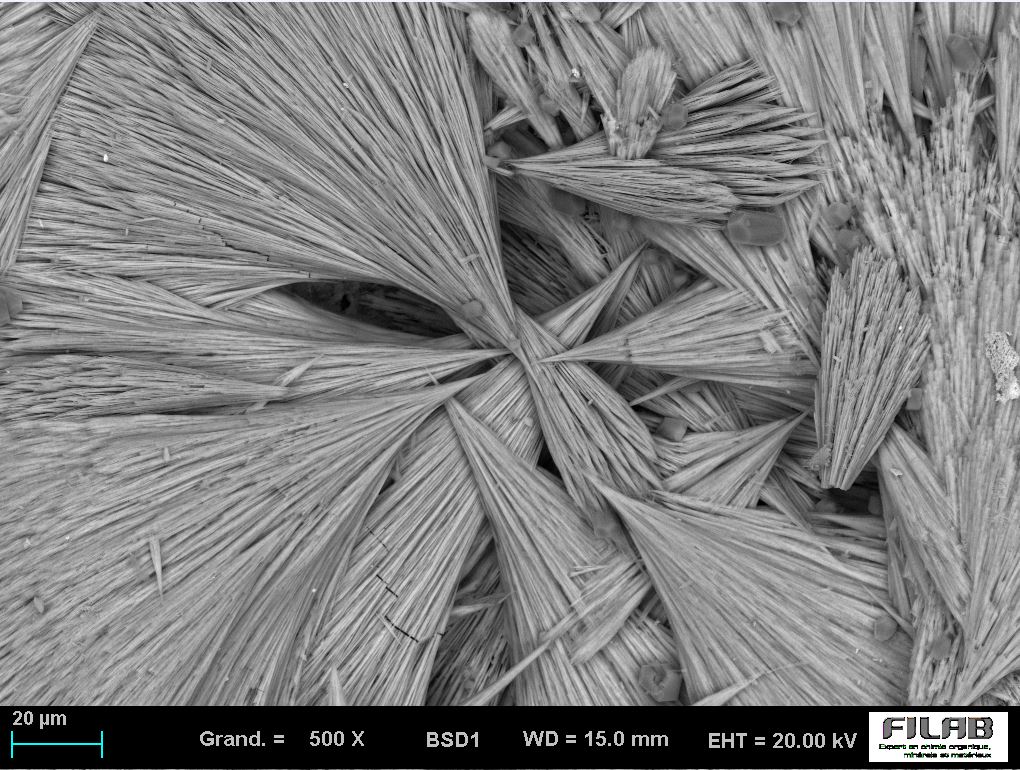
Presence of corrosion
Our FAQ
Fractographic analysis is a key technique in failure analysis that consists of examining fracture surfaces to determine the origin and causes of a material failure. Also referred to as fractography analysis, it provides critical insights into how and why a component has fractured by studying its surface features at different scales.
Fractography analysis is essential because it allows engineers to directly observe the fracture surface, which contains valuable evidence about the failure mechanism. It helps identify the root cause of failure and supports the implementation of corrective actions to prevent similar issues in the future.
Fractographic analysis primarily relies on scanning electron microscopy (SEM) to observe fracture surfaces in high detail. This is often coupled with EDX analysis to determine the elemental composition. Optical microscopy and mechanical testing may also be used to complete the investigation.
Fractography analysis makes it possible to identify different types of failure such as fatigue fracture, brittle rupture, ductile failure, or stress corrosion cracking. Each of these mechanisms leaves distinct signatures on the fracture surface that can be interpreted by experts.
Crack initiation refers to the location where the fracture first began. In fractographic analysis, identifying this area is crucial because it often reveals the origin of the failure, such as a defect, inclusion, or stress concentration.
In most cases, fractography analysis plays a central role in determining the root cause of a failure. By combining surface observations with complementary analyses, it is possible to link the fracture to material defects, manufacturing issues, or service conditions.
Fractographic analysis can be applied to a wide range of materials including metals, alloys, polymers, ceramics, and composites. The interpretation of fracture features depends on the material type and its mechanical behavior.
Fractography analysis should be performed after an unexpected failure, during a quality investigation, or when a component does not meet performance requirements. It is also commonly used in industrial expertise and forensic engineering.
Fractography analysis helps manufacturers improve product reliability, optimize materials and processes, and reduce the risk of recurring failures. It provides concrete, evidence-based conclusions that support technical decision-making and long-term performance improvements.
To obtain a quote, you can contact our team via our contact form, by phone, or by email.
Simply tell us your requirements (type of material, desired analysis, applicable standards, urgency, quantity of samples, etc.). We will then send you a personalized technical and pricing proposal within 24-48 hours.
Turnaround times vary depending on the nature of the analysis and the complexity of the expert assessment project.
However, FILAB is committed to providing fast turnaround times tailored to your industrial constraints and urgent needs.