Fracture Analysis - a FILAB laboratory specialty
L’analyse de rupture est une approche qui englobe l’étude des causes, des mécanismes et des conséquences de la rupture d’un matériau ou d’une structure. L’analyse de rupture utilise des données issues de la fractographie, mais elle intègre également d’autres types d’informations comme les propriétés du matériau, les conditions de service, la conception de la pièce, les contraintes appliquées, et les résultats d’essais mécaniques. Le but de cette analyse est de comprendre non seulement comment la rupture s’est produite, mais aussi pourquoi elle s’est produite dans le contexte spécifique de l’application du matériau ou de la pièce.
Would you like to carry out a fracture analysis in a laboratory?
What is material failure?
Material failure occurs when the applied force exceeds the strength of the material. This strength can be influenced by many factors such as temperature, the material’s chemical composition, or a failure.
Different types of failure can be observed depending on the nature of the material and the way the force is applied. For example, some materials may undergo ductile failure, where they deform significantly before breaking, while others may undergo brittle failure, where they break without significant deformation.
FILAB supports manufacturers with expertise and fracture analysis
Our laboratory fracture analysis services
Material failure is a major issue for many industries, such as aerospace and automotive. To provide an accurate analysis of the causes of failure, the FILAB laboratory offers its expertise in fracture analysis, using cutting-edge techniques and a team of experts.
- Fracture analysis on metal parts
- Fracture analysis on polymers
- Fracture surface analysis by SEM EDX
- Fracture analysis on composites and glass
- Failure analysis from additive manufacturing
Our technical resources for fracture analysis
These fracture analysis examinations are carried out using Scanning Electron Microscopy coupled with an EDX microprobe, a truly cutting-edge tool that requires specific implementation expertise and, above all, interpretation by our experts. It can be supplemented by micrographic observations in optical microscopy, hardness measurements, and mechanical tests (tensile, impact resistance, etc.) in order to refine the diagnosis and increase the relevance of the conclusions regarding the failure phenomenon.
Finally, the FILAB laboratory may be required to confirm the grade of the failed metal part by ICP-MS, ICP-MS-MS or ICP-AES to ensure compliance with the technical specifications required by our clients.
The causes of part failure
In the context of industrial production, the failure of a material or manufactured part can have significant economic and human consequences. Many causes can be at the origin of material failure, ranging from the quality of the materials used to the production methods implemented, to the environment:
Our Breakage Expertise Across Different Materials
Each material has properties that influence its behavior during breakage. The FILAB laboratory carries out breakage analysis on different materials: metal materials, polymers, composites, glass. More specifically: steel, iron and aluminum, plastic and rubber.
Sophisticated technical means are used to simulate breakage phenomena and thus make it possible to design stronger and more durable parts. Indeed, composite parts, made up of several layers of materials, can break in a complex and progressive way, with crack propagation. Plastic parts, on the other hand, are more likely to deform before breaking. Finally, metal parts tend to plastically deform before fracturing suddenly.
Breakage Analysis for Metal Parts
Among the failures studied daily by our experts, breakage analysis of metal parts is an investigation context our clients regularly face. It requires the implementation of a methodical process in order to reach an effective diagnosis.
Step 1: collection of preliminary data
While gathering available information on the breakage is useful (nature, material certificate, assembly information, etc.), knowing the conditions under which it occurred is strategic. Isolated phenomenon or not, occurrence during the production process or once the product has been launched on the market… The more precise this data is, the more effective the interpretation of the analysis results and the more relevant the conclusions regarding the origin of the breakage.
Step 2: understanding the origin of the phenomenon
Characterization and breakage analysis generally begin with a visual examination. This examination makes it possible to assess the part’s overall geometry as well as the morphology of the breakage area (shape, relief, symmetry or lack thereof in the damage, etc.).
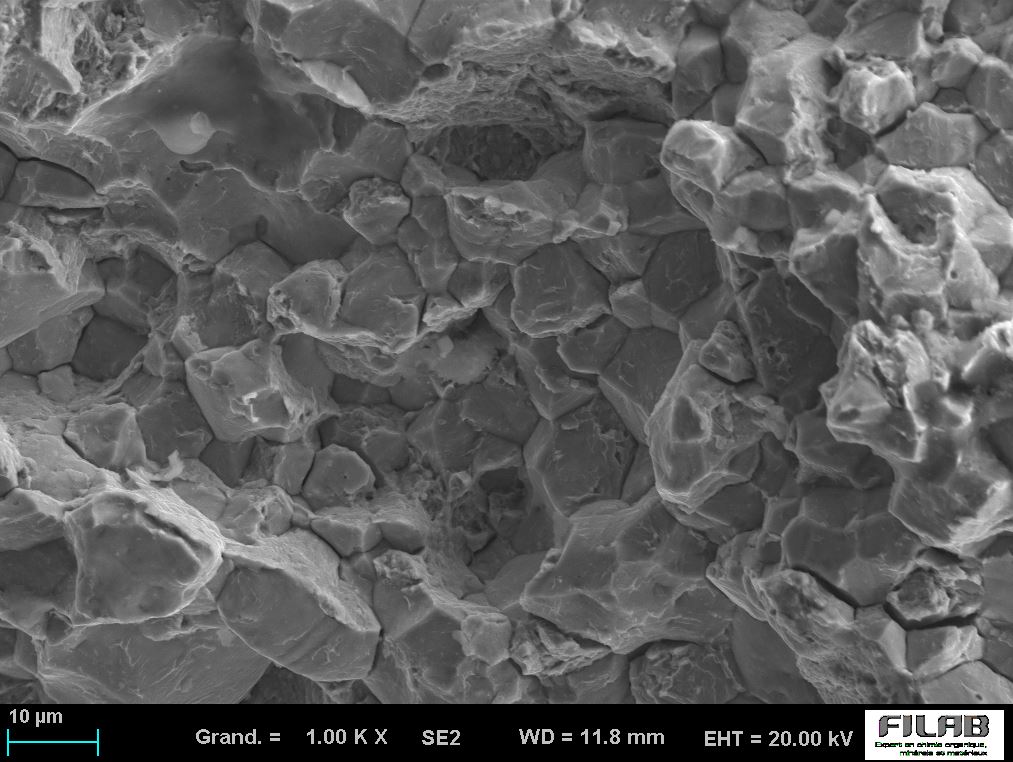
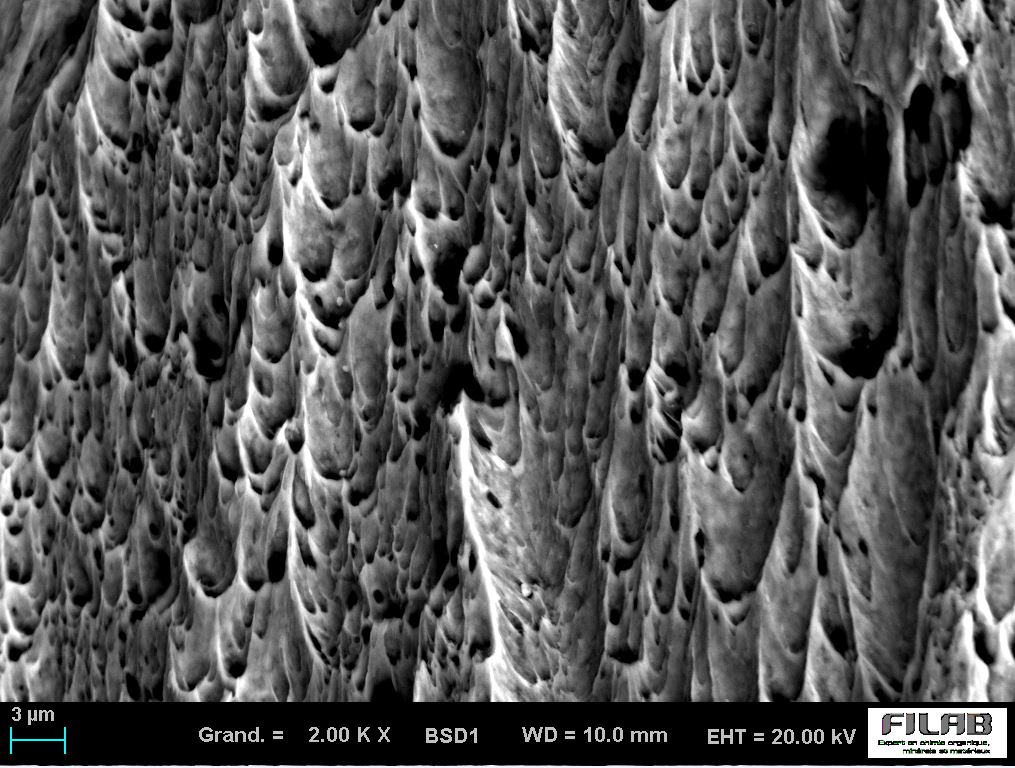
These initial analysis are supplemented by a specific and in-depth observation of the fracture surface, which is a true open book on the stresses experienced by the part that caused the mechanical failure by breakage.
This fractographic expertise makes it possible in particular to locate the initiation point of the break, identify the mode of failure (ductile or brittle, respectively in the presence or absence of deformation, static or dynamic in fatigue, etc.). But it also makes it possible to highlight any material defects or external stresses that may have caused the breakage.
A Few Examples of Applications Carried Out by the FILAB Laboratory in Breakage Analysis
Breakage expertise on high-voltage electrical cables
Study of breaks in metal washers
Breakage expertise on mechanical tensile test specimens
Fractography of a broken mechanical shaft
Our Mechanical Analysis Services
The FILAB Laboratory offers its services for other types of mechanical analysis :
Our FAQ
It is important to take potential fracture risks into account when selecting and using different materials to ensure the safety and efficiency of structures and products.
Materials that may present fracture risks include:
Metals and Alloys: Steel, aluminum, titanium, often used in construction, the aerospace industry, and automotive applications. They can fail due to fatigue, corrosion, or manufacturing defects.
Ceramics and glass: Used in industrial and household applications. These materials are brittle and can break under mechanical stress or thermal variations.
Plastics and polymers: Used in a wide range of applications, from packaging to aerospace components. They can degrade under the effects of UV, heat, or chemical reactions, leading to a loss of strength.
Composites: Composite materials used, for example, in the automotive or aerospace industries can be prone to failure under excessive loads or impact.
It is important to note that the likelihood and nature of failure depend not only on the type of material, but also on its use, environment, and maintenance.
To prevent material fracture, it is essential to adopt appropriate prevention and maintenance measures. Here are some actions to put in place:
- Material selection : Select the most suitable material based on the application, environment, and the stresses it will be subjected to. This involves taking into account properties such as strength, ductility, toughness, corrosion resistance, and resistance to extreme temperatures.
- Precise design and engineering: Ensure that the design of parts and structures is optimized to distribute loads evenly and minimize areas of concentrated stress.
- Quality control and regular testing: Carry out rigorous quality checks during manufacturing and regular testing. This may include fatigue tests and visual inspections.
- Protection against harsh environments: Apply coatings, paints, or other forms of protection to reduce the impact of exposure to corrosion, moisture, chemicals, or UV radiation.
- Compliance with standards and regulations: Adhere to industry standards and current regulations, which are often based on extensive research and feedback to ensure the safety and reliability of materials.
By following these practices, it is possible to significantly minimize the risk of material fracture.
Fracture analysis and fractography make it possible to understand the causes of a material failure. The first analysis consists of examining the surfaces of a part to determine the characteristics of the fracture and identify potential material defects. As for fractography, it makes it possible to examine the crystalline structure of the broken part in greater detail. Various technical methods are available for analyzing material fracture.
- Microscopy makes it possible to observe flaws at the microscopic scale, providing clues about the nature of the fracture.
- Tensile tests , which consist of subjecting the material to a tensile force until it breaks, are also very common.
- The bending tests make it possible to measure a material's resistance to bending.
- 3D tomography is useful for analyzing internal deformations in the material before and after fracture.
- Numerical simulations are used to help understand fracture at the macroscopic level.
All these techniques, used together, provide a comprehensive and accurate view of the material fracture process, making it possible to measure a material's strength limits and prevent potential failures.
La fractographie est l'étude des surfaces de rupture des matériaux, qui se concentre sur l'examen de la topographie de la surface de rupture pour déterminer la cause et le mode de la rupture. Cela se fait généralement à l'aide de microscope électronique à balayage (MEB), pour observer les caractéristiques microscopiques de la surface de rupture. Elle permet d'identifier des phénomènes tels que la fatigue, la fragilité, la ductilité, les inclusions, et d'autres défauts de matériaux, en fonction du faciès de rupture observé. En résumé, la fractographie est une spécificité de l'analyse de rupture, se concentrant spécifiquement sur l'examen détaillé des surfaces de rupture, tandis que l'analyse de rupture est une étude plus globale des causes et des circonstances entourant la rupture d'un matériau ou d'une structure.