Laboratory for analysis and expertise

Laboratory molecular analysis and testing

More than 140 people
More than 140 people at your service
5200 m² laboratory
5200 m² laboratory + 99% of services are provided in-house
Accredited laboratory
Accredited laboratory COFRAC ISO 17025

Molecular characterization makes it possible to identify a molecule, determine its chemical structure, and assess its purity. It is essential for understanding the composition of a substance, detecting impurities, or investigating a non-conformity. 

At the FILAB laboratory, molecule analysis is based on a multi-technique approach in order to deliver reliable results.

Your needs: carry out reliable, actionable molecular characterization to identify and secure the composition of your substances

What is molecular characterization?

This molecular-scale analysis consists of determining the identity, structure, and purity of a molecule. It provides a precise understanding of the chemical composition of a substance, whether it is pure or present in a complex mixture.

Objectives of molecular characterization

Molecule analysis can be carried out in different contexts: confirming the identity of a raw material, investigating a non-conformity, identifying an impurity, or studying a degradation product.

Validate the compliance of a substance with specifications or regulatory requirements

Investigate a non-conformity or an analytical deviation

Study the stability and compatibility of a product in its environment

Analyze the underlying reaction mechanisms and support informed technical decision-making

Identify an unknown molecule or impurity

Optimize a synthesis or formulation process

Understand molecular interactions and distinguish molecules with similar structures

Adapt your production processes to avoid failure risks

Our solutions: provide molecular characterization techniques tailored to your needs and deliver fast, reliable results

Why choose FILAB for your molecular characterization?

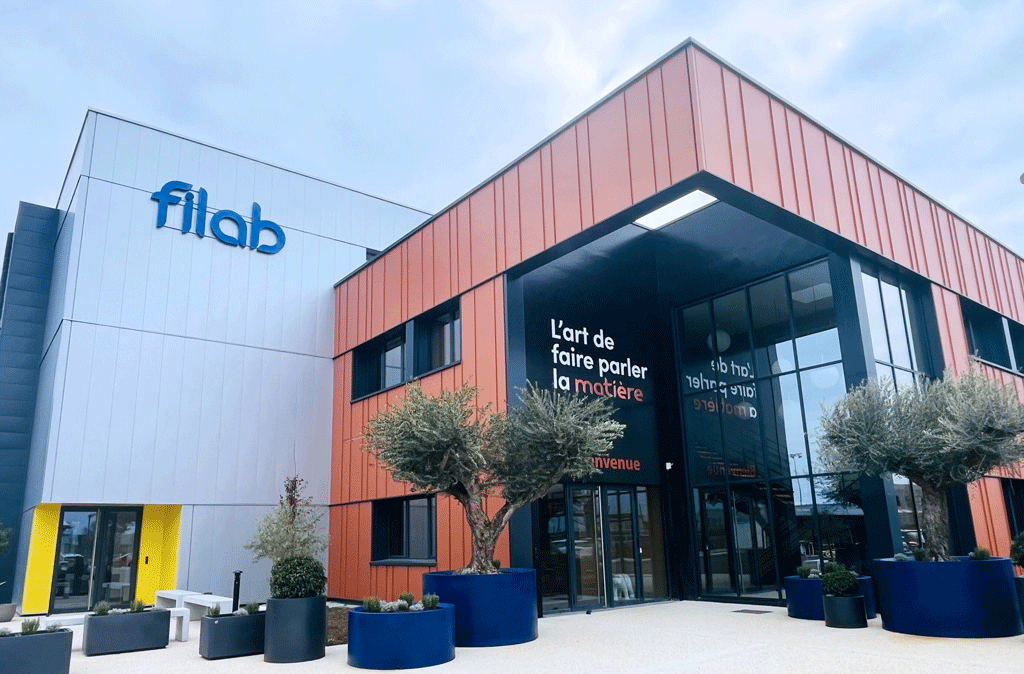
filab-extérieur


At the FILAB laboratory, molecule analysis relies on a multi-technique approach that makes it possible to determine:

  • the chemical structure of a compound,
  • molecular mass, particle size distribution, 
  • thermal and mechanical properties, 
  • density, charge, polarity, and chemical reactivity,
  • purity and the presence of impurities,
  • spectral and structural properties.

Our experts support manufacturers in identifying unknown molecules, verifying compliance, or comparing substances.

Application cases

Identification of an unknown impurity in an active ingredient

Issue: An unexpected chromatographic peak is detected during quality control of a pharmaceutical production batch. 

Analytical solution: Implementation of a molecular characterization strategy combining high-resolution LC-MS and NMR to determine the exact mass, molecular formula, and chemical structure of the impurity. This analysis makes it possible to identify a potential by-product resulting from a side reaction and to adapt the synthesis process.

Comparison of two batches showing a performance gap

Issue: A performance difference between two batches of the same reference is observed for chemical products.

Analytical solution: Carrying out a comparative molecule analysis: chromatography coupled with mass spectrometry, impurity profile analysis, and spectral study (IR/NMR). The results can highlight a variation in composition linked to a change in the supplier of the raw material.

Industries and matrices concerned

Molecular characterization is used in many sectors where control of chemical composition is critical.
Pharmaceutical industry

Raw materials, active substances, excipients, synthesis intermediates, finished products, impurities, and degradation products.

Fine chemicals and specialty chemicals

Reaction intermediates, synthesis products, by-products, residual solvents, organic contaminants.

Cosmetics

Active ingredients, raw materials, complex formulations, residues, trace compounds.

Medical devices

Constituent substances, manufacturing residues, extractables and leachables.

Polymer materials

Monomers, additives, oligomers, degradation products, polymerization residues.

Energy

Organic or inorganic compounds, electrolytes, additives, residues, or contaminants.

Our FAQ

Why carry out molecular characterization?

In the field of chemical substance analysis and characterization, elemental analysis is an essential step in understanding how cells and molecules function. It consists of determining the proportions of atoms making up a chemical element and identifying their nature: this process is also known as molecular characterization.

Each atom has specific properties such as density, melting point or boiling point, but it is thanks to their unique molecular mass that we seek to identify and characterize them.

Molecular characterization and a thorough understanding of the chemical elements that make up your products will enable you to:

  • Validate their compliance with your specifications and regulatory standards
  • Adapt your production processes to avoid failure risks
  • Study the compatibility of a chemical product with its environment

Depending on the nature of the elements, molecular characterization techniques will differ and be more or less complex. As such, the support of a specialist laboratory with a wide range of analytical equipment provides you with the expertise and responsiveness you need for your elemental analysis.

This analysis also makes it possible to understand molecular interactions and distinguish similar molecules. It is therefore very useful in many fields such as biology, chemistry and medicine, as it helps to better understand the underlying mechanisms and facilitates informed decision-making.

Properties measured in molecule analysis

Molecular analysis of materials is an essential technique for understanding the composition and properties of materials. The properties measured in a molecular analysis can include molecular mass, particle size distribution, thermal and mechanical properties, density, charge, polarity and chemical reactivity, as well as chemical structure.

This information can be used to understand how materials behave and react in different situations, which can be crucial for applications such as the design of new materials and the resolution of quality issues.

These data are essential for understanding the physical and chemical properties of materials, and for designing materials with specific properties for a wide range of applications, while meeting the needs of many industries.

What is molecular characterization?

Molecular characterization consists of identifying a molecule and determining its chemical structure using advanced analytical techniques.

In which cases should a molecule analysis be carried out?

It is carried out in the event of non-compliance, product development, a process change, or to confirm the identity of a substance.

What techniques are used in molecular characterization?

The analysis rely on chromatography, mass spectrometry, NMR and spectroscopies adapted to the nature of the compound.

Can an unknown molecule be identified?

Yes, a combined analytical strategy makes it possible to determine the exact mass, molecular formula and structure of an unknown molecule.

Can molecule analysis detect trace-level impurities?

Yes, chromatography-mass spectrometry coupled techniques make it possible to detect and identify compounds present at low concentrations.

What is the difference between identification and molecular characterization?

Identification confirms the nature of a known molecule, whereas molecular characterization aims to determine its precise structure and chemical properties.

Is molecular characterization useful in R&D?

Yes, molecular characterization makes it possible to validate a synthesis, study by-products and optimize a manufacturing process.

How can i get a quote from FILAB?

To get a quote, you can contact our teams via our contact form, by phone or by email.
Simply send us your requirements (type of material, analysis requested, any applicable standard, urgency, number of samples, etc.). We will then send you a personalized technical and pricing proposal within 24-48 hours.

What is the typical analysis turnaround time?

Lead times vary depending on the nature of the analysis and the complexity of the expertise project.
FILAB is nevertheless committed to providing fast turnaround times tailored to your constraints and industrial urgencies.

Why use a molecular characterization laboratory?

Molecular characterization makes it possible to precisely identify a molecule and determine its chemical structure. Unlike elemental analysis, which determines only the composition in chemical elements (C, H, N, etc.), molecular characterization provides a complete structural view of the molecule and any impurities or degradation products.

The filab advantages
A highly qualified team
Responsiveness in responding to and processing requests
A COFRAC ISO 17025 accredited laboratory
(Staves available on www.cofrac.com - Accreditation number: 1-1793)
A complete analytical facility of 5,200m²
Tailor-made support
Tailor-made support
Video debriefing available with the expert
Anaïs DECAUX Customer Support Manager
Ask for your quote