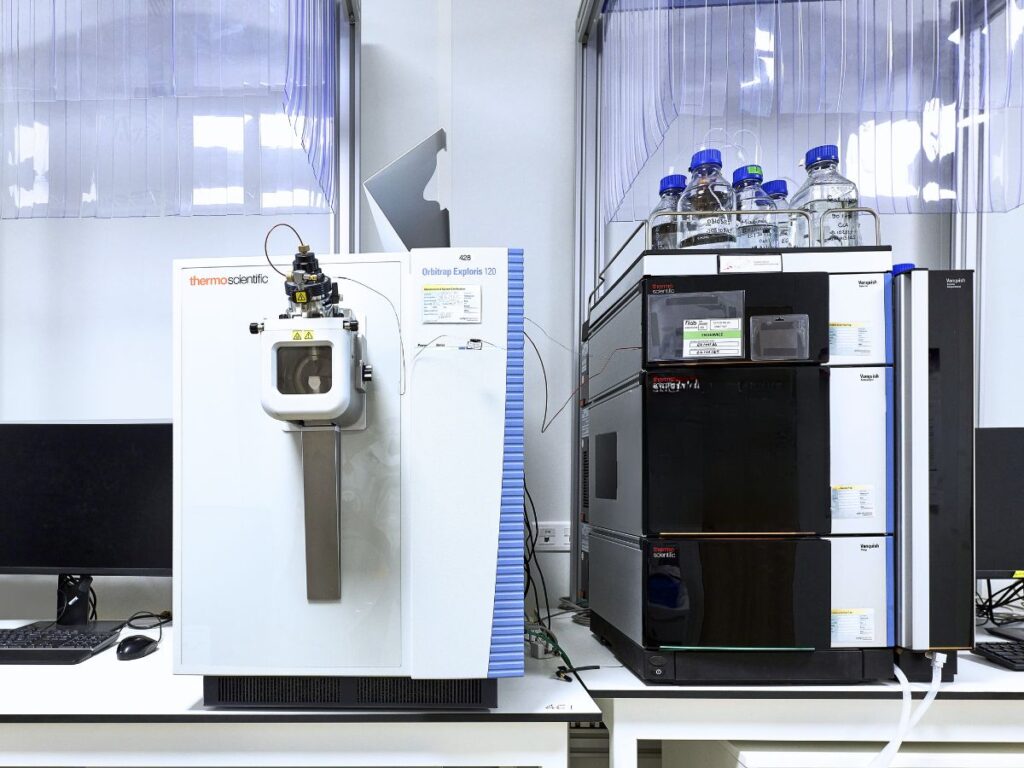
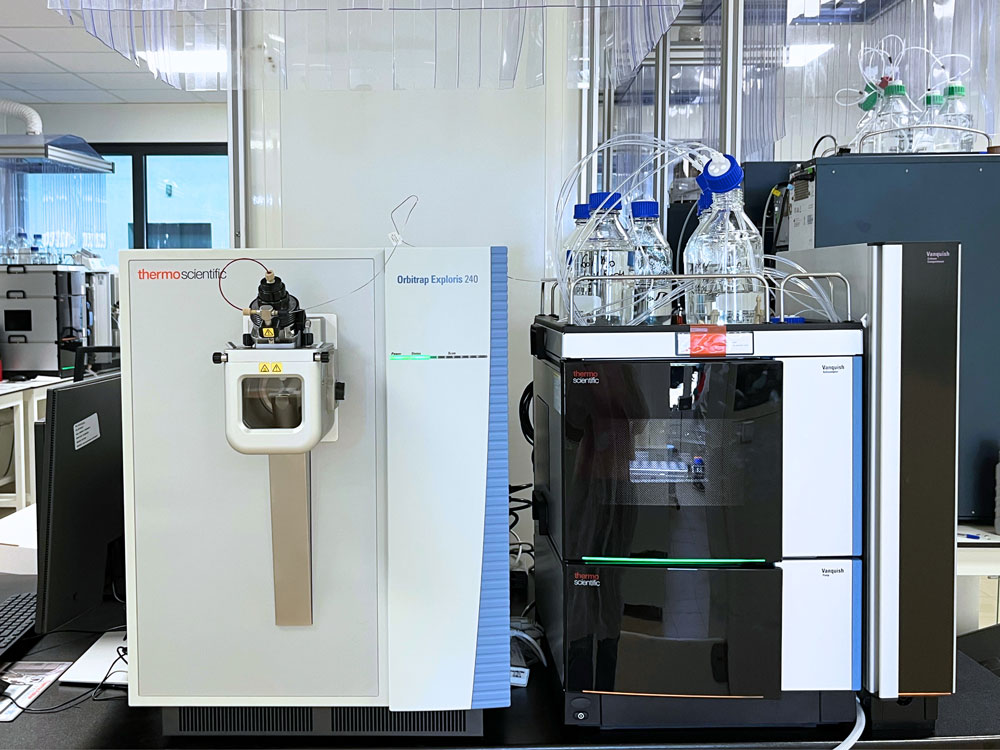
LC-Orbitrap analysis in the laboratory

Chemical analysis Problem solving R&D support
More than 140 people
More than 140 people at your service
5200 m² laboratory
5200 m² laboratory + 99% of services are provided in-house
Accredited laboratory
Accredited laboratory COFRAC ISO 17025
CIR
CIR Research tax credit

Do you need an LC-orbitrap analysis?

What is orbitrap mass spectrometry?

La spectrométrie de masse Orbitrap est une technique d’analyse ultra-précise qui permet de mesurer la masse exacte des molécules présentes dans un échantillon. Elle est utilisée pour identifier, caractériser et quantifier des composés, même à l’état de trace.

Cette technologie repose sur un analyseur de type "Orbitrap", capable de fournir une résolution très élevée et une précision de masse exceptionnelle, souvent à quelques ppm (parties par million) près. Elle est généralement couplée à une chromatographie liquide (LC) en amont, d’où l’appellation LC-Orbitrap.

Orbitrap LC-MS: an ultra-sensitive technology for identifying complex compounds

Mass spectrometry Orbitrap LC-MS is a cutting-edge technique that combines liquid chromatography (LC) to separate compounds in a sample with an Orbitrap detector offering very high resolution and mass accuracy

It makes it possible to identify, even at trace levels, unknown or complex substances in a wide range of industrial matrices (formulations, polymers, plant extracts, etc.). Ideal for the detection of impurities, contaminants or migrating substances, this method is particularly valuable for the pharmaceutical, cosmetic, chemical and packaging sectors.

analysis performed by LC-Orbitrap

These analytical techniques make it possible to provide the following services:

    • High-resolution exact mass measurement (HRMS)
    • Molecular formula determination
    • Identification of unknown compounds
    • Targeted and non-targeted analysis
    • Detection of trace-level compounds
    • Screening of thousands of compounds in a single analysis

Nos solutions : combiner la spectrométrie de masse à l'Orbitrap pour vous fournir des résultats fiables et précis

Did you know?

The FILAB laboratory is equipped with 2 LC-Orbitraps ✨

This dual instrumentation allows us to adapt analytical performance to the challenges of each project, whether for highly reliable routine analysis or for the most complex characterizations requiring greater resolution and sensitivity.

analyse lc-orbitrap
Orbitrap exploris™ 120
Orbitrap exploris™ 240

Pourquoi choisir FILAB pour l'analyse par LC-Orbitrap ?

At the FILAB laboratory, we guarantee our clients a precise, reliable, and fully documented analysis, carried out within a rigorous framework.
You benefit from personalized technical and regulatory support, tailored to your sector and your challenges.
Thanks to our comprehensive analytical platform, we have the ability to combine LC-Orbitrap analysiswith other complementary techniques (GC-MS, ICP, SEM, FTIR…), to go further in understanding your issues.

Applications of orbitrap LC-MS analysis

Elle est utilisée dans de nombreux secteurs pour :

L’identification de contaminants inconnus (taches, odeurs, résidus sur produits finis)

La recherche de sous-produits ou impuretés dans des formulations chimiques ou pharmaceutiques

L’analyse non ciblée pour des investigations R&D ou des contrôles qualité poussés

Le profilage de matières premières complexes d’origine végétale ou polymère

Discover our case study

Chemical characterization of DM: why does LC-Orbitrap make the difference?

Read the article
To go further

Proteomic characterization by LC-Orbitrap

To go further

Lipidomic characterization by LC-Orbitrap

  • Global lipid profiling
  • Characterization of phospholipids, triglycerides, sphingolipids, and glycolipids
  • Targeted quantification of lipids of interest
  • Study of lipid oxidation and degradation
  • Comparison of lipid profiles between samples
  • Quality control of raw materials and finished products
To go further

Metabolomic Characterization by LC-Orbitrap

  • Untargeted metabolic profiling
  • Identification of known and unknown metabolites
  • Metabolic pathway studies
  • Targeted quantification of metabolites
  • Trace-level small molecule analysis
To go further

Glycomic & Biopolymer Characterization by LC-Orbitrap

FAQ

What is the difference compared with a conventional LC-MS?

The Orbitrap offers better resolution and greater accuracy than conventional mass spectrometers (such as quadrupole or ion trap systems). It is particularly useful for identifying complex molecular structures, distinguishing isomers or resolving very close masses in complex matrices.

What types of samples can be analyzed?

Any type of organic matrix: powders, liquids, polymers, plant extracts, thin films, solutions, cosmetics, etc.

It is particularly well suited to complex or multi-component samples, even in small quantities.

Can compounds be quantified with LC-Orbitrap?

Yes, semi-quantitative or relative quantification is possible, especially for complex mixtures or screening. For precise regulatory assays, it can be combined with other approaches (LC-MS/MS).

We detected an unusual odor in a batch of finished product. Can LC-Orbitrap identify the source?

Thanks to its high resolution, LC-Orbitrap is ideal for identifying unknown or unlisted organic compounds responsible for odors, discoloration or visual defects. It makes it possible to analyze traces in complex matrices (cosmetics, polymers, formulations…).

How can LC-Orbitrap help us verify the purity of an active ingredient or excipient?

It makes it possible to detect trace-level impurities, including non-targeted ones, often invisible in conventional LC-MS. 

This is useful during pharmaceutical development, supplier qualification, or when process changes are introduced.

In an R&D project, we need to elucidate the structure of an unknown by-product. Is this possible with this technique?

Non-targeted analysis with LC-Orbitrap makes it possible to propose a molecular formula from a signal and to partially or fully elucidate the structure of a compound using MS/MS fragmentation and internal or external databases.

Can this method be used to characterize complex natural or plant extracts?

LC-Orbitrap is highly suitable for analyzing multi-component mixtures derived from plants, essential oils, bio-based polymers… It enables comprehensive profiling and differentiation between batches or suppliers, even in the absence of standards.

Can it help solve migration issues in packaging or syringes?

Yes, especially for identifying migrating substances at very low concentrations (phthalates, residual solvents, additives, etc.), as part of compatibility studies or regulatory compliance assessments (pharmaceutical, cosmetic, food).

How does Orbitrap mass spectrometry work?

First of all, Orbitrap mass spectrometry enables ions to be trapped by an electrostatic field. These ions have an axial oscillation frequency that varies according to their mass-to-charge ratio, which makes it possible to separate them.

The Orbitrap consists of a central electrode and an outer cylindrical electrode. The central electrode, coaxial with the inner axis, traps ions in an orbital motion, and a mass spectrum can then be generated from the detector, which converts the image of the induced current of the trapped ions into a frequency spectrum using the Fourier transform.

As a result, Orbitrap mass spectrometry offers quantitative mass spectrometry coupled with liquid chromatography (LC-MS) at high resolution and mass accuracy (HRAM).

What is the difference between an LC-Orbitrap HRMS analysis and an LC-MS/MS analysis?

The LC-Orbitrap HRMS combines liquid chromatography with a high-resolution mass spectrometer capable of providing exact mass measurements. It is particularly well suited to non-targeted approaches, such as screening for unknown compounds, identifying unexpected molecules or characterizing complex mixtures. It makes it possible to explore a sample without necessarily knowing in advance which compounds are being sought.

The LC-MS/MS (triple quadrupole) is mainly used for targeted and quantitative analysis. It makes it possible to search for and quantify, with high sensitivity, molecules that have already been identified, thanks to the monitoring of specific mass/mass transitions.

Thus, LC-Orbitrap HRMS is preferred for identification, molecular characterization and broad screening, while LC-MS/MS is often chosen for the precise quantification of known trace-level compounds.

At FILAB laboratory, these two approaches are complementary: HRMS Orbitrap makes it possible to explore and characterize complex matrices, while LC-MS/MS provides targeted, sensitive quantification of the compounds of interest.

The filab advantages
A highly qualified team
Responsiveness in responding to and processing requests
A COFRAC ISO 17025 accredited laboratory
(Staves available on www.cofrac.com - Accreditation number: 1-1793)
A complete analytical facility of 5,200m²
Tailor-made support
Tailor-made support
Video debriefing available with the expert
Thomas ROUSSEAU Scientific and Technical Director
Ask for your quote