Karl Fischer analysis for accurate water content determination

Chemical analysis Problem solving
More than 140 people
More than 140 people at your service
5200 m² laboratory
5200 m² laboratory + 99% of services are provided in-house
Accredited laboratory
Accredited laboratory COFRAC ISO 17025
You would like to determine water content using the Karl Fischer method?

What is the Karl Fischer method?

The Karl Fischer method is a chemical technique used to measure the water content of a sample. It is particularly suitable for determining water in liquids or detecting trace amounts of water, down to ppm levels, in a sample. The procedure is based on the oxidation of sulfur dioxide by iodine.

Its accuracy and ability to detect trace moisture make it an essential tool for quality control laboratories and for ensuring product quality and compliance.

Moisture measurement by Karl Fischer analysis

Karl Fischer analysis, also known as “Karl Fischer moisture,” refers to the measurement of moisture or water content in samples using the Karl Fischer method. It is widely recognized for its precision and adaptability to various types of materials, whether solid, liquid, or gaseous.

Karl Fischer moisture measurement is particularly useful in industries where water content can influence product quality, stability, and shelf life.

Karl Fischer method principle

The Karl Fischer method is based on a well-defined chemical reaction between the water in the sample and Karl Fischer reagents. This reaction produces hydrogen iodide, the amount of which is directly proportional to the water content.

By measuring the amount of hydrogen iodide generated, the method allows precise calculation of the sample’s water content.

This principle enables highly sensitive and accurate measurement of water content, making it valuable across various industries for analyzing liquids, solvents, and other samples containing small amounts of water.

Karl Fischer analysis: for which industries?

Karl Fischer analysis is essential for ensuring product quality by preventing excess or insufficient moisture that could alter their properties.

The method is used in many industrial sectors:

Pharmaceuticals

Pharmaceuticals

Analysis of water content in raw materials and finished products

Chemicals

Chemicals

Determination of residual moisture in solvents, reagents, and polymers

Materials

Materials

Moisture analysis in materials such as ceramics, plastics, and coatings

Our solutions: providing analytical equipment for water content measurement using the Karl Fischer method

Why choose FILAB for Karl Fischer analysis?

Karl Fischer-min

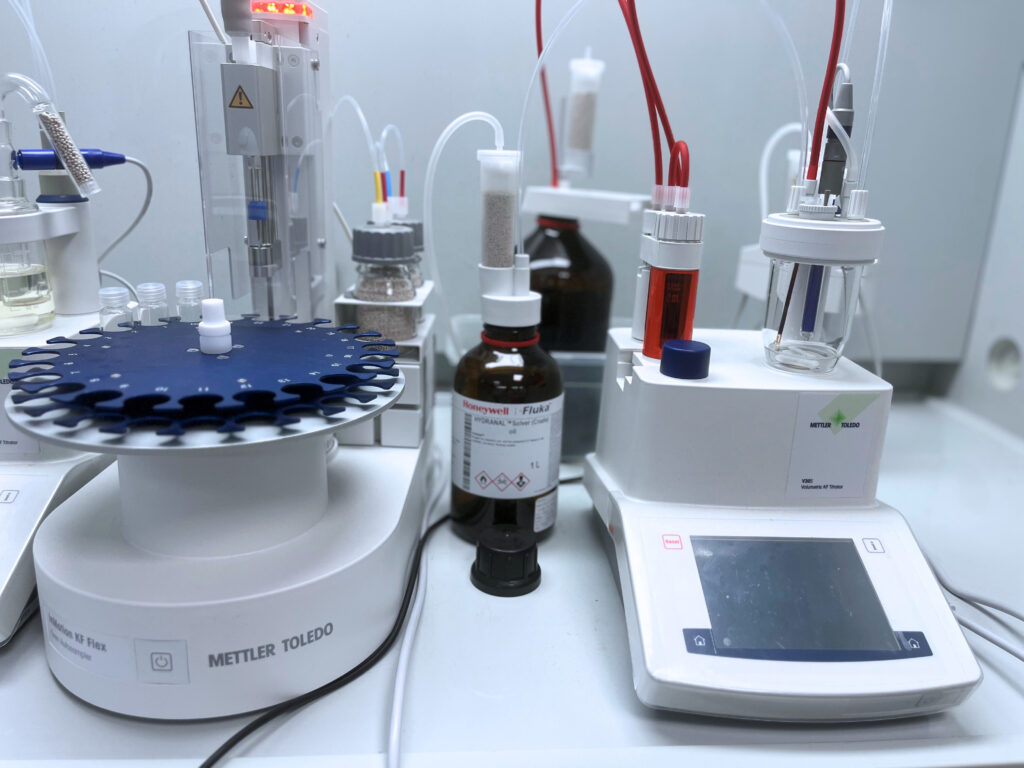
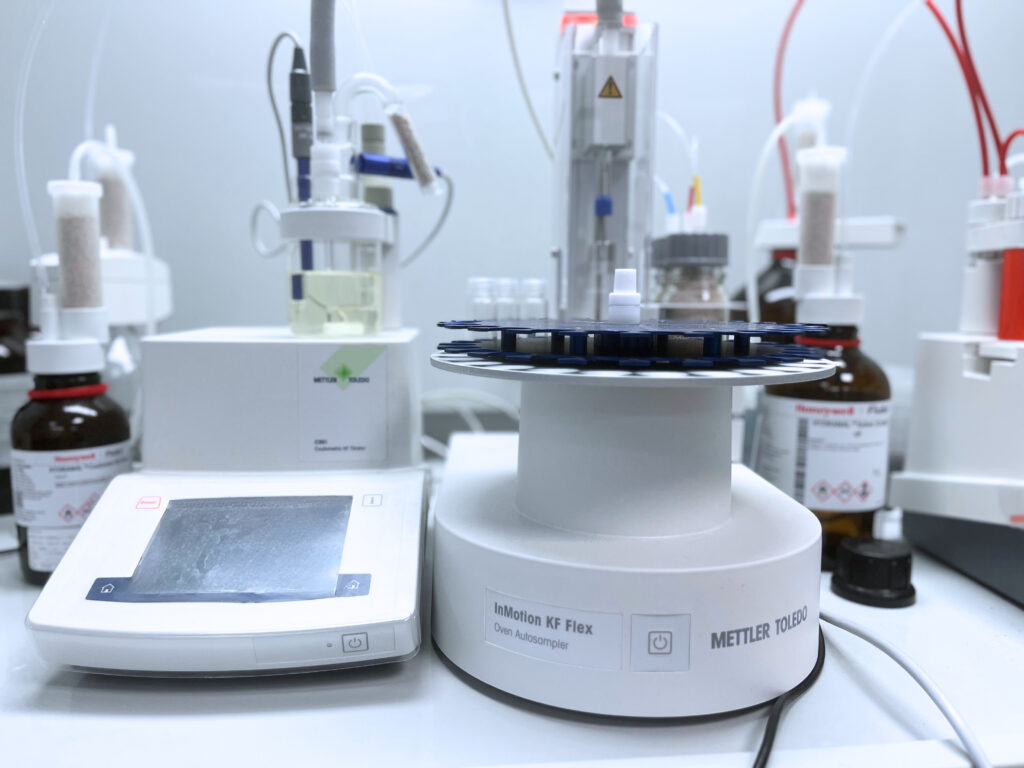
As part of research and development projects, FILAB provides valuable support to industrial clients across various sectors for water content determination using the Karl Fischer method. To meet diverse needs, FILAB’s analytical equipment includes several titrators:

  • A V30S volumetric titrator, enabling measurement of high water contents up to 100%
  • A C30SD coulometric titrator, covering a range from 1 ppm to 5%

In addition, FILAB is equipped with a KF oven designed for water content determination by oven extraction, with a temperature range from 40 to 280°C.

This provides FILAB with extensive capabilities to meet water content measurement needs across a wide variety of samples and conditions.

Our additional services

Our FAQ

Comment obtenir un devis avec FILAB ?

Pour obtenir un devis, vous pouvez contacter nos équipes via notre formulaire de contact, par téléphone ou par e-mail.
Il vous suffit de nous transmettre votre besoin (type de matériau, analyse souhaitée, norme éventuelle, urgence, quantité d’échantillons…). Nous vous envoyons ensuite une proposition technique et tarifaire personnalisée en 24-48H.

Quelle est la durée typique des analyses ?

Les délais varient selon la nature de l’analyse et la complexité du projet d’expertise.
FILAB s’engage toutefois à fournir des délais rapides et adaptés à vos contraintes et urgences industrielles.

What are the types of Karl Fischer analysis and when should they be used?

There are two main types of Karl Fischer analysis: volumetric titration and coulometric titration.

  • Volumetric titration: Suitable for samples with higher water content (generally above 1%). The volume of reagent required to react with the water is measured to determine the water content.
  • Coulometric titration: Ideal for samples with low water content (below 1%). In this case, iodine is generated electrochemically in the titration cell, and the amount of electricity used to produce iodine is measured to calculate the water content.
Which solvents are used in the Karl Fischer method ?

The solvents used in the Karl Fischer method influence both sample preparation and the titration reaction. Choosing the right solvent is essential to ensure complete dissolution of the sample and an accurate reaction with the Karl Fischer reagent, enabling precise water content measurement.

Methanol is commonly used as a solvent in the Karl Fischer method to dissolve the sample and facilitate the chemical reaction with the KF reagent. It is particularly effective for solubilizing various compounds and enabling accurate detection of water content.

In Karl Fischer analysis, methanol is often preferred due to its compatibility with a wide range of samples, ensuring reliable and reproducible moisture measurements.

How do you prepare a sample for Karl Fischer analysis?

Sample preparation depends on its nature. Solids may require dissolution in a suitable solvent. Samples must be handled to minimize exposure to ambient moisture.

How do you choose between volumetric and coulometric methods?

Coulometric titration is highly sensitive and suitable for very low water amounts (often below 10 µg), making it ideal for high-precision applications such as electronics, pharmaceuticals, and biotechnology.

What are the advantages of Karl Fischer analysis compared to other methods?
  • High precision and accuracy, even at very low levels
  • Fast results (often within minutes)
  • High specificity to water
  • Versatility across solids, liquids, and gases
Which samples can be analyzed using Karl Fischer?

Karl Fischer analysis is used across many materials:

  • Pharmaceuticals: tablets, capsules, powders, solutions
  • Chemicals: solvents, acids, bases, intermediates
  • Food & cosmetics: oils, powders, creams, shampoos
  • Polymers & plastics: resins, films, additives
  • Petroleum products: lubricants, fuels, additives
The filab advantages
A highly qualified team
Responsiveness in responding to and processing requests
A COFRAC ISO 17025 accredited laboratory
(Staves available on www.cofrac.com - Accreditation number: 1-1793)
A complete analytical facility of 5,200m²
Tailor-made support
Tailor-made support
Video debriefing available with the expert
Clément BOENARD Head of Inorganic Chemistry Department
Ask for your quote