"I used Filab for a chemical analysis. Very satisfied with the service. Responsive team, deadlines met, and a clear analysis report. I recommend them."
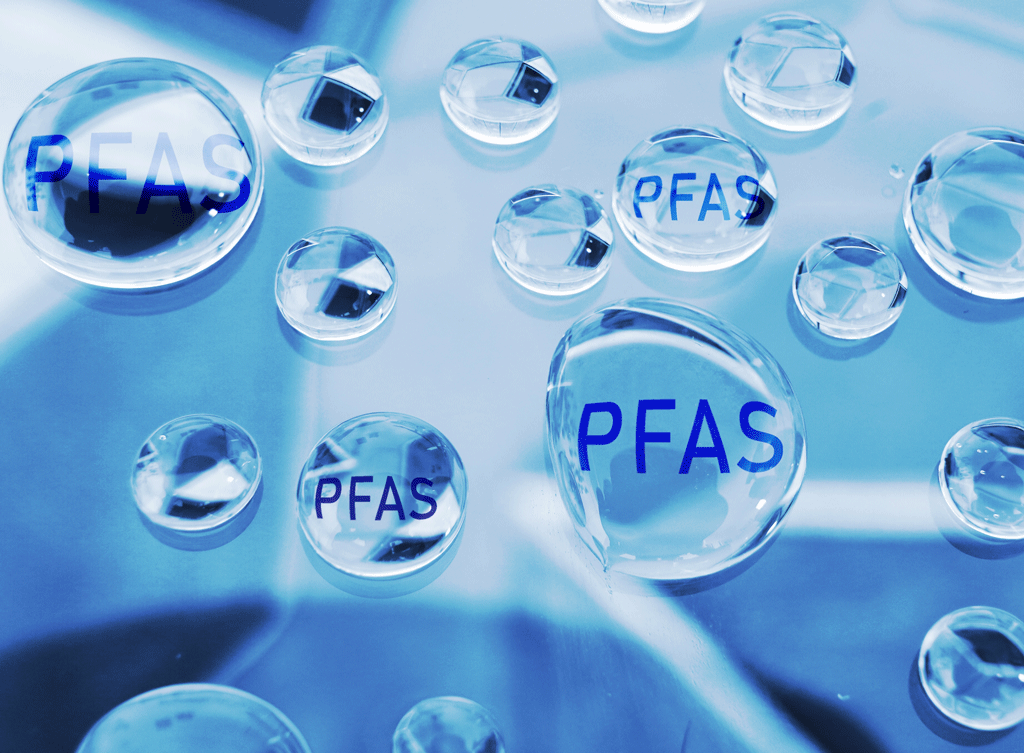
PFAS analysis in the laboratory: identifying and quantifying per- and polyfluoroalkyl substances
PFAS analysis: regulatory compliance and chemical characterization
What are PFAS?
PFAS (Per- and PolyFluoroAlkyl Substances) are a large family (several thousand) of molecules containing at least one highly fluorinated carbon motif (C–F bonds), which is very stable. This stability explains their persistence in the environment and often in the body, hence the nickname “forever chemicals”.
These are chemical compounds with anti-adhesive, waterproofing, or high-heat-resistant properties.
Per- and polyfluoroalkyl substances (PFAS) are now subject to major regulatory restrictions in France and Europe, affecting many industrial sectors: cosmetics, textiles, plastics processing, coatings, technical materials, industrial equipment, and more.
FILAB laboratory’s PFAS expertise
FILAB is an independent laboratory specializing in analytical chemistry and materials characterization. We deploy cutting-edge expertise dedicated to trace detection and quantification of substances subject to strict regulatory restrictions. This expertise is applied in particular to complex and heterogeneous matrices, such as polymers, chemical formulations, or industrial fluids.
Our approach goes beyond simple measurement:
To ensure the reliability of every PFAS analysis, our laboratory develops tailor-made multi-technique approaches. We combine complementary methodologies based on high-resolution chromatographic and spectrometric coupling techniques (notably LC-MS/MS). The high performance of our PFAS analysis laboratory ensures:
- Structural elucidation and compound speciation.
- Ultra-trace quantification (detection thresholds in the ppb/ppt range).
- Detailed interpretation of PFAS presence, whether short- or long-chain molecules, precursors, or their polymeric forms (fluoropolymers).
Our PFAS analysis services
Targeted PFAS Analysis: 20 Substances
1 to 10 ppb depending on the matrix
- Regulatory status review
- Product compliance verification
- Supplier control
- PFAS pre-audit
Advanced PFAS Analysis: 36 Substances
- 1 to 20 ppb depending on the matrix
- Cosmetics
- Plastics processing
- Technical textiles
- Surface treatments
- Composite materials
Total Fluorine Determination
- Combustion + ion chromatography (IC)
- Furnace fusion (bead) + IC
- Overall evidence in the event of an authority inspection
- A guidance tool for additional analysis
- Demonstration of compliance with “no fluorine” requirements
Critical case: polymeric PFAS
Total fluorine> 50 ppm & targeted PFAS <25 ppb?
This suggests the likely presence of polymeric PFAS that cannot be detected by standard targeted methods.
Our solution: Qualitative screening by Pyrolysis GC/MS (Py-GCMS)
This technique makes it possible to:
- identify signatures of fluorinated polymers
- differentiate polymeric PFAS / non-PFAS
- provide scientific evidence in the event of an audit or inspection
Why choose FILAB?
In the face of regulatory changes concerning forever pollutants, relying on a competent PFAS testing laboratory is essential. FILAB positions itself as a PFAS expert laboratory capable of supporting the chemical, cosmetics, and environmental sectors.
With a diverse, state-of-the-art analytical platform (GC-MS, LC-MS\/MS, CI, Py-GCMS…), the FILAB laboratory adapts its per- and polyfluoroalkyl substance analysis methods according to the matrix to be studied (liquid, solid, powders…).
PFAS testing in finished cosmetic products (emulsions, makeup products, lotions...) and cosmetic raw materials
Total fluorine testing by combustion ion chromatography (CIC)
Quantification of fluorinated molecules by LC-MS
Search for traces of elemental impurities (contamination, pollution, residue…)
Screening by LC-MS for fluorinated molecules
Analysis of APIs, excipients, raw materials, reagents, solvents in the pharmaceutical sector
PFAS: where do we stand with the regulations?
Since French law No. 2025-188 of February 27, 2025 (Environmental Code, Art. L.524-1), the use of products containing PFAS has been progressively banned, with key deadlines:
- Since January 1, 2026: ban on placing certain products containing PFAS on the market (including cosmetic products).
- From 2030: extension to textiles and other industrial uses (with exemptions for essential uses).
- REACH Regulation (EU): a “universal” PFAS restriction is currently being assessed by the ECHA, strengthening control and traceability obligations across supply chains.
- Firefighting foams: gradual ban in the EU, with a regulatory threshold of 1 mg/L for the sum of PFAS.
We invite you to contact us to find out the applicable thresholds for your product and to discuss with our experts how they should be interpreted in relation to your matrix 📞📧.
PFAS analysis: which matrices should you entrust to FILAB?
Identifying PFAS compounds requires specific extraction protocols depending on your industry. As a PFAS expert laboratory, FILAB works on a wide variety of complex industrial matrices:
- Materials and packaging: testing of polymers, textiles, and food-contact packaging.
- Formulations and finished products: regulatory compliance analysis (REACH) for cosmetics or chemical products.
Whether you are looking for a responsive PFAS testing lab for routine checks or a PFAS expert lab to develop methods on atypical matrices, our engineers adapt to your needs.
Expertise, preuves et traçabilitéMise à jour : juin 2026
Trust FILAB laboratory for your analysis of per- and polyfluoroalkyl substances (PFAS)
Confier votre analyse de substances per- et polyfluoroalkylées (PFAS) au laboratoire FILAB, c’est s’appuyer sur une expertise technique, un cadre qualité documenté et une lecture experte des résultats pour des décisions industrielles, qualité ou réglementaire.
Un expert à votre contact
Responsable expertise
Barbara Beauvais accompagne les projets d’analyse de substances per- et polyfluoroalkylées (PFAS).
An expert at your side
Expertise Manager
Barbara Beauvais supports projects for the analysis of per- and polyfluoroalkyl substances (PFAS).
Notre démarche en 4 étapes :
- Échange sur votre problématique et vos contraintes.
- Proposition d’un protocole analytique adapté et d’un devis.
- Réalisation des analyses et relecture experte des résultats.
- Livraison d’un rapport détaillé, exploitable et traçable.
Les avis de nos clients
"Very responsive laboratory, with excellent analysis quality and deadlines met. Communication is smooth, the technical explanations are clear, and the team knows how to adapt to specific needs. I recommend them for their professionalism and reliability!"
"Clear and precise deliverable, delivered on time. I recommend them."
Transparence & contactDernière vérification : juin 2026
Où nous trouver et comment nous contacter
FILAB est un laboratoire physique situé en France, indépendant et accrédité. Toutes les coordonnées ci-dessous permettent de vérifier notre identité et de lancer votre demande.
Laboratoire FILAB
Ecoparc Dijon Bourgogne
80 rue Jean-Louis Auguste Petitjean
21850 Saint-Apollinaire, France
Tél. +33 (0)3 80 52 32 05
FAQ
A PFAS analysis aims to detect and quantify per- and polyfluoroalkyl substances present in a matrix (liquid, solid, powder, polymer, etc.) using chromatography techniques coupled with mass spectrometry (LC-MS/MS).
These substances are used for their non-stick, water-repellent, and heat-resistant properties in:
- non-stick coatings (cookware, technical textiles);
- cosmetics and food packaging ;
- industrial additives (paints, varnishes, lubricants).
What types of samples can be tested for PFAS?
The FILAB laboratory analyzes PFAS in pharmaceutical products, cosmetics, solvents, food packaging, and polymer materials.
analysis are carried out mainly by LC-MS/MS or by ionic combustion (CLI) for total fluorine determination. These methods enable detection at thresholds of 1 to 10 ppb depending on the matrix.
The FILAB laboratory offers the analysis of 36 PFAS, including the 20 substances mentioned in the European Water Directive, such as PFOA, PFOS, PFHxA, PFNA or PFDA.
Since February 2025, French law has provided for the gradual ban of PFAS in cosmetics, clothing textiles and ski waxes as of January 1, 2026.
In the event of regulatory non-compliance, a process improvement, or a product failure, manufacturers may need to carry out analysis of per- and polyfluoroalkyl substances.
Subject to significant regulatory constraints, monitoring their presence is therefore essential.
Carrying out these substance checks requires precise tools, capable of reaching ppm or even ppb levels. At FILAB, they are carried out by LC-MSMS and we are able to achieve a quantification limit of 1 to 10 ppb depending on the matrices.