News

Cosmetics: how to analyze the additives in your packaging materials

Cosmetic packaging: additives to be analyzed in the laboratory

Stabilizers, colorants, UV inhibitors, antioxidants… There are many different additives that can be added to polymer plastics to improve their properties and performance.

What are they? What are their functions and properties? And how can they be identified?

What are additives?

First, it is necessary to define what are known as additives. Additives, which are chemical substances, can be incorporated into polymer and plastic formulations.

They offer benefits for the packaging of cosmetic products, whether in physical, chemical, or mechanical terms.

migration plastifiants

Why analyze them

While these additives are essential for obtaining high-performance materials that meet brand requirements, their use also requires rigorous control.

  • Their chemical nature may influence compatibility with the product formula.
  • Their concentration must be controlled to optimize packaging performance and compliance.
  • Their evolution over time can lead to migration phenomena towards cosmetic formulas.
  • Some additives may interact with the product's ingredients, altering its stability or odor.
  • They can also impact the recyclability or sustainability of packaging.
  • Their presence and dosage must meet the specific regulatory requirements for the cosmetics sector.

The most common additives in plastic polymers:

  • Plasticizers
    are used to make packaging more flexible and pliable.
    Examples: phthalates, DEHP, DBP, TOTM, etc.
  • UV agents
    are used to protect packaging from the harmful effects of UV rays.
    Examples: Benzophenone-3, Tinuvin 770, Tinuvin 622, Chimassorb 944, Tinuvin 327, Tinuvin 328, Tinuvin P
  • Thermal stabilizers and antioxidants
    help prevent material degradation when exposed to high temperatures or oxidation. Examples: Irganox® (Irganox 1010, Irganox 1076, Irganox 3114), Irgafos® (Irgafos 168), Triphenyl phosphite (TPP), BHT, etc.
  • Reinforcing agents
    to improve the mechanical strength of the plastic, such as tensile strength, flexibility, hardness, etc. Examples: glass fibers, mineral fillers, nanoparticles, etc.
  • Colorants
    are added to give cosmetic packaging a specific color.
    Examples: organic and inorganic pigments, liquid colorants, etc.
  • Antistatic agents
    prevent electrostatic charge from building up on the surface of the plastic. Examples: amides, esters, quaternary ammonium salts, etc.
  • Lubricants and release agents
    are used to improve the processing properties of plastic during production (flow, friction reduction, etc.). Examples: fatty acids, stearic acids, waxes, etc.

How to identify and analyze the additives in your packaging materials?

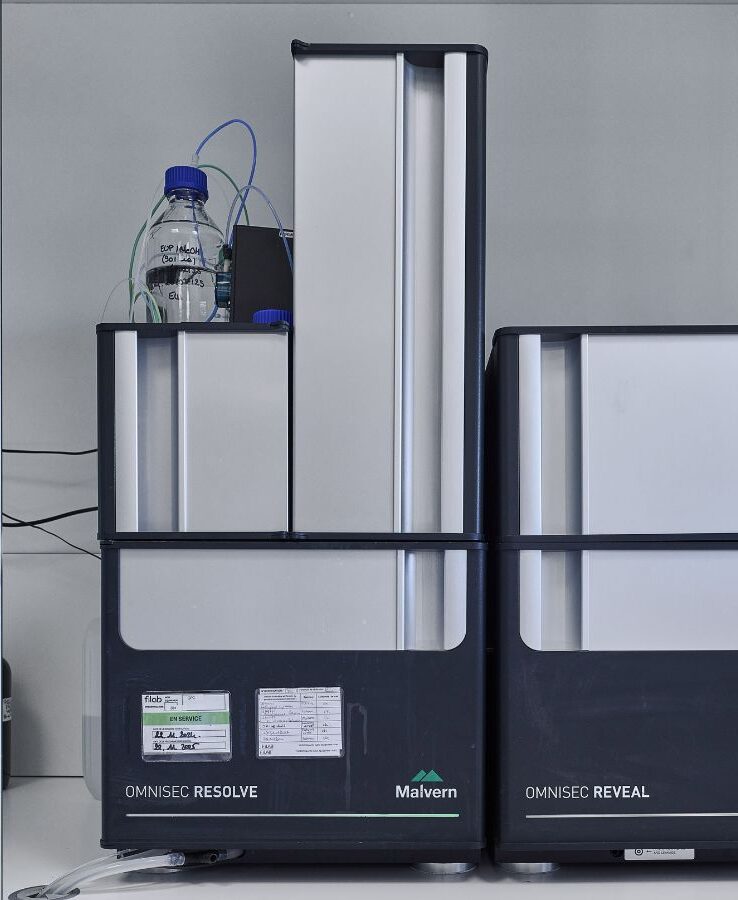
GPC

Firstly, there are various separation techniques (chromatography) for analyzing additives in plastics, depending on the type of additive and the quantity to be detected.

For volatile and semi-volatile additives, the preferred techniques are:

Gas chromatography (GC) : HS-GC/MS, GC/MS, GC-MS/MS, Pyrolysis-GC/MS
This method separates the different components of a plastic sample using a chromatography column and a solvent. Additives can be detected and quantified based on their retention time.
However, for non-volatile additives, the preferred techniques are:

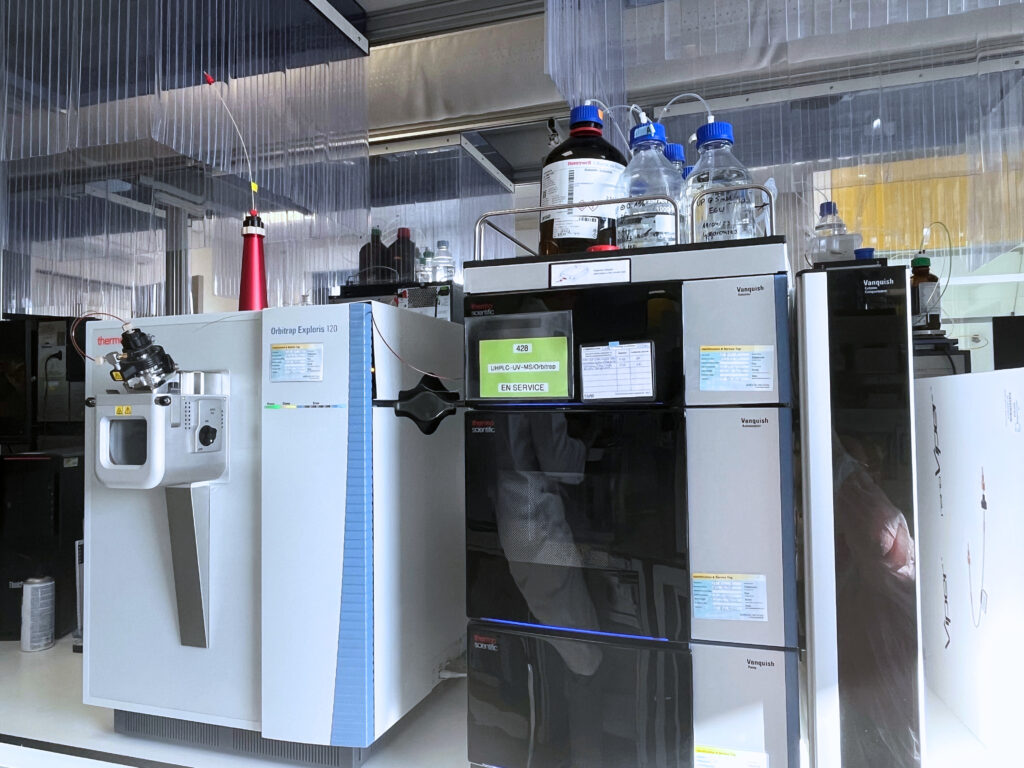
Liquid chromatography (LC): LC-UV, LC-ELSD, LC-RI, LC/MS, LC-MS/MS, LC-QTOF/MS, LC-ORBITRAP/MS
This method separates the different components of a packaging sample using a chromatography column and a solvent. Additives can be detected and quantified based on their retention time.

QTOF, ORBITRAP… Pourquoi passer par de la Haute Résolution ?

Tout d’abord, la spectrométrie de masse haute résolution (HR-MS) est une technique d’analyse chimique avancée qui permet de mesurer avec précision les masses moléculaires des composés présents dans un échantillon. Cette précision est obtenue grâce à la présence d’un détecteur de haute résolution, tel que l’ORBITRAP ou le temps de vol QTOF (Quadrupole Time of Flight)).

Ensuite, l’HR-MS est très utile pour l’identification de composés inconnus dans un échantillon et pour la caractérisation de mélanges complexes de composés… notamment au sein d’un packaging cosmétique.

Finalement, les deux techniques de spectrométrie de masse haute résolution (QTOF et Orbitrap), ont des avantages et des inconvénients distincts.

LC- Obitrap analysis
HPLC-Orbitrap

Advantages and disadvantages

Indeed, the advantage of QTOF is its ability to provide results with high mass resolution, high sensitivity, high measurement accuracy, and extended linearity. It is also capable of performing rapid analyses, which is very useful in routine applications.

As for the Orbitrap, it is often considered to have even better sensitivity and selectivity than the QTOF. In addition, it is capable of analyzing highly complex and heterogeneous samples, such as polymer mixtures.

These two techniques are highly complementary in identifying additives in packaging materials; the choice of one technique over the other will depend on the nature of the sample, the compounds being sought, etc.

On the other hand, there are databases of additives for packaging that can be used to identify the additives present in plastics and to obtain information about their properties.

The solution: call on a specialized and experienced laboratory

In conclusion, depending on requirements and applications, numerous analysis methods and techniques can be used to characterize additives in packaging materials:

  • Identification of additives by GC/MS, LC-QTOF, LC-ORBITRAP, etc.
  • Determination of the additive content of cosmetic packaging
  • Chemical analysis of varnish and resin
  • Polymer analysis
  • Product deformulation to assess the presence of additives
  • Custom chemical analysis
  • Removable and releasable

Contact us

We are available to answer your questions.

Specialised analysis and expertise laboratory for manufacturers

More than 140 people
More than 140 people at your service
5200 m² laboratory
5200 m² laboratory + 99% of services are provided in-house
Accredited laboratory
Accredited laboratory COFRAC ISO 17025
+2200 clients
+2200 clients in France and abroad

Contact us

Our services are reserved for professionals.