Case study

Industrial marking on metal parts: cleaning process

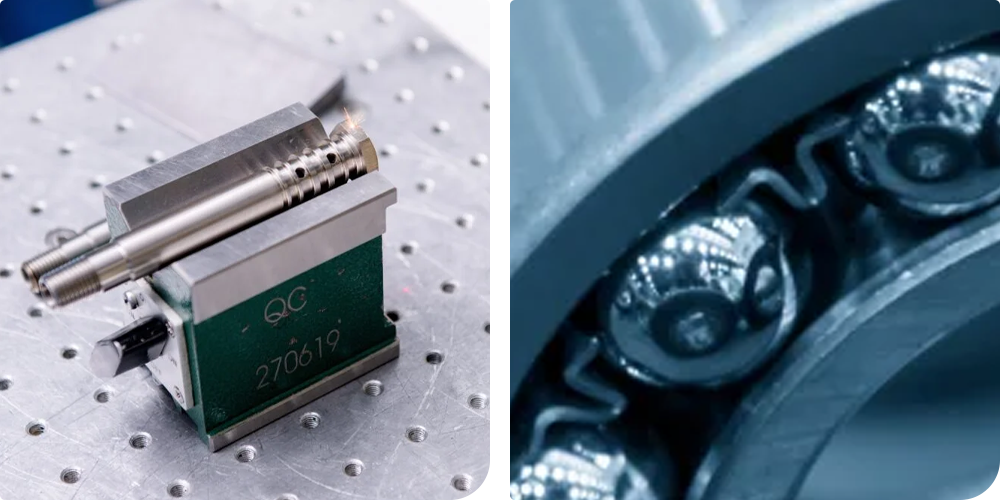
This is a laser surface treatment of the texturing type that can be used to create effects or give new properties to all types of materials depending on the desired function.
Accueil Blog Industrial marking on metal parts: cleaning process

The problem?

What is the approach for conducting a cleaning process study in the context of industrial marking?

Industrial marking is an essential practice in many sectors, including aerospace, medical devices, automotive, and more. It is a method used to inscribe information on products or components, such as serial numbers, barcodes, manufacturing dates, logos, or any other specific instructions. These markings are crucial for traceability, quality management, regulatory compliance, and product safety.
Summary

01
Background to the cleaning process study
02
Measurement of nickel content and comparative study
03
Additional analyses by ICP-AES
04
Additional analyses using IRTF
05
Conclusion of the study
01

Background to the cleaning process study

First, FILAB's client performs surface treatment on nickel joints. This involves laser texturing, a surface treatment that creates effects or gives new properties to all types of materials depending on the desired function.

This laser marking leaves behind a small amount of dust.

The study will focus on measuring the amount of nickel dust deposited on the parts after marking and comparing three post-marking cleaning processes.

Three samples are analyzed for the comparative study:

  • untreated (without cleaning),
  • cleaning with solvent and ultrasound,
  • cleaning with a brush and blowing.
02

Measurement of nickel content and comparative study

SEM-EDX Analysis (Scanning Electron Microscope)

Scanning electron microscopy (SEM-EDX) technology is a well-known and recognized technique. It produces very high-resolution images of a sample's surface (magnification of around *1,000,000). It is used to study the chemical composition and morphology of solid materials.
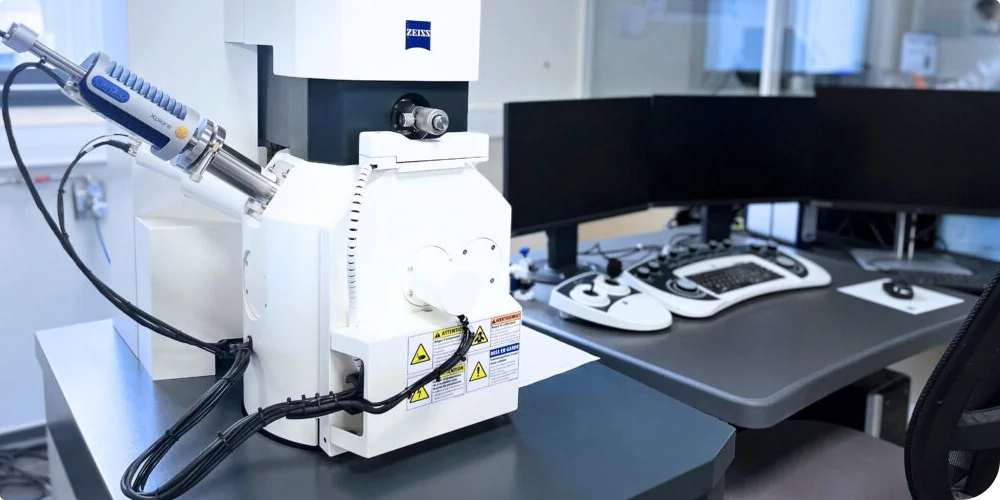
In this specific context, SEM-EDX analysis of nickel (Ni) joints reveals:

  • The presence of particles around each hole on all textured parts.
  • The surfaces of the holes, on the other hand, do not show any particles, only cavities resulting from laser marking.
  • The quantity of particles appears to be lower on cleaned parts (brushing + blowing) than on raw parts.
  • However, it is difficult to determine whether the quantity of particles is lower on parts degreased by ultrasound.
03

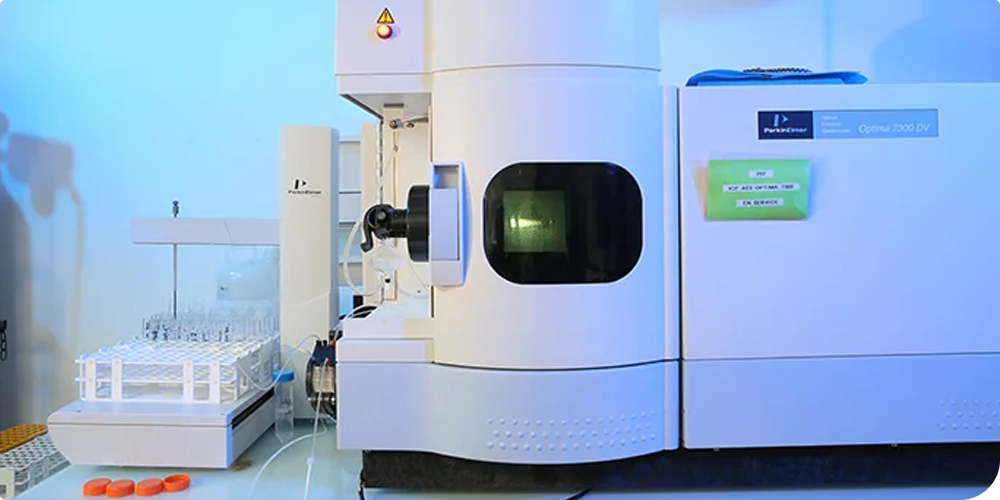
Additional analyses by ICP-AES

ICP-AES is a cutting-edge technique that uses inductively coupled plasma to excite atoms and ions in a sample, producing light emissions specific to each element. Thanks to its sensitivity and ability to analyze multiple elements simultaneously, ICP-AES is an essential tool for accurate and rapid characterization of materials.

ICP-AES analysis highlights that:

  • The nickel content obtained is lower for brushed and degreased products than for those analyzed without cleaning.
  • The treatments therefore do have the effect of reducing the nickel content and thus the quantity of particles present on the parts.
  • Cleaning by brushing and blowing appears to be slightly more effective than degreasing with ultrasound.
04

Additional analyses using IRTF

Fourier Transform Infrared Spectroscopy (FTIR) is an analytical technique used to obtain the absorption spectrum of a solid, liquid, or gaseous sample. FTIR chemical analyses are non-destructive and measure the amount of light absorbed by a sample. This is done based on the wavelengths emitted by an infrared beam.

In this study, FTIR was used to detect the presence of polylactate and cellulose particles (related to the brushing of the parts).

05

Conclusion of the study

The analyses carried out by FILAB shed light on the interaction between unwanted particles and the surfaces of treated parts, highlighting the crucial importance of carefully selecting the appropriate cleaning processes.

For FILAB's client, it is essential to adopt a methodical approach when choosing these methods, taking into account not only their effectiveness in removing contaminants but also their ability to preserve the structural and functional integrity of the parts.

Thus, after analyses and expert assessments have been carried out, the client is in a position to make the best decision according to their needs.

Need help? Contact our team

Other studies that may be of interest to you

Corrosion rate: the strategic choice of materials

One of our customers wanted to test the corrosion resistance of their heat exchangers. Find out more

Comparative study of two joints Find out more

Étude comparative de deux joints Find out more

Services associated with the case study

Laboratory analysis of a joint

Laboratory analysis and expertise of surface treatments

Medical Devices

Aeronautics / Aerospace

Automobile

Laboratory specializing in analysis and expertise for industrial companies

More than 140 people
More than 140 people at your service
5200 m² laboratory
5200 m² laboratory + 99% of services are provided in-house
Accredited laboratory
Accredited laboratory COFRAC ISO 17025
+2200 clients
+2200 clients in France and abroad

Contact us

Our services are reserved for professionals.