Case study

Case study: goniometry and comparison of surface tensions

One of our customers wanted to measure the contact angle and surface tension of their materials.
Home • News • Case study: goniometry and comparison of surface tensions

The problem?

Faced with an issue related to the varying behaviour of its liquid product depending on different supplier formulations, one of our pharmaceutical clients wanted to measure the contact angle and surface tension of its samples deposited on three different substrates.

The client called on FILAB to verify that the formulation, in this case eye drops, exhibited optimal wetting behaviour on several types of surfaces.


Summary

01
Understanding the wetting behaviour of a drop on a substrate
02
The approach used
03
Conclusion of the study
01

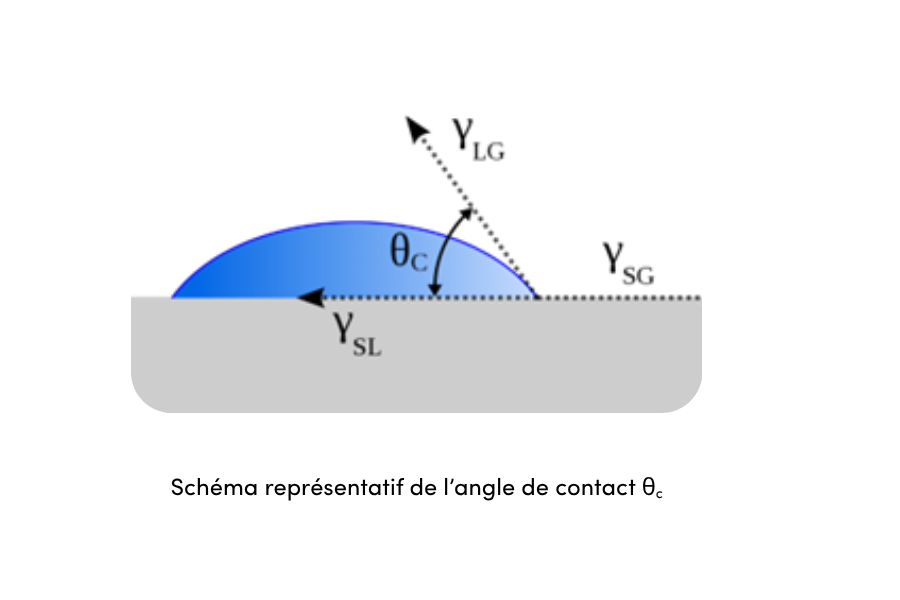
Understanding the wetting behaviour of a drop on a substrate

Objective:

The aim of the study is to measure the contact angle and surface tension of several formulations on three different substrates.

    1. silicone support,
    2. neutral polyethylene support,
    3. polyethylene support with antimicrobial agent.
02

The approach used
Approach :

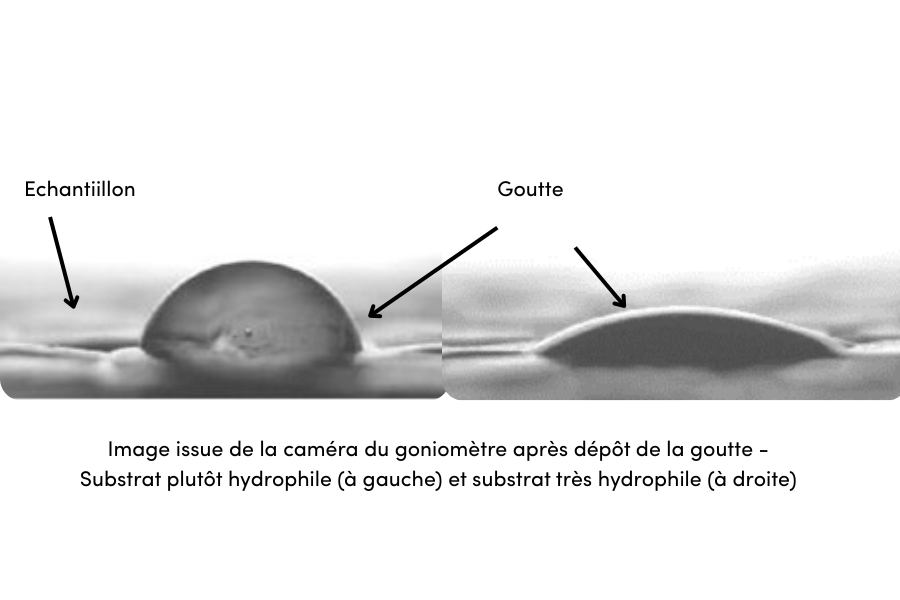
The technique used is goniometry, specifically the sessile drop method. A 4 µL drop of water (the model liquid) is placed on each sample. Measurements are taken a few seconds after placement, once the drop has reached a stable state. Each formulation is tested on the appropriate substrates.

For each formulation, surface tensions and contact angles are measured and compared between the different substrates.

04

Conclusion of the study

According to the analysis report, the nature of the substrate significantly influences the behaviour of the formulations. For the same formulation, the spreading and adhesion properties vary significantly depending on the contact surface.

Conclusion :

This study revealed that surface tensions are generally higher on polyethylene substrates than on silicone substrates.

Observation of the droplets shows that the silicone substrate is more hydrophobic than the polyethylene substrate, since the droplet forms a larger contact angle and lower surface tension on this substrate. This simple observation perfectly illustrates the interaction between this formulation and the tested surfaces.

Need help? Contact our team

Other case studies you may be interested in

Material balance

A material balance is an essential process in materials science, chemistry, physics, and various industries. It involves analyzing and understanding the properties and behavior of materials. Learn more +

Galvanic coupling: securing a naval assembly

One of our customers encountered sealing issues during the final validation tests of their product. Learn more +

ATG kinetics: simulation of PVC part aging

One of our customers wants to evaluate the thermal behavior of 3D-printed parts. Learn more +

Services related to the case study

Metal analysis in black mass

Laboratory specializing in analysis and expertise for industrial companies

+140 employees
+140 employees here to listen to you
5,200 m² laboratory
5,200 m² laboratory +99% of services carried out in-house
Accredited laboratory
Accredited laboratory COFRAC ISO 17025
+2,200 clients
+2,200 clients in France and abroad

Contact us

Our services are reserved for professionals.

Frequently asked questions

Why compare a liquid formulation on several substrates?

Wetting behaviour depends on the interaction between the formulation and the surface it contacts. FILAB compared several eye-drop formulations on three substrates to examine these differences. A measurement performed on a single substrate does not necessarily describe how the same formulation will behave on another material.

Which substrates were compared in the wettability study presented by FILAB?

The study examined a silicone substrate, a neutral polyethylene, and a polyethylene containing a microbial agent. The comparison aimed to determine how the nature of these surfaces influenced the behavior of the formulations. These three substrates define the scope of the case studied and do not represent all materials that may be used with an eye drop.

What can a sessile drop contact angle measurement be used to compare?

The sessile drop method examines the shape of a drop deposited on a substrate and makes it possible to compare its contact angle under defined conditions. FILAB used it to characterize differences in wetting between the surfaces tested. Interpretation must take into account the liquid, the surface, and the measurement protocol.

Why control the volume and observation time of a droplet during measurements?

Comparable deposition and observation conditions make it possible to interpret differences between samples consistently. The protocol described by FILAB specifically calls for a measurement a few seconds after deposition, once the droplet has stabilized. The choice of reference liquid and test conditions must also be specified to understand the results.

What did the comparison of substrates show in this goniometry study?

The study highlighted the influence of substrate type on the behavior of the formulations. The observations notably reported a higher contact angle on silicone than on polyethylene under the conditions tested. These results document the liquid/substrate interaction; they do not constitute an assessment of the eye drops’ therapeutic efficacy.