


"I used Filab for a chemical analysis. Very satisfied with the service. Responsive team, deadlines met, and a clear analysis report. I recommend them."
Granulometric laboratory analysis

More than 140 people
at your service

5200 m² laboratory
+ 99% of services are provided in-house

Accredited laboratory
COFRAC ISO 17025
Home • Analytical services • Our analysis services • Granulometric laboratory analysis
Specialists in materials characterization, FILAB carries out your particle size analysis in accordance with ISO 13320 and B822 to help you control the reactivity and compliance of your powders and particles.
Using laser diffraction and sieving, our experts support you, whatever your industry, to validate your raw materials and resolve your failures.
Your needs: carry out a particle size analysis in the laboratory
Particle size analysis is used to measure and characterize particles in terms of size, shape, surface area, porosity and other physical characteristics.
Control the physical properties of your products: flowability, reactivity, texture, solubility, stability, filtration performance…
Optimize your industrial processes: grinding, mixing, dispersion, coating, separation, drying…
Anticipate or solve quality issues: presence of agglomerates, poor dispersion, overly broad distribution…
materials
Materials and particles subject to particle size analysis
Metallic and mineral powder
Organic powder
Particles
Grains/sand
Particle size analysis, or granulometric analysis, can be carried out on different materials: powders, grains, divided solids, particles… This materials and particle analysis technique is frequently used in the food industry, fine chemicals, additive manufacturing, and the pharmaceutical industry.
Our particle size analysis services
In the laboratory, there are three possible types of particle size analysis: laser particle size analysis, sieve particle size analysis and sedimentation particle size analysis.
To measure the particle size of your samples, an analytical method is chosen according to the nature of the material, the target size range and the standards to be met:
analysis
Laboratory particle size analysis techniques
Each particle size analysis technique has its advantages and limitations, but all are useful for characterizing particle size and therefore their behavior in different environments.
Particle size analysis by sieving
The sieve particle size analysis uses sieves of different sizes. This system makes it possible to separate particles according to their size. Different sieves fit together to create a gradation from top to bottom. There are also sieve shakers that automate the agitation, separation and determination of a sample's particle sizes. The sieving technique used depends on various parameters, such as the particle size to be determined, the sieving mode (wet or dry), and static electrical factors. In sieve analysis, three main types of sieve shakers are distinguished: mechanical, vibratory and sonic.
Laser particle size analysis
Laser particle size analysis is a cutting-edge technique that uses a laser beam to measure the size of individual particles in a sample. This analysis can be carried out in liquid or wet form, or in dry form.
Particle size analysis by sedimentation
And finally, particle size analysis by sedimentation is based on the principle of gravity and measures the sedimentation rate of particles in a liquid.
Analytical objectives of particle size analysis
The goal is to quantify the particle size distribution to ensure industrial performance.
This analysis helps control key indicators (D10, D50, D90) in order to optimize product homogeneity, solubility and flowability.
It therefore ensures compliance with standards and anticipates the rheological behavior of your materials.
Why use a laboratory for particle size analysis?
- Multisector expertise : dedicated support for the Pharmaceutical, Cosmetics, Aerospace and Nuclear industries.
- Strict compliance : results provided according to the most stringent standards and guidelines.
- Additional analysis : the option to combine particle size analysis with shape analysis (Morphology), specific surface area measurement (BET) or observation by SEM-EDX.

Nuclear

Aerospace

Space

Medical

Pharmaceutical

Chemicals

Cosmetics

Automotive

Electronics

Defense/Security

Food industry
Our particle size analysis equipment
FILAB has state-of-the-art analytical equipment for your particle size analysis:
Latest-generation laser particle size analyzers
Electron microscopes for observing particle morphology
Sieve columns in accordance with ASTM and ISO standards
Discover all Customer qualifications

AIRBUS
Qualification
Applications of particle size analysis
Our services are designed for many industrial sectors:
Pharmaceutical : controlling powder size for consistent bioavailability
Pharmaceutical : controlling powder size for consistent bioavailability
Cosmetics : texture and stability of powders, creams, gels…
Cosmetics : texture and stability of powders, creams, gels…
Construction materials : sand, cement, concrete
Construction materials : sand, cement, concrete
Metallurgy and additive manufacturing: quality of metal powders for laser melting
Metallurgy and additive manufacturing: quality of metal powders for laser melting
Fine chemicals: particle reactivity, blend formulation
Fine chemicals: particle reactivity, blend formulation
Sector-specific application example: particle size analysis in pharmaceuticals
Particle size analysis techniques are useful in the pharmaceutical industry for characterizing medicines, especially in the form of powders or granules, and thus ensuring their quality. By controlling particle size, particle size analysis helps ensure a homogeneous distribution of active ingredients, which guarantees optimal drug efficacy. Particle size parameters are key factors in product quality and performance. Particle size analysis techniques enable manufacturers to better understand the physicochemical properties of their products, produce more stable formulations, and maximize the pharmacokinetics of medicines.
Would you like to have the particle size of your materials analyzed? Contact FILAB to benefit from tailored support and reliable analysis carried out in our laboratory in Dijon, France.
Learn more
What is the minimum quantity i need to carry out a particle size analysis?
For laser particle size analysis, a minimum quantity of 5 g will be required.
What parameters are studied during a particle size analysis?
The particle size distribution and the d10, d50 and d90 parameters will be determined. The measurement range is estimated from 0.1 to 2000 µm. It can be carried out using either a wet or dry method.
What is the difference between dry and wet methods?
The dry method makes it possible to characterize powders without destroying the initial agglomeration.
The wet method is used to disperse particles. The analysis will be carried out on particles in suspension. Here, particle size can be described as primary or aggregated.
The wet method is used to disperse particles. The analysis will be carried out on particles in suspension. Here, particle size can be described as primary or aggregated.
Expertise, preuves et traçabilitéMise à jour : juin 2026
Pourquoi faire confiance au laboratoire FILAB pour votre analyse granulométrique ?
Confier votre analyse granulométrique au laboratoire FILAB, c’est s’appuyer sur une expertise technique, un cadre qualité documenté et une lecture experte des résultats pour des décisions industrielles, qualité ou réglementaire.
Accréditations reconnues
- ISO 17025
- Nadcap MTL
- SAFRAN
- FRAMATOME
- EDF
- DASSAULT AVIATION
- Aubert & Duval
- Airbus Defence & Space
- Liebherr
- FDA registered
Un expert à votre contact
Responsable expertise
Clément Boenard accompagne les projets d’analyse granulométrique.
Recognized accreditations
- ISO 17025
- Nadcap MTL
- SAFRAN
- FRAMATOME
- EDF
- DASSAULT AVIATION
- Aubert & Duval
- Airbus Defence & Space
- Liebherr
- FDA registered
An expert at your side
Expertise Manager
Clément Boenard supports particle size analysis projects.
Notre démarche en 4 étapes :
- Échange sur votre problématique et vos contraintes.
- Proposition d’un protocole analytique adapté et d’un devis.
- Réalisation des analyses et relecture experte des résultats.
- Livraison d’un rapport détaillé, exploitable et traçable.
Avis vérifiés
Les avis de nos clients
N
Nicolas a.
12 May 2026
"Very responsive laboratory, with excellent analysis quality and deadlines met. Communication is smooth, the technical explanations are clear, and the team knows how to adapt to specific needs. I recommend them for their professionalism and reliability!"
5/5
C
Charlotte t.
8 May 2026
"Clear and precise deliverable, delivered on time. I recommend them."
5/5
Transparence & contactDernière vérification : juin 2026
Où nous trouver et comment nous contacter
FILAB est un laboratoire physique situé en France, indépendant et accrédité. Toutes les coordonnées ci-dessous permettent de vérifier notre identité et de lancer votre demande.
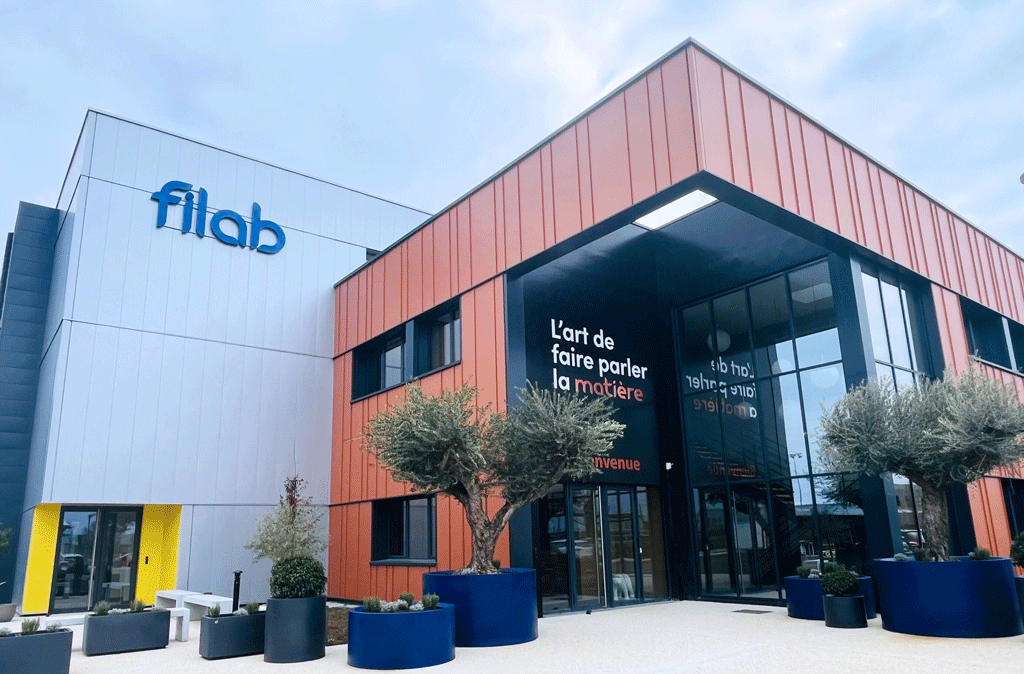
Laboratoire FILAB
Ecoparc Dijon Bourgogne
80 rue Jean-Louis Auguste Petitjean
21850 Saint-Apollinaire, France
Tél. +33 (0)3 80 52 32 05
Our FAQ
What is particle size analysis?
It is a measurement method used to determine the distribution of particle sizes in a material.
What is particle size analysis?
Particle size analysis consists of characterizing the size and distribution of particles in a sample, whether solid or liquid.
What is the purpose of particle size analysis?
The goal is to control a product’s physical properties and optimize its manufacturing, quality, and performance.
What is the purpose of a particle size distribution test?
A particle size distribution test makes it possible to determine the distribution of particle sizes in a powder.
It therefore ensures material quality and optimizes performance in additive manufacturing, pharmaceuticals, or metallurgy. Good control of particle size improves flowability, compaction, and powder reactivity, thereby ensuring better homogeneity and greater efficiency in the final application.
Why perform particle size analysis?
Particle size analysis makes it possible to monitor the quality and performance of powders used in various industrial sectors. Particle size directly influences the flowability, compaction, dissolution, and reactivity of materials.
In additive manufacturing and metallurgy, it ensures proper powder fusion and an optimal surface finish of parts. In the pharmaceutical industry, it is crucial for ensuring the uniform bioavailability of active ingredients. In the food industry, it affects the texture and solubility of ingredients.
This analysis also makes it possible to meet regulatory standards, optimize production processes, and ensure repeatable powder performance.
What are the risks associated with poor particle size distribution?
An unsuitable particle size distribution can cause flow problems, density variations, or compaction defects. This can affect powder performance, particularly in pharmaceuticals or metallurgy.
What does D90 particle size mean?
d90 corresponds to the size below which 90% of the particles in the analyzed sample are found.
What is fine particle size?
A low particle size means that the material’s particles are very fine, often at the micrometric or nanometric scale.
What parameters are measured during particle size analysis?
The main parameters are d10, d50 and d90 diameters, which represent the sizes below which 10%, 50% and 90% of the particles are found, respectively. Distribution curves may also be provided.
How is particle size measured?
Particle size is measured by laser diffraction, sieving, sedimentation depending on the required precision and application.
Comparison of different particle size analysis techniques and other technical methods according to industrial needs:
| Technique | Industries | Benefits |
| Sieving | Construction, ceramics | Simple, ISO/ASTM standard, suitable for granular materials. |
| Laser diffraction | Pharmaceutical, cosmetics | High precision, fast, detailed powder analysis. |
| Sedimentation | Metallurgy, chemistry | Ideal for suspended particles, precise size assessment. |
| Electron microscopy | Advanced materials | Ultrafine analysis of nanoparticles, very high resolution. |
Each technique is suited to specific needs depending on the size and nature of the particles to be analyzed.
What regulations apply to particle size analysis in the laboratory?
Laboratory particle size analysis can be carried out in accordance with established standards and regulations. Two of the main international standards include ISO 13320 and ASTM B822. ISO 13320 sets out guidelines for particle size analysis by laser diffraction, while ASTM B822 applies to dry sieve particle size analysis. By following these standards, laboratories can ensure that their results are consistent and reliable.
How does particle size affect product quality across different industries?
Particle size distribution affects product quality by influencing the physical and functional properties of materials in various industries:
- Pharmaceutical : Affects the dissolution and bioavailability of medicines.
- Cosmetics : Influences the texture and application of powders and creams.
- Ceramics : Plays a role in the mechanical strength and finish of parts.
- Construction : The particle size distribution of sands and gravel determines the strength of concrete.
- Metallurgy : Affects the melting and solidification of metal powders for additive manufacturing.
Precise particle size distribution ensures optimal performance and consistent quality.
What adaptations are made to the analysis depending on specific materials?
FILAB laboratory adapts particle size analysis according to the materials by choosing the most suitable method for each type of particle. For example, for materials such as sand and gravel, sieving is used. For fine powders, such as in the pharmaceutical and cosmetics sectors, laser diffraction is preferred, offering greater precision. Finally, sedimentation is used to analyze suspended particles, such as those found in slurries or liquid suspensions, with adjustments based on the density and viscosity of the materials.
What equipment is used for particle size analysis?
Particle size analysis relies on different equipment depending on the method used. Laser diffraction uses a laser particle size analyzer that sends a beam of light onto the particles and measures diffraction. Sieving requires a series of standardized sieves and a mechanical shaker to sort particles by size. Finally, scanning electron microscopy (SEM) makes it possible to observe particle morphology and size in detail.
How does particle size influence porosity and permeability?
The particle size distribution plays a key role in a material’s porosity and permeability by influencing the arrangement of particles.
Large, uniform particles create greater porosity with large interstitial voids, promoting high permeability. Conversely, fine or variably sized particles reduce these spaces, lowering porosity and limiting fluid flow.
In metallurgy, proper particle size distribution ensures controlled porosity in sintered powders. In the pharmaceutical sector, it affects tablet dissolution. In civil engineering, it impacts the filtration and strength of concrete and ceramics.
Why control particle size in HPL (high-pressure laminate)?
In high-pressure laminate (HPL), controlling the particle size of mineral fillers (silica, alumina, calcium carbonate) is essential to ensure the quality, strength and homogeneity of the material.
Controlled particle size helps optimize compaction, thereby reducing surface defects and improving the laminate’s mechanical strength. It also influences porosity, affecting layer adhesion and the durability of the final product.
What is the benefit of granulation?
Granulation makes it possible to homogenize particle size to improve a product’s stability, texture or reactivity.
Can nanoparticle size be analyzed?
Yes, using suitable methods such as dynamic light scattering (DLS) or SEM observation. Contact us to define the most suitable method.
The filab advantages

A highly qualified team

Responsiveness in responding to and processing requests

A COFRAC ISO 17025 accredited laboratory
(Staves available on www.cofrac.com - Accreditation number: 1-1793)

A complete analytical facility of 5,200m²

Tailor-made support

Video debriefing available with the expert
Contact us
To find out more about these services, don't hesitate
to contact our team.
to contact our team.


Ask for your quote