


"I used Filab for a chemical analysis. Very satisfied with the service. Responsive team, deadlines met, and a clear analysis report. I recommend them."

More than 140 people
at your service

5200 m² laboratory
+ 99% of services are provided in-house

Accredited laboratory
COFRAC ISO 17025

CIR
Research tax credit
Home • Our technical resources • X-ray Fluorescence Analysis Laboratory (XRF)
Would you like to carry out an X-ray fluorescence (XRF) analysis to determine the chemical composition of your materials?
What is x-ray fluorescence or XRF?
X-ray fluorescence spectrometry, also known as XRF, or X-ray fluorescence, is a non-destructive analytical technique that uses X-rays to enable the quantitative and qualitative determination of the elemental composition of a sample. X-ray fluorescence is also used to determine the thickness and composition of layers and coatings.
Elemental analysis by x-ray fluorescence
Determining the elemental composition by XRF analysis makes it possible to identify and quantify the elements present in a sample by bombarding it with X-rays. The elements emit characteristic photons that are detected and analyzed to produce an accurate spectrum. This fast, non-destructive technique is suitable for a wide range of materials, providing reliable and detailed analysis. It is particularly useful in the field of metallurgy.
Elemental analysis by X-ray fluorescence is a fast, non-destructive technique suitable for a wide range of materials, providing reliable and detailed analysis. It is particularly useful in the field of metallurgy.
Material analysis by X-ray fluorescence analysis
XRF instruments are capable of analyzing a wide variety of materials, such as metals, ceramics, glass, polymers, paints and pigments, powders, and liquids. This method is widely used in the metallurgical industry and materials characterization. By using X-rays, this method measures the amount of elements present in the sample: from uranium to potassium, including calcium and iron.
Metal analysis by x-ray fluorescence
Metal analysis by X-ray fluorescence (XRF) is a non-destructive technique that makes it possible to determine the elemental composition of metallic materials. By using an X-ray beam to excite the atoms present in a sample, this method identifies and quantifies the constituent elements, even at very low concentrations. FILAB laboratory is equipped with advanced X-ray fluorescence technologies, offering accurate and rapid analysis for a wide range of metals, including complex alloys.
Deposit analysis by X-ray fluorescence spectrometry
X-ray fluorescence spectrometry is also a preferred technique for deposit analysis on various substrates. Whether it involves metallic coatings, oxides, or other types of residues or deposits, this method makes it possible to measure the thickness and elemental composition of deposits with precision. Thanks to the high sensitivity of FILAB’s equipment, it is possible to detect layers from a few nanometers to several micrometers, thus providing a complete characterization of deposits, essential for industrial applications such as electronics, aerospace, and surface treatment.
Why carry out an X-ray fluorescence (XRF) analysis?
X-ray fluorescence analysis (XRF) is an analytical technique used in laboratories for the rapid and accurate determination of elemental composition.
Thanks to its non-destructive approach, X-ray fluorescence may be necessary for various industrial needs such as:
- Material control and alloy identification by X-ray fluorescence
- Elemental analysis of sample composition
- Detection of metal traces
- Thickness measurement
FILAB: laboratory for chemical composition analysis by X-ray fluorescence (XRF)
Our technical resources: X-ray fluorescence analyzer
The X-ray fluorescence analyzer is a technical means of determining the chemical composition of materials. These instruments use an X-ray beam to excite the atoms in a sample, causing them to fluoresce. The resulting fluorescence spectra reveal the elements present in the sample and their concentrations, enabling accurate and rapid analysis.
This technique can also be complemented by ICP spectrometry (AES or MS).
Our chemical composition analysis services
The FILAB laboratory offers a full range of analysis services for the characterization of your chemical compositions:
X-ray fluorescence analysis in accordance with REACH regulations
X-ray fluorescence analysis (XRF) helps assess compliance with REACH regulations (Registration, Evaluation, Authorisation and Restriction of Chemicals) by enabling the rapid and accurate identification of chemical substances in materials.
This technique is used to detect the presence of substances of very high concern (SVHC) and other regulated chemicals in finished products and raw materials. Thanks to X-ray fluorescence analysis, industries can ensure their products comply with REACH requirements, avoid prohibited substances, and guarantee consumer safety while minimizing environmental risks.
Expertise, preuves et traçabilitéMise à jour : juin 2026
Pourquoi faire confiance au laboratoire FILAB pour votre analyse par Fluorescence X (XRF) ?
Confier votre analyse par Fluorescence X (XRF) au laboratoire FILAB, c’est s’appuyer sur une expertise technique, un cadre qualité documenté et une lecture experte des résultats pour des décisions industrielles, qualité ou réglementaire.
Accréditations reconnues
- ISO 17025
- Nadcap MTL
- SAFRAN
- FRAMATOME
- EDF
- DASSAULT AVIATION
- Aubert & Duval
- Airbus Defence & Space
- Liebherr
- FDA registered
Un expert à votre contact
Responsable expertise
Clément Boenard accompagne les projets d’analyse par Fluorescence X (XRF).
Recognized accreditations
- ISO 17025
- Nadcap MTL
- SAFRAN
- FRAMATOME
- EDF
- DASSAULT AVIATION
- Aubert & Duval
- Airbus Defence & Space
- Liebherr
- FDA registered
An expert at your side
Expertise Manager
Clément Boenard supports X-ray Fluorescence (XRF) analysis projects.
Notre démarche en 4 étapes :
- Échange sur votre problématique et vos contraintes.
- Proposition d’un protocole analytique adapté et d’un devis.
- Réalisation des analyses et relecture experte des résultats.
- Livraison d’un rapport détaillé, exploitable et traçable.
Avis vérifiés
Les avis de nos clients
N
Nicolas a.
12 May 2026
"Very responsive laboratory, with excellent analysis quality and deadlines met. Communication is smooth, the technical explanations are clear, and the team knows how to adapt to specific needs. I recommend them for their professionalism and reliability!"
5/5
C
Charlotte t.
8 May 2026
"Clear and precise deliverable, delivered on time. I recommend them."
5/5
Transparence & contactDernière vérification : juin 2026
Où nous trouver et comment nous contacter
FILAB est un laboratoire physique situé en France, indépendant et accrédité. Toutes les coordonnées ci-dessous permettent de vérifier notre identité et de lancer votre demande.
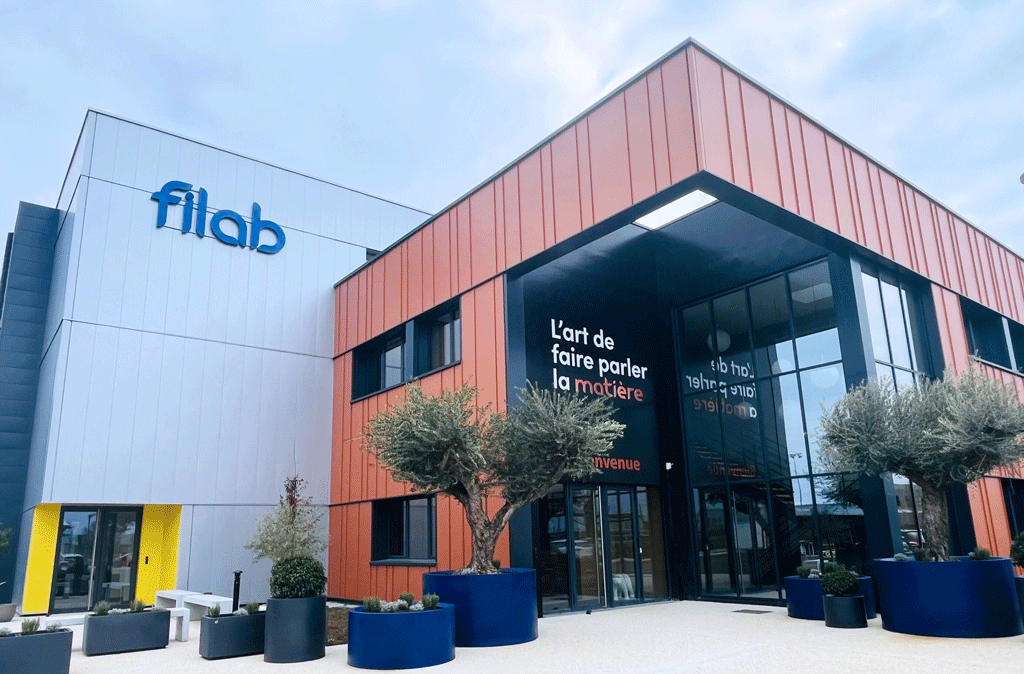
Laboratoire FILAB
Ecoparc Dijon Bourgogne
80 rue Jean-Louis Auguste Petitjean
21850 Saint-Apollinaire, France
Tél. +33 (0)3 80 52 32 05
FAQ
What is the elemental composition of a sample?
The elemental composition of a sample refers to the quantity and proportion of each chemical element present in the sample. This information is essential for many industries, including pharmaceuticals, food processing, and metallurgy. This analysis can be carried out using various technologies, such as spectroscopy or XRF. Knowing a sample's elemental composition can help determine its quality and origin, and even identify contaminants or purity levels. This type of analysis can also be used to validate regulations and quality standards.
The differences between wavelength dispersive (WDXRF) and energy dispersive (EDXRF) systems
The wavelength-dispersive (WDXRF) and energy-dispersive (EDXRF) systems are two analytical techniques used in X-ray fluorescence.
Choosing between the two will depend on your needs, the elements to be analyzed, and the desired resolution:
- WDXRF is a method that uses a single crystal to focus different elements
- EDXRF uses a detector that simultaneously measures the intensity of all elements
- WDXRF offers higher spectral resolution
- EDXRF is faster and more versatile
Which should you choose: X-ray fluorescence analysis or ICP-MS analysis?
The choice between these two techniques depends on the specific needs of the chemical analysis and the advantages and limitations of each method. The FILAB laboratory can advise you.
X-ray fluorescence analysis is suited to elements with a high atomic number, whereas ICP-MS spectrometry is more appropriate for elements with a lower atomic number.
X-ray fluorescence analysis is ideal for solid samples because it measures the elements present on the surface. ICP-MS spectrometry, on the other hand, is better suited to liquid samples because it measures the concentration of elements in the solution itself.
What are the principles of X-ray fluorescence?
X-ray fluorescence is an analytical technique in which a sample is bombarded with X-rays, causing the emission of element-specific photons. These emitted photons are then detected and analyzed to identify and quantify the elements present in the sample. The technique is non-destructive and enables accurate analysis of elemental compositions.
What are the advantages of XRF analysis?
The advantages of X-ray fluorescence analysis are its speed and non-destructive nature. Samples do not need to be damaged or altered to be analyzed. Qualitative and quantitative determination also improves efficiency.
X-ray fluorescence analysis is fast and accurate, providing real-time results for elemental composition. In addition, it can detect a wide range of elements, from sodium to uranium, with low detection limits. Finally, XRF is versatile and suitable for various types of samples, including solids, liquids, and powders.
What are the limitations of X-ray fluorescence?
X-ray fluorescence (XRF) has certain limitations, such as difficulty detecting light elements (such as lithium and beryllium) due to their weak X-ray emission. The analysis can be influenced by the sample matrix, requiring complex corrections for accurate results. The limited penetration depth of X-rays restricts the analysis to the sample surface, which may not be representative of the whole. In addition, XRF equipment can be expensive, requiring an initial investment and regular maintenance.
Some examples of X-ray fluorescence application areas
X-ray fluorescence (XRF) is used in various industrial sectors to solve specific problems:
> Metal and alloy production: XRF is used to analyze the chemical composition of metals and alloys to ensure they meet technical specifications and to guarantee the quality of finished products.
> Cement manufacturing: XRF helps control the quality of raw materials and finished products by analyzing their elemental composition, thereby ensuring that the cement produced meets construction industry standards.
> Oil industry: XRF is used to analyze the composition of catalysts and petroleum products, optimizing refining processes and ensuring the quality of derived products.
> Material recycling: In the recycling of metals and plastics, XRF makes it possible to identify and sort materials according to their composition, improving recycling efficiency and the purity of recovered materials.
What types of samples can be analyzed by X-ray fluorescence?
X-ray fluorescence is extremely versatile and can be used to analyze a wide variety of solid samples, such as metals, alloys, minerals, ceramics, glass, and even certain biological materials. It is also effective for analyzing deposits or coatings on various substrates. The sample can be in powder, pellet, or bulk form, and extensive preparation is generally not required, saving time and preserving the integrity of the material.
Can X-ray fluorescence analysis be applied to all types of industrial materials?
X-ray fluorescence analysis (XRF) is extremely versatile and can be applied to a wide range of industrial materials, including metals, alloys, minerals, ceramics, polymers, and even certain organic materials. Before proceeding with the analysis, we recommend discussing the nature of your samples with our experts to determine whether XRF is the best method for your specific needs.
What is the minimum sample size required for X-ray fluorescence analysis?
One of the advantages of X-ray fluorescence analysis is its ability to analyze small samples. In general, the minimum sample size required depends on the type of spectrometer used, but samples measuring just a few millimeters can often be analyzed effectively. However, to ensure representativeness and optimal result accuracy, it is advisable to provide a sample large enough to cover the surface of the X-ray beam, which may vary depending on the equipment. If you have limited-size samples, our teams can advise you on the best approach to take.
Are the results obtained by X-ray fluorescence sufficiently accurate for industrial quality control?
X-ray fluorescence is widely used for quality control in many industrial sectors because of its accuracy and reproducibility. The technique makes it possible to detect and quantify elements at very low concentration levels, which is essential for ensuring that materials comply with standards and specifications. In addition, XRF can analyze multiple elements simultaneously, making it an efficient method for controlling the chemical composition of your products. For specific applications where very strict tolerances are required, custom calibrations can be performed to further improve measurement accuracy.
The filab advantages

A highly qualified team

Responsiveness in responding to and processing requests

A COFRAC ISO 17025 accredited laboratory
(Staves available on www.cofrac.com - Accreditation number: 1-1793)

A complete analytical facility of 5,200m²

Tailor-made support

Video debriefing available with the expert


Ask for your quote