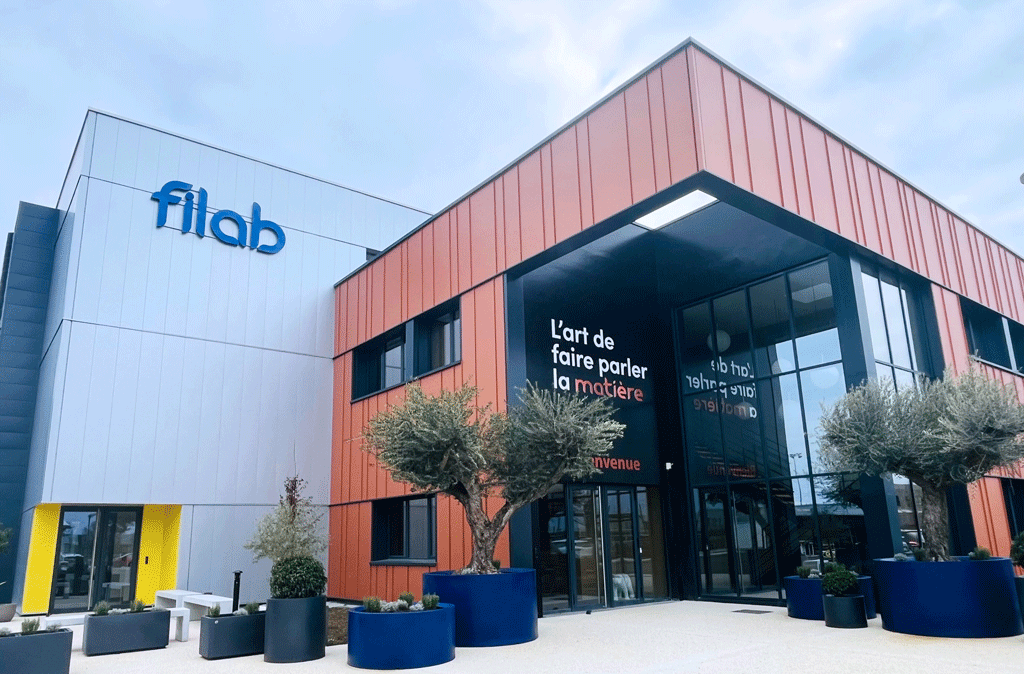
Deformulation, study of the chemical composition of formulas or materials
What is deformulation (reverse engineering)?
Deformulation, or “reverse engineering,” of a commercial product, often made up of a complex mixture, consists in determining, through various chemical analyses, the nature and quantities of the raw materials present in the formulation.
This chemical composition analysis can be applied to different types of products, formulas, and materials: paints, plastics (polymers), composites, metals and metal alloys, varnishes…
In what context are industries required to verify the chemical composition of products or materials?
Our services
The de-formulation of materials makes it possible to determine the composition of materials, thereby facilitating the improvement of existing materials and the development of new products. This analysis is essential in industries such as aerospace and automotive, where precise knowledge of materials contributes to performance and safety.
The de-formulation of adhesives helps to understand the chemical composition and adhesion properties of adhesives used in various industrial applications. This analysis is common in sectors such as construction and electronics, where optimal adhesion is necessary to ensure the durability and reliability of assemblies.
The de-formulation of mixtures involves analyzing complex formulations to identify and quantify the components. This technique is particularly useful in industries where compliance with safety standards and product innovation are priorities.
The de-formulation of polymers makes it possible to analyze polymer materials in order to reveal their structure and additives. This knowledge is essential in the plastics industry to develop products that are stronger, lighter, and more environmentally friendly.
By de-formulating coatings, laboratories can discover the resins, plasticizers, and other components used. This type of analysis supports industries by ensuring quality and durability, particularly for surface finishes.
The de-formulation of composite materials helps identify the matrices and reinforcements used, which is essential for sectors requiring high-performance materials, as well as when lightness and strength are key characteristics.
This reverse-engineering analysis enables companies to understand competitors' product formulations, offering an opportunity to optimize their own products or develop competitive alternatives. It is particularly valued in highly competitive sectors such as cosmetics and chemicals.
The de-formulation of active ingredients is essential, especially for the pharmaceutical industry, as it makes it possible to understand the composition and mode of action of active substances. This analysis supports your innovation processes and ensures regulatory compliance.
Analyzing pharmaceutical products through de-formulation helps identify excipients and active agents, which is essential to ensure the efficacy and safety of medicines, thereby meeting strict regulatory requirements.
The de-formulation of elastomers details the composition and properties of these flexible materials used by industries where durability and adaptability are essential, such as automotive and gasket manufacturing. This analysis makes it possible to refine formulations to improve characteristics such as elasticity and resistance to extreme environmental conditions.
The de-formulation of silicone makes it possible to identify the components and specific formulations of these versatile materials, which is essential for sectors requiring high performance and biocompatibility, such as medical and electronics. This analysis helps optimize properties such as thermal resistance and flexibility, which are crucial for developing durable and safe products. It therefore supports innovation and continuous improvement in silicone applications.
The de-formulation of rubber reveals the components and additives used in its manufacture, providing valuable insights for improving the quality and performance of rubber products. This analysis is particularly important for the automotive industry, where high-quality tires are essential for safety and durability.
How does polymer de-formulation work?
La déformulation, appliquée aux polymères, consiste à analyser en détail la composition d’un matériau plastique afin d’identifier la nature et la proportion des différentes matières premières qui le constituent. Grâce à des techniques d’analyses chimiques avancées (chromatographie, spectroscopie, etc.), cette approche permet de décortiquer les additifs, charges, stabilisants et résines entrant dans la formulation d’un polymère.
Cette expertise s’adresse à une large gamme de matériaux et d’industries, incluant les plastiques techniques, les composites polymères, mais aussi les peintures, vernis ou autres formulations complexes. L’objectif est de comprendre précisément la structure et les caractéristiques des polymères pour améliorer leur performance, contrôler leur qualité ou développer de nouvelles formulations.
FAQ
De-formulation, also known as "chemical reverse engineering," is the process of breaking down a formula (a finished product) to identify and quantify all of its ingredients or chemical components. The goal is to understand the product's exact composition, including the raw materials used, their proportions, and sometimes even the structure of complex molecules.
Deformulation is useful in many contexts:
Understanding a competitor’s product: identifying the key ingredients and proportions in a competitor’s product can help develop similar or superior products.
Problem solving: if a product has defects or unsatisfactory performance, deformulation can help identify the ingredient or ingredient interaction causing the issue.
Quality control: verifying that suppliers comply with composition specifications for raw materials or finished products.
Improving existing products: identifying opportunities to optimize costs, improve performance, or substitute ingredients.
Regulatory compliance: ensuring that products comply with regulations on composition and labeling.
Research and development: gaining knowledge of existing formulations to innovate and create new products.
Almost any formulated product can be deformulated. This includes, but is not limited to:
Cosmetics: creams, lotions, shampoos, makeup, perfumes.
Pharmaceutical products: tablets, syrups, ointments, vaccines (although more complex).
Polymers and plastics: films, packaging, composites.
Paints and coatings: lacquers, varnishes, inks.
Adhesives and sealants: glues, silicones.
Industrial chemicals: lubricants, cleaners, detergents.
A combination of techniques is generally required, including:
Chromatography:
GC (Gas Chromatography) / GC-MS (Gas Chromatography-Mass Spectrometry): For volatile or semi-volatile compounds.
HPLC (High-Performance Liquid Chromatography) / LC-MS (Liquid Chromatography-Mass Spectrometry): For non-volatile or heat-sensitive compounds.
GPC/SEC (Gel Permeation Chromatography / Size Exclusion Chromatography): For determining the molecular weight of polymers.
Spectroscopy:
FT-IR (Fourier Transform Infrared Spectroscopy): For identifying functional groups and bond types.
NMR (Nuclear Magnetic Resonance): For molecular structure elucidation.
XRF (X-ray Fluorescence Spectrometry) / ICP-OES (Inductively Coupled Plasma Optical Emission Spectrometry): For elemental analysis (metals, minerals).
Microscopy:
SEM (Scanning Electron Microscopy) / EDX (Energy-Dispersive X-ray Spectroscopy): For surface imaging and localized elemental analysis.
Thermal techniques:
TGA (Thermogravimetric Analysis): To determine composition based on mass loss through heating.
DSC (Differential Scanning Calorimetry): For phase transitions and material purity.
Other techniques:
Titrimetry, pH measurement, density measurement, viscometry, etc., for specific physical and chemical properties.
Choose a laboratory that:
Has proven expertise in the type of product you want to deformulate.
Offers a wide range of advanced analytical techniques.
Has a team of qualified experts in analytical chemistry and data interpretation.
Provides strict confidentiality and a rigorous ethical framework.
Delivers clear, detailed, and interpreted reports.
Can offer guidance on the most appropriate analytical strategy for your needs.
Almost all polymer-containing materials can be deformulated, including:
Plastics: packaging films, injection-molded parts, extruded profiles, fibers, etc. (PE, PP, PVC, PET, PS, ABS, PC, PA, PMMA, etc.).
Elastomers/Rubbers: seals, tires, hoses, gloves (NR, SBR, EPDM, NBR, FKM, silicone, etc.).
Composites: fiber-reinforced materials (glass fiber, carbon fiber) with polymer matrices (epoxy, polyester, vinyl ester).
Adhesives and sealants: glues, silicones, polyurethanes.
Paints and coatings: surface coatings, varnishes, inks.
Foams: polyurethane, expanded polystyrene, etc.
Textile fibers: polyester, polyamide, polypropylene, acrylic, etc.
Yes. By identifying the type of polymer, fillers (type, size, surface treatment), plasticizers, and compatibilizers, it is possible to understand why a material has certain mechanical properties. This information can then be used to modify the formulation to improve rigidity, flexibility, impact resistance, durability, etc.
Deformulation is essential for recycling because it makes it possible to precisely identify the types of polymers present in plastic waste. For effective recycling, it is crucial to separate different polymers (for example, PET from PVC) because incompatible blends can degrade the properties of the recycled product. In addition, it can help identify the presence of problematic additives (such as certain flame retardants) that may make a material unsuitable for recycling or require specific treatment.
How did FILAB help one of its clients understand a silicone yellowing phenomenon?
Learn moreTransition Offer: analytical and consulting solution to optimize your environmental impact
FILAB supports manufacturers in their LCA (Life Cycle Assessment) efforts for their products to find environmental optimization solutions thanks to its expertise in chemistry and materials.
- Choose the right materials from the design stage
- Reduce your product’s environmental footprint
- Reduce environmental impact by optimizing the production chain
- Turn waste into resources
to contact our team.