Case Study

Microplastics Detection: Analysis of Industrial Filters for Regulatory Compliance

In a regulatory context focused on microplastics detection, one of our clients wanted to analyze its industrial filters
Home News Microplastics Detection: Analysis of Industrial Filters for Regulatory Compliance

What was the issue?

As part of its regulatory compliance requirements and quality control of its products, our client, a cosmetics specialist, urgently contacted the FILAB laboratory to demonstrate that the PE it uses is not found in its finished products. 

To meet this regulatory and technical challenge, FILAB deployed a proven microplastics detection approach, already validated on many complex matrices in the laboratory. While our methodology is based on rigorous analytical standards, its application is tailored to the client’s real-world needs: here, it takes the form of a custom protocol, optimized for direct analysis on its silicon filters and sized to meet its operational urgency..

Contents

01
The context and the client challenge
02
The technical solution proposed by FILAB
03
Benefits for the client
04
Study Conclusion
01

The context and the client challenge

The client uses molten Polyethylene (PE) in the formulation of certain products. The main challenge is to demonstrate that this polymer remains perfectly integrated into the product and that there is no presence of microplastics (residual solid Polyethylene particles) in the finished product.

They urgently need to analyze several already prepared filtration samples (cut-off thresholds of 1µm and 5µm to validate the absence or presence of PE microparticles.

For the laboratory to carry out this analysis, the client provided us with specific Silicon filters of 10mm in diameter, ready for analysis.

02

The technical solution proposed by FILAB

In response to the urgency and the specificity of the matrices, FILAB has implemented a targeted, step-by-step analytical protocol, ensuring maximum efficiency and cost control.

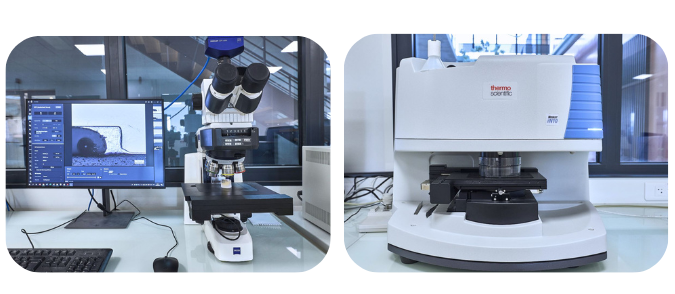
Step 1: Optical screening and molecular characterization (µFTIR)

The first phase of the analysis is based on combining two techniques directly on the surface of the Silicon filters:

1/ Optical microscopy : to locate, count, and map suspicious particles on the filter.

2/ Micro-Fourier Transform Infrared Spectroscopy (µFTIR) : to obtain the chemical signature of particles larger than 50µm (and down to 20-30µm if the matrix allows it). This step makes it possible to reliably distinguish solid polyethylene from any other impurities.

Step 2: Ultra-precise analysis of microparticles (RAMAN spectroscopy)

To ensure complete exhaustiveness and cover the full spectrum of the supplied filters (notably the thresholds at 1µm and 5µm, FILAB systematically carries out a second phase of analysis by RAMAN micro-spectroscopy.

This cutting-edge technology takes over to identify particles of smaller size (less than 20µm), which are inaccessible in conventional infrared analysis.

In addition, it provides the mathematical and physical certainty that no microplastics are present across the entire particle size range required by the regulatory context.
Analyses are carried out on a maximum number of particles per filter. To ensure maximum responsiveness in the face of urgency, investigations are stopped on a sample as soon as the presence of microplastics (polyethylene) is confirmed.

03

Benefits for the client

Faced with a major regulatory and commercial imperative, the collaboration between FILAB and its client shows that a complex technical constraint can be overcome through a tailored, agile approach.

By combining the complementary strengths of Micro-IRTF (for global screening) and Raman spectroscopy (for detecting the tiniest traces), FILAB provided its client with a complete analytical mapping, carried out directly on its silicon filters. The optimized stop rule (Stop on Positives) and the bundled logistics offer made it possible to reconcile operational urgency with cost control.

04

Study Conclusion

Thanks to this rigorous protocol, our client secures the compliance of its products, validates control over its Polyethylene formulation processes, and provides indisputable scientific evidence to support its quality requirements. A concrete illustration of FILAB's expertise: turning an urgent technical issue into a calm, lasting compliance solution.

Need help? Contact our team

Other case studies you may be interested in

Fracture facies study

Inspect a broken metal anchor to identify the cause of the failure. Learn more +

Chromium oxidation

Chromium is a chemical element belonging to the transition metals group. It is a hard, shiny, corrosion-resistant metal used in many fields due to its physical and chemical properties. Chromium has different oxidation states. Learn more +

Optimization of the coating of a can

One of our clients wants expertise and optimization of the coating used on the cans it uses to market its beverages. Learn more +

Analytical and expert testing laboratory specialized for industrial companies

More than 140 people
More than 140 people at your service
5200 m² laboratory
5200 m² laboratory + 99% of services are provided in-house
Accredited laboratory
Accredited laboratory COFRAC ISO 17025
+2200 clients
+2200 clients in France and abroad

Contact Us

Our services are reserved for professionals.