

Using infrared spectroscopy to authenticate luxury goods: combating counterfeiting
How to detect counterfeits using Fourier transform infrared spectroscopy (FTIR)

The use of Fourier transform infrared spectroscopy (FTIR) for the authentication of luxury goods is an innovative and effective method that guarantees the authenticity of high-end items and combats counterfeiting.
This technique is based on analyzing the unique spectral signatures that each material emits when exposed to infrared light.
The principle of FTIR in the authentication of luxury goods
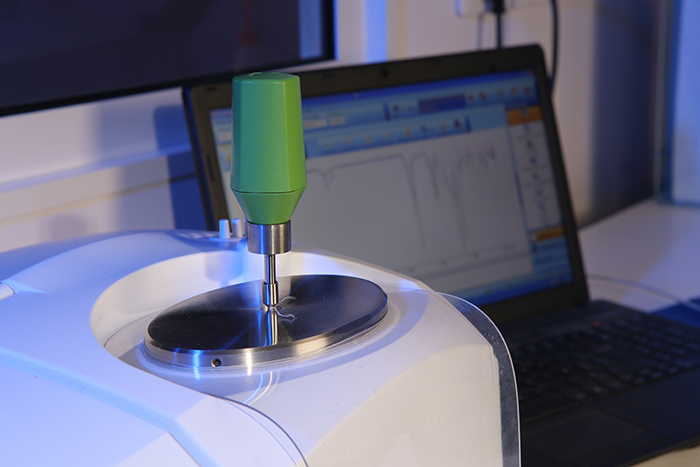
Fourier Transform Infrared Spectroscopy (FTIR) is an analytical technique that provides the absorption spectrum of a solid, liquid, or gaseous sample. FTIR chemical analysis are non-destructive and measure the amount of light absorbed by a sample based on the wavelengths emitted by an infrared beam.
The advantages of FTIR compared to other methods
This technique provides a rapid and non-destructive method for identifying the chemical composition and detecting impurities or contamination in a variety of materials.
This analysis method is non-destructive, requiring no sampling that could damage valuable items.
In addition, this technique can identify subtle differences in the chemical composition of materials, thereby distinguishing authentic products from high-quality counterfeits.
Why authenticate your luxury goods?
Companies often invest heavily in product development and brand image building.
Conducting counterfeit analysis helps protect this investment by detecting and preventing the sale of imitation products that could damage the brand’s reputation and consumer confidence.
This type of analysis can also be useful in disputes related to intellectual property or allegations of counterfeiting. It can also be used to prevent the entry of counterfeit products that could harm the local economy and mislead consumers.
In conclusion: FTIR, a crucial technique for guaranteeing luxury goods
Infrared spectroscopy offers a valuable method for authenticating luxury goods, enabling brands to protect their reputation and consumers to ensure the authenticity of their purchases. With counterfeits becoming increasingly sophisticated, technologies such as IR spectroscopy are crucial for maintaining the integrity of the luxury market.
Frequently asked questions
How does FTIR help investigate a suspected counterfeit luxury product?
FTIR measures an absorption signature associated with chemical bonds in the material examined. Comparison with a documented reference may reveal a difference in polymer, coating or formulation. This information contributes to an authentication investigation, but alone does not prove an object’s commercial origin or establish that the entire product is counterfeit.
Why is an authentic reference needed when comparing two infrared spectra?
A reference with a controlled provenance helps distinguish a relevant difference from normal manufacturing variation or ageing. Measurement areas and conditions must be comparable. A spectral library can guide material identification, but does not always replace a reference product when the question concerns a specific formulation or finish.
Is infrared analysis of a luxury item always non-destructive?
The protocol depends on geometry, material and access to the area of interest. Some measurements can be performed directly, while others require contact, preparation or sampling. For a valuable item, preservation constraints must be defined before analysis so that the method suits both the object and the information required.
Does an identical FTIR spectrum confirm that two products are authentic?
A strong resemblance mainly indicates that the materials examined have similar chemical characteristics under the measurement conditions. It guarantees neither an entirely identical formulation nor a common origin. Authentication may require other analyses, traceability evidence and examination of several components, taking account of each method’s detection limits.
When should FTIR be complemented in a luxury product investigation?
Additional investigations are useful when the difference concerns inorganic elements, a very thin layer, localised contamination or a low-level additive. Microscopy, elemental analysis or separation techniques can then be used according to the material. FILAB designs the investigation around the differences to be assessed and the sampling constraints. Explore analysis for the luxury industry.