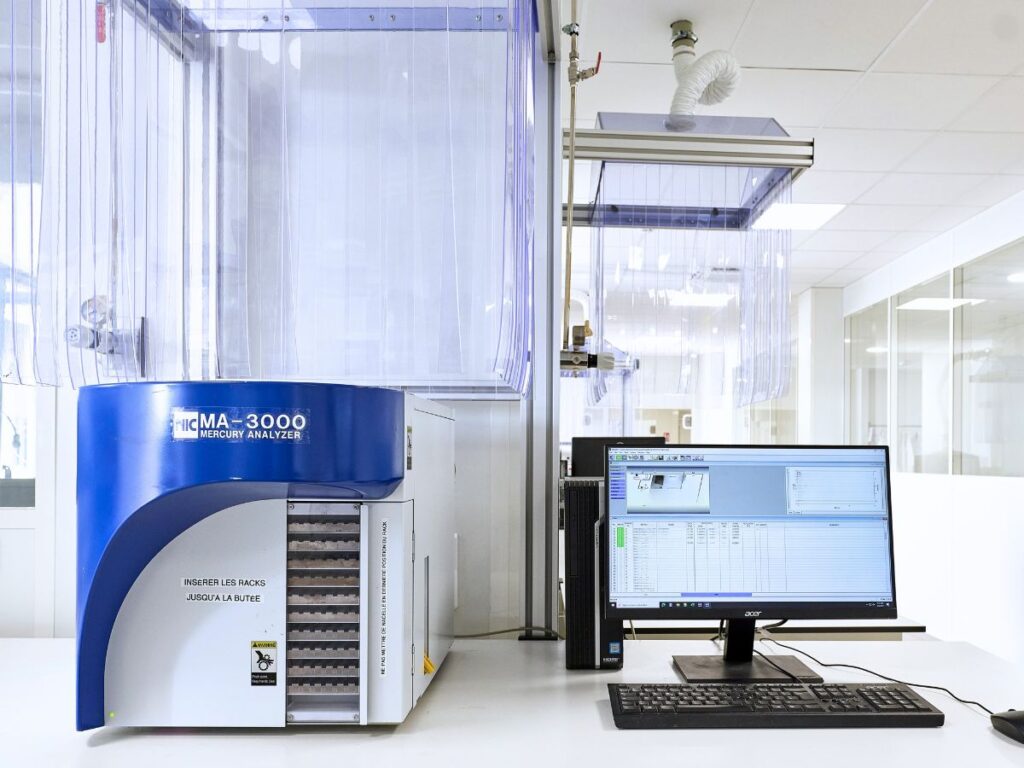
Laboratory analysis and quantification of Mercury using an Amalgamator
Your needs: monitoring the presence of mercury in your products to validate their compliance
Mercury is one of the ETMs (metal trace elements) that may present a toxicological profile depending on its concentration in an environment. Naturally present or resulting from human activity (metallurgy, waste incineration, etc.), the use of mercury is highly regulated in industrial sectors such as cosmetics, pharmaceuticals, and the energy sector.
Analyzing the presence of mercury in a product using precise analytical tools is intended to limit the risks related to the safety of staff and consumers.
Our solutions: carrying out qualitative and quantitative mercury analysis using reliable and precise technical means such as the Mercury Amalgamator
The FILAB laboratory supports manufacturers in assessing their product or environment in the presence of mercury. Handling mercury requires specific technical means, such as a mercury amalgamator, as well as the expertise of our teams regarding the associated regulations.
FILAB offers several mercury analysis services, such as:
- Mercury analysis by mercury amalgamator*
- Heavy metals analysis
- Mercury quantification by ICP-AES and ICP-MS
- Mercury analysis according to the RoHS directive Mercury analysis in cosmetic products
*The mercury amalgamator
is an absorption spectrometer that makes it possible to quantify mercury in liquid or solid samples through vaporization rather than mineralization. This technique achieves very high levels of sensitivity for a faster analysis (less than 5 minutes).
Quite simply because we are facing major environmental challenges. Mercury, a metal that can be harmful to human health and the environment, may be found in soil, sediments, groundwater, and surface water. It is therefore crucial to measure its concentration accurately and understand its chemical properties in order to take effective action and implement sustainable solutions.
A laboratory specializing in mercury analysis such as Filab is equipped with advanced technologies to perform reliable tests and provide recommendations tailored to each client's needs, whether they are businesses, public organizations, or individuals. By calling on our experts, we can guarantee the quality of the analysis and the reliability of the results, helping to better protect our environment and our health.
Mercury is a contaminant found in the environment that can seriously harm health and is highly regulated. Our mercury analysis laboratory has implemented various methods to measure and analyse levels in your products. Commonly used methods include:
- atomic absorption spectrophotometry,
- gas chromatography,
- atomic fluorescence spectrometry,
- and analysis coupled with mass spectrometry.
The results of these analyses are crucial for assessing the level of contamination and implementing effective decontamination measures to protect public health and the environment.
European laboratories must comply with strict standards and regulations when it comes to mercury analysis and measurement. European Union directives establish maximum mercury limits in various products, such as foodstuffs, cosmetics and medicines.
For a mercury analysis laboratory such as Filab, this means that it must be able to accurately detect mercury levels in samples submitted for analysis. Quality standards, such as ISO 17025, also apply, ensuring accuracy, traceability and reliability in mercury analysis results. Ultimately, these regulations ensure that European consumers are protected against excessive exposure to mercury.