News

Traveling into the infinitely small… AFM at the service of extreme surfaces

What are the modes and applications of AFM?

FILAB laboratory is pleased to announce the arrival of AFM at its analytical facility in Dijon in early September 2022. It has been equipped with an FX40 Automatic AFM, which is equipped with AI. It enables faster and more reliable analysis. This makes FILAB the first laboratory in Europe to be equipped with an AI-powered AFM.

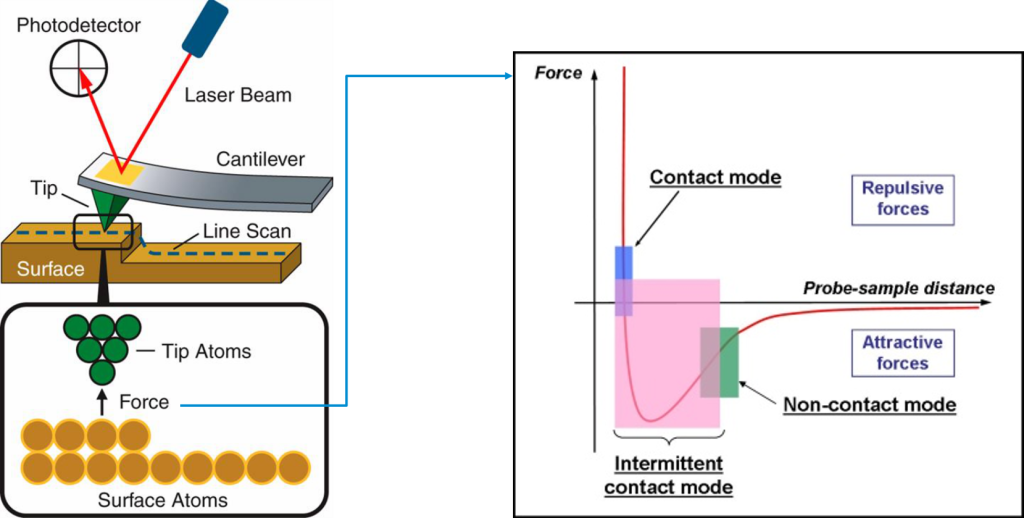
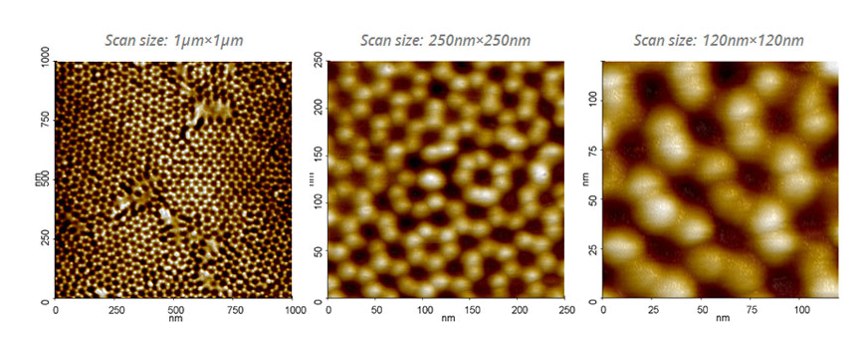
The Atomic Force Microscope is a high-resolution local probe microscope that can be used to visualize the topography of a sample’s surface as well as its tribology, mechanical behavior, electrical behavior, and chemical behavior.

This method allows for point-by-point analysis of the sample surface using a probe consisting of a nanometric tip. This microscope therefore offers the possibility of studying the infinitely small.

Depending on the problem encountered, AFM offers several modes: contact mode and non-contact mode. But then, which modes are used for which applications?

The mode non-contact

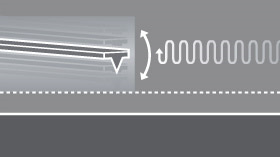
  • The non-contact mode of the AFM allows the topography of the sample to be measured without damaging it.

The mode contact

As for the AFM’s contact mode, it also allows the topography to be measured (although this is less commonly used) but above all to perform various measurements: 

  • mechanical
  • electrical
  • magnetic

To do this, it is necessary to adapt the type of tip according to the sample (stiffness constant and application).

Discover the different ways to contact the AFM:

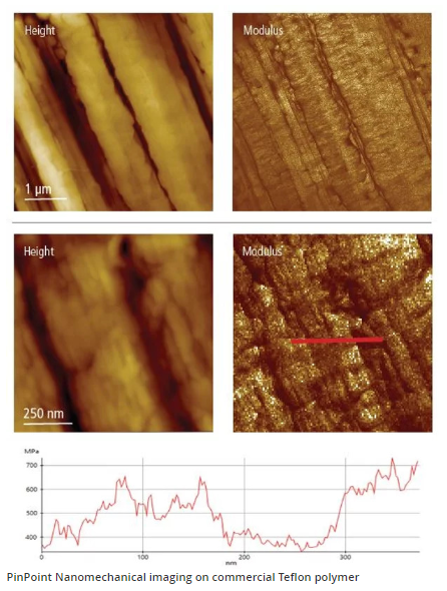
FMM mechanical mode

Among all contact modes, the FMM mechanical mode allows measurements of mechanical properties (Young’s modulus, deformation, adhesion) to be taken.

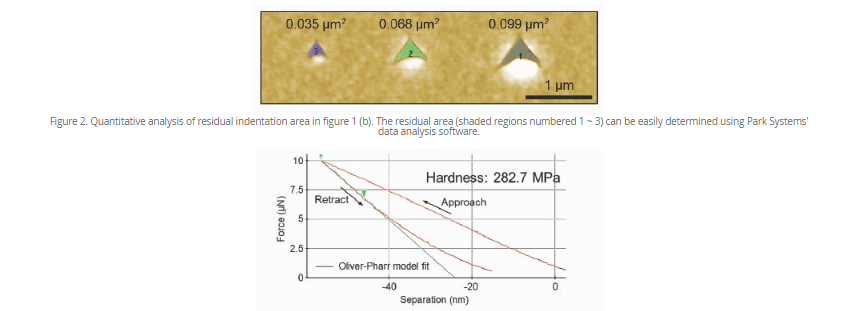
Mechanical nanoindentation mode

Mechanical nanoindentation mode, meanwhile, allows various measurements to be taken: 

  • Hardness measurements and Young’s modulus

  • Indentation area measurements to calculate hardness

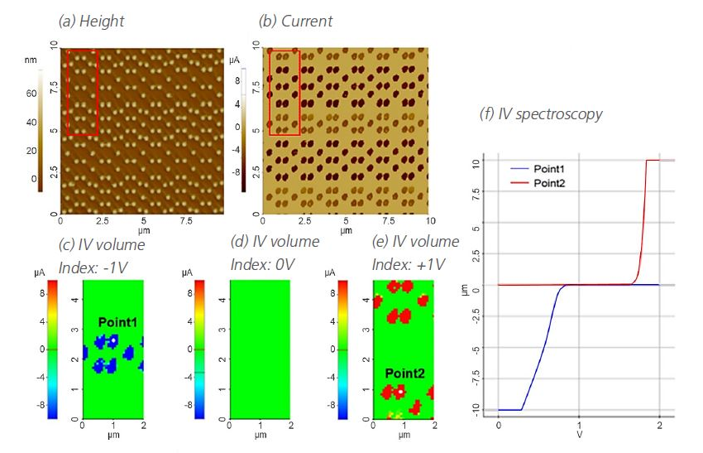
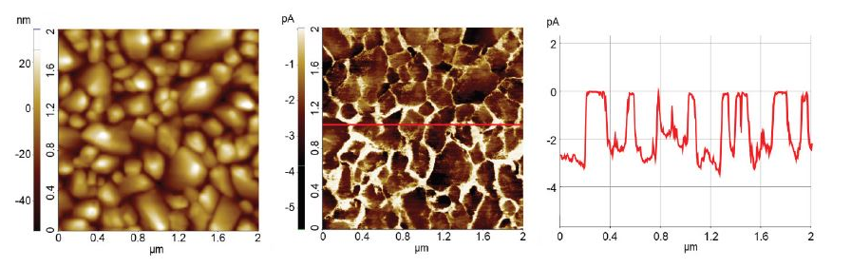
C-AFM pinpoint electric mode

With the C-AFM pinpoint electric mode, it allows you to:
  • Measuring electrical properties (current, resistance, I/V spectroscopy)

  • Apply voltage between the tip and the sample.

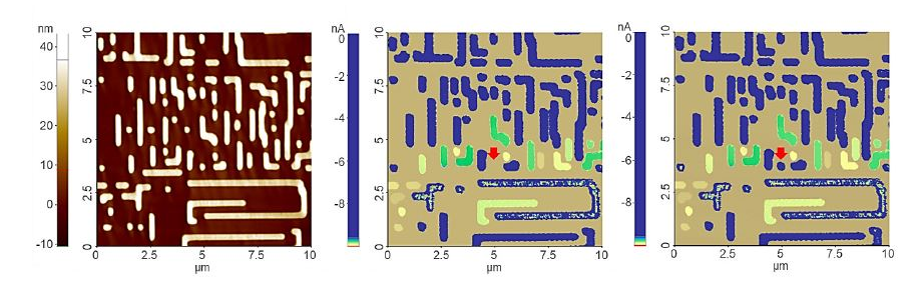
Leakage current observed in c-AFM on an SRAM component (contact with the n-doped area below)

(Constant voltage applied during imaging)

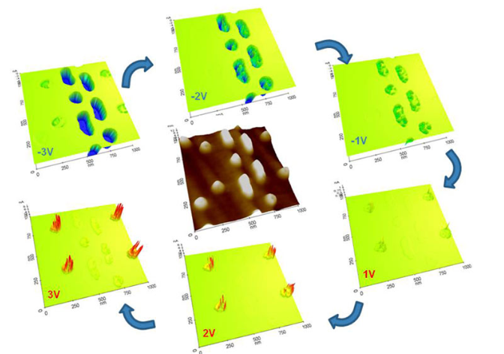
Images at different voltages and single-point spectroscopy

Current mapping on a pentacene film deposited on Ni (111)

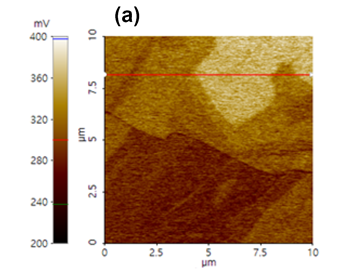
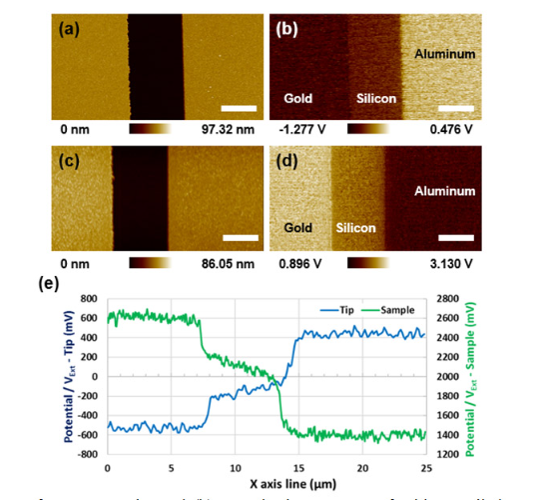
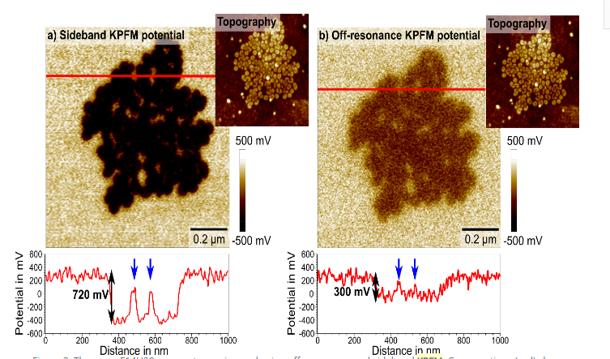
EFM pinpoint electric mode

The purpose of this mode is to achieve:

  • electrostatic property measurements (surface voltages)
  • applications of a voltage between the tip and the sample

Highly oriented pyrolytic graphite (HOPG)

Surface potential measurement, work function (KPFM measurement):

Particles on Si

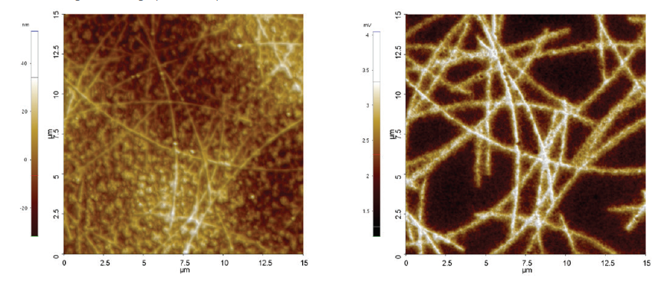
Detection of nanowires in PET (EFM measurement):

MFM magnetic mode

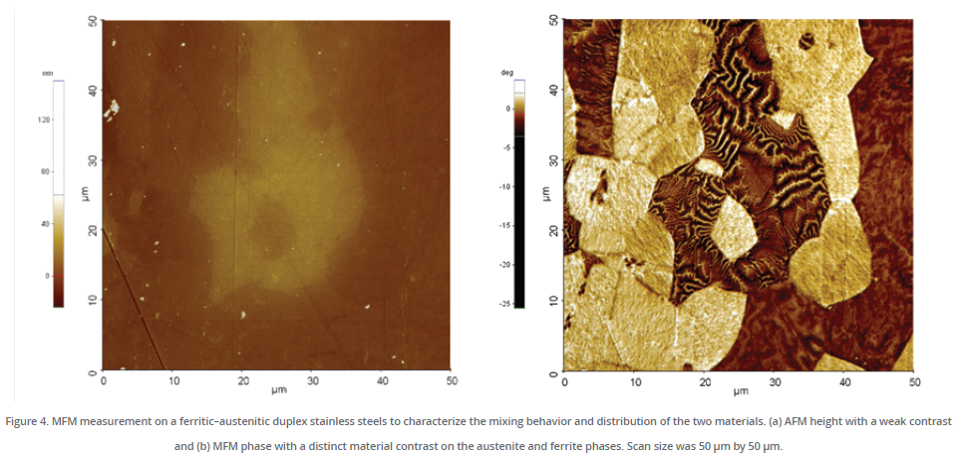
With this MFM magnetic mode, measurements of magnetic properties (differentiation of magnetic domains) can be performed.

Frequently asked questions

What information does AFM analysis provide about a surface?

AFM explores a surface with a tip and measures tip–sample interactions. It can establish topography and roughness parameters over a defined area. Depending on the mode and probe, it can also examine mechanical, electrical or magnetic responses. Each quantity requires an appropriate protocol and interpretation.


How should contact and non-contact AFM modes be selected?

The choice considers material fragility, surface relief and the property to be measured. Contact mode maintains contact with the surface; a non-contact mode uses interactions at a distance. The tip and settings must limit disturbance and artefacts; a mode’s name alone does not guarantee measurement without alteration.

Does an AFM image directly show the exact shape of the objects observed?

The image depends both on sample relief and on tip geometry. Some objects may appear wider, and a worn or contaminated tip can introduce artefacts. Probe selection, checking its condition and comparing several areas are therefore essential before interpreting measured dimensions.

What can electrical and magnetic AFM modes measure?

With a suitable probe and setup, AFM can map a local electrical response, surface potential or contrasts associated with magnetic interactions. These signals are not interchangeable and can be influenced by topography or the environment. Controls and documented conditions are needed to attribute the contrast to the property of interest.

How can an AFM measurement be representative of an industrial defect?

Define relevant areas, scan sizes and comparison criteria, preferably with a reference surface. Preparation, mounting and cleanliness must preserve the defect. Several acquisitions may be necessary, because a local scan does not automatically represent the entire component. Explore outermost surface analysis.