Material Testing & Chemical Analysis Services for Industry

Chemical analysis Characterization of materials R&D Support
More than 140 people
More than 140 people at your service
5200 m² laboratory
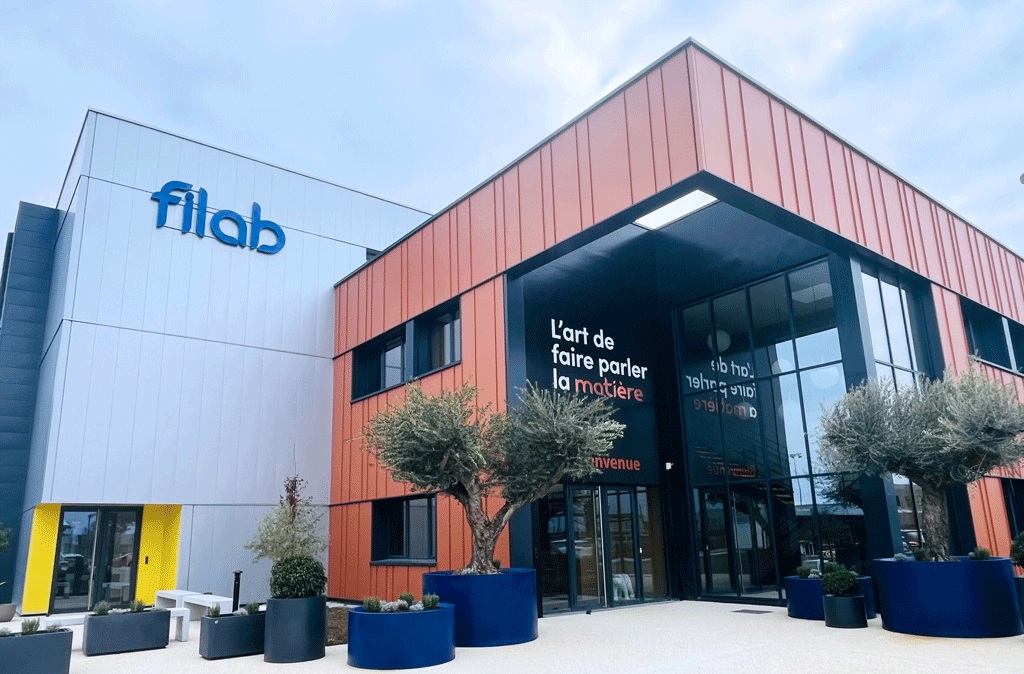
5200 m² laboratory + 99% of services are provided in-house
Accredited laboratory
Accredited laboratory COFRAC ISO 17025

The FILAB laboratory offers you a physico-chemical analysis and characterization service for all types of materials

Materials science makes it possible to optimize the performance and durability of materials by studying their structure and properties.

As a materials laboratory, FILAB provides its expertise and state-of-the-art analytical capabilities.Located on 5,200 m², our materials analysis laboratory relies on a comprehensive technical platform and a team of specialized engineers and PhDs.

Materials characterization at the FILAB laboratory makes it possible to assess their physical, chemical, mechanical, thermal, electrical, optical, and magnetic properties.

Why carry out material characterization?

01
Compatibility of the material with the product's end use
02
Evolution of the material over time or in different environments
03
Compliance of materials with regard to current standards
04
Performance of the material

Each material has its own characteristics, and its properties will determine the performance of the final product. Indeed, the criteria for selecting a material may depend on its chemical nature, composition, form (particle size, crystallinity, morphology, etc.), surface condition, and more. From manufacturing to the use of the final product, it is essential to ensure the compliance of the materials used and to control the risks of failure (cracking, breakage, corrosion, etc.).

The support and expertise of a laboratory specialized in material characterization or materials analysis enables you to optimize your production processes with more suitable materials, and to accurately analyze the causes of and remedies for failures in your products and materials.

Our Services

Chemical composition analysis and reverse engineering

Morphological study of materials

Failure analysis of materials: fracture, delamination, contamination, degradation, corrosion, adhesion

Characterization of metal powders

Characterization of HAP powders

Surface analysis of materials: surface treatment, number of layers, coating, surface condition

Study of material extractables and leachables

Nanomaterial analysis

Extreme surface study

Thermal analysis

Materials characterization in the laboratory

Materials Characterization

Metal Alloys

Composition analysis and reverse engineering

Professionals across all industrial sectors, do you want to ensure the compliance of your metal alloys by studying their chemical composition?
The analysis of the composition of metal alloys is part of our materials characterization services. These analysis, and in particular reverse engineering, make it possible to identify the structure and concentration of the constituent elements of your alloys, thereby providing information on performance and potential applications.

Failure analysis

Have the defects in metal alloys analyzed to understand their causes and consequences. We carry out in-depth studies of metallurgical failures for a better understanding of their nature and extent.

Extreme surface study

The surface of a material is where all interactions with its environment occur, which can affect material performance and protection.

Laboratory extreme surface analysis, as part of materials characterization, involves studying surface layers at the nanometric scale. This analysis reveals precise information about surface composition, structure, and interactions, in order to optimize performance in specific applications.

Impurity analysis

Impurity analysis in a metal alloy: how can it affect performance?

Impurity analysis on metallic materials helps ensure material compliance and prevent potential failures by identifying the contaminants present. These can indeed alter the physical, chemical, or mechanical properties of materials.

Contamination analysis on parts

Quickly analyze contamination on your metal part thanks to our state-of-the-art analytical equipment.

Contamination analysis on metal parts in the context of materials characterization makes it possible to identify and quantify contaminants, thereby enabling corrective measures to ensure the integrity, performance, and longevity of components in their specific applications.

Materials Characterization

Polymers and Composites

Extreme surface study

Carry out nanoscale analysis to better understand the key factors behind material performance and protection.

Quantification of hazardous substances
Molecular Weight Determination
Polymer Deformulation

Find out what is hidden in your products with polymer deformulation. This technique allows you to determine the nature and quantities of the materials present in a formulation within a material. Reveal the true chemical composition of a product with this in-depth analysis.

Chemical Composition Analysis
Polymer Characterization

La caractérisation polymère en laboratoire regroupe l’ensemble des méthodes destinées à évaluer la structure moléculaire, la composition et les principales propriétés physiques, chimiques et mécaniques, afin de mieux comprendre le comportement et les performances des matériaux polymériques.

Materials Characterization

Surface Analysis

Extreme surface study

The surface of a material is crucial to its interactions with the environment and
influences its performance and protection. Surface analysis at the
nanoscale makes it possible to understand the challenges your material must face.

Chemical Composition Analysis
Morphological Study

Explore the structure and layers of your samples through our analysis services, using optical microscopy and scanning electron microscopy (SEM). Discover hidden details and measure the thickness of the different layers.

Failure Analysis

Whether caused by an internal manufacturing issue or a customer return, product failure can affect its reliability, strength, and
performance. Discover the reasons behind these failures and the consequences they bring.

Development and Validation of Surface Treatment Processes

FILAB offers technical and human solutions to industrial companies to detect and understand defects in organic or metallic treatments. Don't let failure issues slow you down. Trust our expertise.

Surface Treatment Analysis

Organic or metallic treatments can lead to failure issues over time or because of poor compatibility with the product's environment. To identify and understand these defects, FILAB offers industrial companies its technical and human resources.

Materials Characterization

Ceramics and Glass

Ceramics and Glass Analysis

At FILAB, our state-of-the-art analytical equipment is capable of carrying out characterization on ceramics and glass.

Chemical composition analysis and reverse engineering
Morphological Study of Materials

Visual analysis of a sample using high-performance imaging techniques, such as optical microscopy or scanning electron microscopy (SEM). Thanks to these methods, you will be able to better measure the thickness of the different layers
present.

Crystallographic Characterization

Optimize the performance of your materials by studying their atomic composition using XRD.

Laboratorycrystallographic characterization provides atomic information, particularly on the arrangement of the crystals in the material, in order to better understand the mechanical, thermal and electrical properties of ceramics and glass.

Determination of Physical Properties
Failure Analysis Expertise

L'étude de défaillance sur les verres et sur céramique permet d’identifier les causes sous-jacentes de ruptures ou de dégradations, permettant ainsi de d'améliorer et renforcer la résilience et la durabilité de ces matériaux dans leurs applications spécifiques.

Microstructural Analysis Expertise
Materials Characterization

Powders

Characterization of metal powders according to Ma-0015

Characterization of metal powders according to the Ma-0015 standard for additive manufacturing.

Characterization of HAP powders

Analysis and characterization of your hydroxyapatite powders (HAP) carried out according to the ISO 13779-3 and ISO 13779-6 standards by the FILAB laboratory.

Morphological Study

The morphological study of powders, as part of material characterization, makes it possible to analyze particle shape, size and distribution.

Discover the hidden secrets of a sample thanks to our
advanced imaging techniques such as optical microscopy or scanning electron microscopy (SEM). In addition to revealing relevant details, these methods also provide information on the thickness of the different layers present.

Powder purity analysis and control

The quality of a powder plays a decisive role in improving its final results. As a result, the FILAB laboratory carries out powder control analysis to support you in your manufacturing processes.

Characterization of organic powders
Powder characterization

Laboratory powder characterization is an analytical approach that makes it possible to assess particle size, particle size distribution, morphology and chemical composition, influencing the quality and performance of products in a wide range of industries, from pharmaceuticals to metallurgy.

What analysis techniques are used to characterize materials?

FILAB’s analytical platform covers 5,200 m² and offers a range of techniques to best meet your needs for physico-chemical materials characterization. In addition, the laboratory invests heavily every year in its analytical platform in order to continue providing high-performance technical capabilities.

Our techniques

Organic fraction analysis

IRTF, GC-MS, HPLC

Surface Analysis

MEB, EBSD, AFM, TOF-SIMS, XPS

Mineral fraction analysis

ICP, SEO, XRD, elemental analyzers

Thermal analysis

ATG, Py-GCMS, DSC

Other

BET, Optical Microscope, Helium Pycnometry, GPC, DMA/TMA, Goniometer, Laser Granulometry, IGA, RAMAN...

Our FAQ

What is materials characterization technology?

Material characterization is a technique that has evolved over time. It became a formal scientific research field in the early 20th century with the development of microscopy.

It is an essential step in understanding their properties and performance. Many techniques are available to scientists and engineers to characterize a material, ranging from microscopy to spectroscopy.

Material characterization is a technique used to determine the chemical composition of a material, its crystal structure, microstructure, morphology, mechanical and thermal properties... The choice of technique depends on the type of material to be characterized, the required precision, and the information sought.

How can a material be characterized?

Characterizing a material in the laboratory is possible using different complementary approaches, such as:

  • Molecular or elemental (chemical) analysis
  • Diffraction for crystal structure
  • Microscopy for morphology / microstructure
  • Surface analysis (XPS, SEM, TOF-SIMS)
  • Thermal testing (DSC, TGA)
  • Mechanical / electrical / magnetic properties depending on use
What is materials science?

Materials science studies the structure, properties, and performance of materials. It makes it possible to understand the relationship between chemical composition, internal structure, physical properties, performance, and applications of a material.

Materials science encompasses fields such as physics, chemistry, materials engineering, and other related sciences. Materials science researchers study a wide variety of materials, including metals, polymers, ceramics, composites, and semiconductors. The goal is to develop new materials with improved properties or to enhance existing materials.

What does materials chemistry involve?

Materials chemistry is a discipline that studies materials from a chemical perspective: structure, composition, reactions. It plays an essential role in the discovery and development of new materials.

The analytical techniques used in materials chemistry include chemical synthesis and spectroscopy. They also include advanced characterization techniques such as X-ray diffraction, electron microscopy, and nuclear magnetic resonance spectroscopy to examine material properties at the atomic scale.

Why use a materials laboratory?

Using a materials laboratory can be useful in a wide range of industries and application areas:

Materials analysis and characterization:
To understand the physical, chemical, and mechanical properties of materials, such as strength, ductility, conductivity, and chemical reactivity.

Quality control:
To ensure that the materials used in a specific industry meet the required quality and performance standards, with durability and corrosion resistance testing.

Development of new materials:
For innovation and the development of new materials that offer better performance, greater durability, or lower cost. This may include research into composites, polymers, nanomaterials, ceramics, and metals.

Materials failure analysis:
To analyze material failures in existing structures or defective products, understanding the cause of failure can help prevent problems and improve product design.

Regulatory and environmental compliance:
To ensure that the materials used comply with current regulations, particularly regarding their environmental impact, recyclability, and toxicity.

Manufacturing process optimization:
To improve manufacturing processes, reduce costs, and increase production efficiency by gaining a better understanding of material behavior during different processes.

Using a materials laboratory provides access to specialized expertise and advanced equipment to carry out these analyses and tests, which may not be available in-house for many organizations. This helps ensure the performance, safety, and durability of products and projects, while also fostering innovation and competitiveness.

What is laboratory material characterization?

Material characterization brings together a set of techniques that make it possible toidentify the composition, structure, microstructure, and physicochemical properties of a material. Relying on a competent laboratory such as FILAB laboratory makes it possible to obtain reliable, tailored analysis.

What analysis can be used to study a material’s structure?

Depending on the nature of the material and the objective, several analytical techniques can be used: X-ray diffraction (XRD) for crystal structure, electron microscopy (SEM or FIB-SEM) for morphology and topography, infrared (FTIR) or Raman spectroscopy for chemical groups, or calorimetry (DSC) for thermal transitions.

Which materials can be characterized in the laboratory?

La caractérisation matériau s’applique à de nombreux types de matériaux : polymères, métaux et alliages, composites, céramiques, verres, poudres ou matériaux organiques. 

Les techniques disponibles au laboratoire FILAB permettent d’adapter les méthodes en fonction de la densité, de la conductivité, de la morphologie ou de la sensibilité thermique des échantillons.

When should you use a full material characterization?

Material characterization is recommended when developing a new product, changing suppliers, addressing a compliance issue, monitoring aging, or in the event of a failure.

This analytical service provides data to support root cause analysis, optimize a process, or validate a material’s performance in its final use.

The filab advantages
A highly qualified team
Responsiveness in responding to and processing requests
A COFRAC ISO 17025 accredited laboratory
(Staves available on www.cofrac.com - Accreditation number: 1-1793)
A complete analytical facility of 5,200m²
Tailor-made support
Tailor-made support
Video debriefing available with the expert
Contact us
To find out more about these services, don't hesitate
to contact our team.
Alexandre VIGLIONE Technical Sales Representative
Ask for your quote
Around this topic