


"I used Filab for a chemical analysis. Very satisfied with the service. Responsive team, deadlines met, and a clear analysis report. I recommend them."
Metallurgical failure analysis laboratory
Chemical analysis
Material characterization
Problem solving

More than 140 people
at your service

5200 m² laboratory
+ 99% of services are provided in-house
Home • Analytical services • Analysis • Metallurgical analysis • Metallurgical failure analysis laboratory
Your needs: optimize the manufacturing of your metal products and analyze the causes of metallurgical failures
Steelmakers, foundries, manufacturers and suppliers, you face major strategic challenges that require you to monitor the quality of your materials in order to optimize your industrial processes (costs, lead times, scrap rates, etc.). FILAB, a laboratory specializing in metallurgy and steelmaking analysis and metallurgical failure analysis, is here to support you.
Whether used in the aerospace, automotive, medical, rail or nuclear sectors, metal alloy parts perform strategic mechanical functions that ensure the safety of people and property.
What is a metallurgical failure?
A metallurgical failure, or metal alloy failure, occurs when a metallic material can no longer perform its function due to a change in its structure, composition or physical properties. This failure is primarily characterized by a deterioration in the mechanical properties of the metallic material. This can lead to cracks, porosity, corrosion, fractures, oxidation and other issues that affect the performance and durability of the part or structure.
Issues related to metallurgical failures
From the design stage to the market launch of a product with metal components, you face several types of issues, including:
- The control of raw materials
- The substitution of metal alloys
- Understanding and anticipating the behavior of materials in their operating environment
- The performance of surface treatments
- Optimizing manufacturing and machining processes to reduce the risk of failure.
Causes of metallurgical failures
Metallurgical failures are generally caused by unforeseen variations in operating or manufacturing conditions, such as improper heat treatment, excessive pressure, mechanical stress or overload leading to fatigue from repeated loading, as well as corrosion phenomena, or a defective manufacturing process. Metallurgical and metallographic laboratory analysis is often necessary to identify the underlying causes of the failures observed.
body.page-id-2069:not(.elementor-editor-active) .elementor-column.bwa-eeat-col-2069 > .elementor-element-populated,
body.page-id-2069:not(.elementor-editor-active) .elementor-column.bwa-eeat-col-2069 .elementor-widget-wrap {
padding: 10px !important;
}
Why use a laboratory specialized in metallurgical failures?
As an industrial player in the fields of Metallurgy, Steelmaking and Foundry, and microelectronics, it is essential to optimize the manufacturing of your metal products. Metallurgical failures can be dangerous and costly because they can lead to a loss of structural integrity, industrial accidents, and expensive repairs.
Understanding the causes of metallurgical failures that can compromise the performance of your products requires in-depth expertise and a rigorous analysis of the parameters involved in manufacturing your parts. FILAB’s laboratory is here to support you in this process by providing customized solutions for metallurgical failure analysis.
Our solutions: supporting manufacturers through our metallurgical expertise to identify and resolve metal product failures
FILAB, a laboratory made up of experts in metallurgical analysis and failure characterization, offers its analytical services, from the design stage to the manufacturing and implementation of a product with metal components.
Backed by its experience and state-of-the-art analytical equipment, FILAB laboratory has a wide range of tools specific to the metallurgical sector enabling it to provide the following services:
Thus, combined with checks on chemical composition and mechanical properties, metallurgical expertise makes it possible to verify the overall metallographic structure of the material and identify any defects. These defects (precipitates, inclusions, porosity, shrinkage cavities, etc.) are weak points.
Our metallurgical expertise through metallographic examination
When it comes to understanding the properties of a metallic material, metallographic examination can provide important information about its internal structure. It can reveal the presence of defects, discontinuities and other anomalies that may affect the material’s performance and service life. FILAB laboratory specializes in metallographic analysis.
The different metallurgical failure analysis techniques
Metallographic failure analysis techniques are based on the study of the microstructure of the sample taken from the metal component damaged by the failure.
Different techniques are used when analyzing a metallurgical failure or metal alloy failure:
- The optical microscope makes it possible to observe surface structures and defects in the sample using different staining and polarization techniques.
- The SEM for metallurgy uses electron beams to study the internal structure of the sample with a higher resolution than optical microscopy.
- The X-ray diffraction makes it possible to obtain information on the crystalline structure of the sample.
Our metallurgical failure analysis
Our complementary chemical analysis
Failure analysis : analysis of fracture surfaces, analysis of contamination or particles, adhesion issues, corrosion phenomena, metallographic examination, weld analysis...
Custom chemical analysis : determination of purity and impurities
Surface analysis and coating characterization
Flowability test on powders
Verification of metal alloy grades : ferrous and non-ferrous, stainless steels (NF EN 10088-1/2/3), titanium, copper, lead, nickel, zinc, aluminum, tin, cobalt...)
Aluminum analysis, thallium, gallium and indium
Expertise, evidence and traceabilityUpdated: June 2026
Why trust the FILAB laboratory for your Metallurgy, Steelmaking and Foundry analysis and expertise?
Entrusting your Metallurgy, Steelmaking and Foundry analysis and expertise to the FILAB laboratory means relying on technical expertise, a documented quality framework, and expert interpretation of results for industrial, quality, or regulatory decisions.
Recognized accreditations
- ISO 17025
- Nadcap MTL
- SAFRAN
- FRAMATOME
- EDF
- DASSAULT AVIATION
- Aubert & Duval
- Airbus Defence & Space
- Liebherr
An expert at your side
Expertise manager
Clément Boenard supports analysis and expertise projects in Metallurgy, Steelmaking and Foundry.
Recognized accreditations
- ISO 17025
- Nadcap MTL
- SAFRAN
- FRAMATOME
- EDF
- DASSAULT AVIATION
- Aubert & Duval
- Airbus Defence & Space
- Liebherr
An expert at your side
Expertise manager
Clément Boenard supports analysis and expertise projects in Metallurgy, Steelmaking and Foundry.
Our approach in 4 steps:
- Discussion of your issue and constraints.
- Proposal of a suitable analytical protocol and a quote.
- Execution of the analysis and expert review of the results.
- Delivery of a detailed, actionable, and traceable report.
Avis vérifiés
What our clients say
N
Nicolas a.
12 May 2026
"Very responsive laboratory, with excellent analysis quality and deadlines met. Communication is smooth, the technical explanations are clear, and the team knows how to adapt to specific needs. I recommend them for their professionalism and reliability!"
5/5
C
Charlotte t.
8 May 2026
"Clear and precise deliverable, delivered on time. I recommend them."
5/5
Transparency & contactLast checked: June 2026
Where to find us and how to contact us
FILAB is a physical laboratory located in France, independent and accredited. All the contact details below allow you to verify our identity and submit your request.
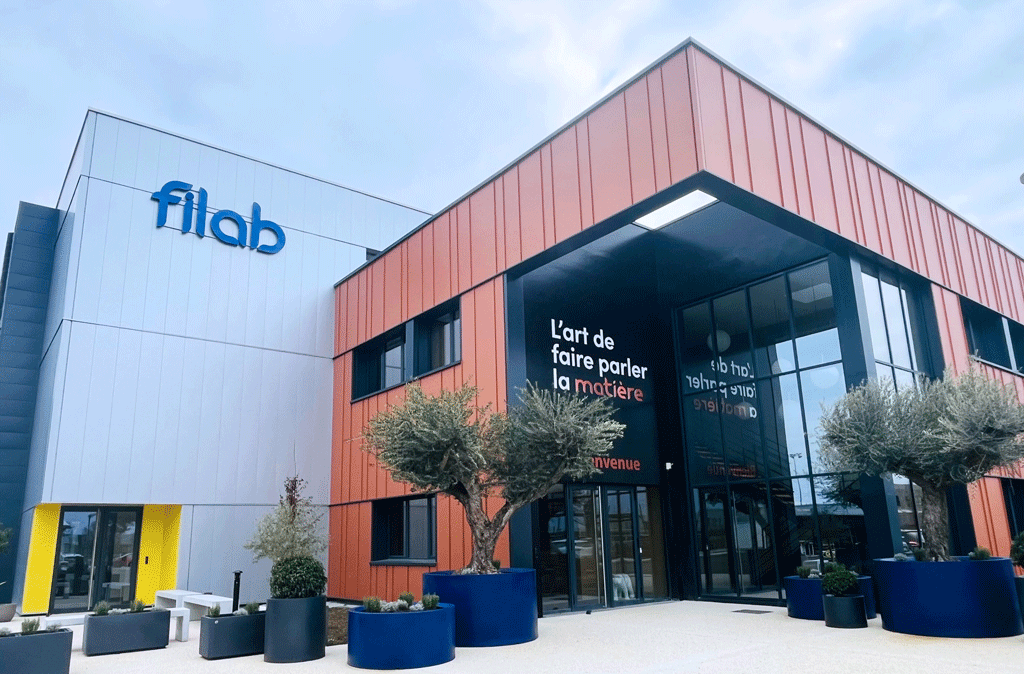
FILAB Laboratory
Ecoparc Dijon Bourgogne
80 rue Jean-Louis Auguste Petitjean
21850 Saint-Apollinaire, France
Tel. +33 (0)3 80 52 32 05
Our FAQ
The stages of metallurgical failure analysis
Metallurgical failure analysis helps understand the reasons behind a metal failure. This analysis begins with a visual and macroscopic examination of the material, followed by sample preparation for microscopic observation (optical, scanning electron microscopy and X-ray diffraction) to analyze the structure and composition of the sample.
The results of these analysis help the laboratory identify the type of failure, such as corrosion, fatigue, fracture, etc.
The differences between metallographic and metallurgical expertise
Metallurgy focuses on the study of the physical and chemical properties of metals and alloys, as well as on the manufacturing and development of new materials for specific applications.
Metallography is a specific analysis technique that involves preparing metal samples for microscopic analysis. It makes it possible to examine their structure, composition and quality. Metallography is essential for characterizing the microstructures of metals, which is useful for understanding their mechanical behavior and susceptibility to corrosion or other degradation phenomena, namely metallurgical failures.
Filab's expertise in metallurgy is thus strengthened by its metallography expertise. Through this metallurgical expertise, the laboratory is able to carry out analysis of metal structures in various tests.
The differences between fracture surface analysis and fractography
Fracture surface analysis and fractography are two techniques used to analyze material failure. Fracture is one of the ways materials can fail.
The analysis of fracture surface focuses on the macroscopic examination of the fracture surface, while fractography examines the microstructure of the fracture surface at the microscopic scale. This difference makes it possible to obtain complementary information about material failure.
Fractography is particularly useful for materials with a fine or complex structure, while fracture surface analysis is more applicable to materials with a simpler macroscopic structure. By combining these two techniques, the laboratory can gain a more complete understanding of material failure.
Why resolve metal alloy failures?
Manufacturers face many issues related to metal alloy failures, which require a multidisciplinary approach.
Resolving metal alloy failures makes it possible to pursue continuous improvement in order to optimize product performance and reliability while minimizing environmental impacts and ensuring safety.
Detecting failures, understanding their complex mechanisms, and carefully selecting materials are at the heart of industrial challenges. FILAB offers failure analysis and support in research and development.
What are metal alloy failures?
Some specific metal alloys may experience characteristic failures, and the alloy composition can influence the type of failure encountered.
- Stainless Steel (Austenitic)
Stress corrosion cracking (SCC): Chloride environments can induce cracks in stainless steels austenitic, in the presence of internal or applied stresses.
- Aluminum Alloys
Galvanic corrosion: When aluminum alloys are in contact with a metal such as stainless steel, and in the presence of an electrolyte, aluminum may undergo accelerated corrosion due to the electrochemical potential difference between the metals.
- Titanium Alloys
Pitting corrosion: Although titanium alloys are extremely corrosion-resistant, in very aggressive environments, for example in the presence of chlorides at high temperature, they may undergo localized corrosion.
- Steels
Atmospheric corrosion: Steels, if not properly protected, may undergo rapid corrosion when exposed to the atmosphere, particularly in humid or saline environments, leading to rust formation.
- Nickel Alloys
High-temperature creep: Nickel-based alloys, under extreme stresses and at very high temperatures, may deform slowly.
- Bronze
Fatigue: Bronze components may fail due to fatigue as a result of repeated cyclic loads.
Each alloy has unique properties that influence its behavior under different operating and environmental conditions. Understanding the failure mechanisms specific to each type of alloy is essential for material selection and component design.
What types of failures occur in metal alloys?
Metal alloys can experience different types of failures depending on their composition, heat treatment, use, and the environment in which they are found. Here are the main types of failures encountered in metal alloys:
- The fatigue of a material, and here of metal, refers to the progressive failure of a material under repeated or fluctuating stresses that are often well below the material's yield strength.
- Corrosion is the degradation of metals caused by a chemical reaction with their environment.
- Wear is the gradual loss of material from the surface of a metal due to physical contact and relative motion.
- Stress corrosion cracking is a failure caused by the combination of corrosion and tensile stresses.
- Creep is the slow, permanent deformation of a material under constant stress at high temperature.
- Hydrogen embrittlement is a process by which metals become more brittle and prone to cracking in the presence of hydrogen.
- Temper embrittlement occurs in certain alloy steels which, when exposed to certain intermediate temperatures, can lose their toughness.
These types of failures show the importance of choosing the right alloy for a specific application, as well as the importance of heat treatment, design, and maintenance in the service life of metal components.
The filab advantages

A highly qualified team

Responsiveness in responding to and processing requests

A COFRAC ISO 17025 accredited laboratory
(Staves available on www.cofrac.com - Accreditation number: 1-1793)

A complete analytical facility of 5,200m²

Tailor-made support

Video debriefing available with the expert


Ask for your quote
Around this topic