

Size exclusion analysis - Everything you need to know about chromatography
As an industrial manufacturer, do you develop, produce, or test polymers, proteins, excipients, or complex formulations?
Steric exclusion analysis, also known as Gel Permeation Chromatography (GPC analysis), also known as Size Exclusion Chromatography (SEC), is a method of choice for determining the average molar mass and size distribution of your macromolecules in solution.
Would you like to carry out a steric exclusion analysis
What is steric exclusion analysis?
Steric exclusion analysis (also known as size exclusion chromatography, SEC, or GPC depending on the application) is a powerful analytical method for separating macromolecules according to their size or molecular weight.
This chromatographic technique is particularly well suited to the in-depth study of polymers, proteins, polysaccharides, and other large molecules used in various industrial sectors.
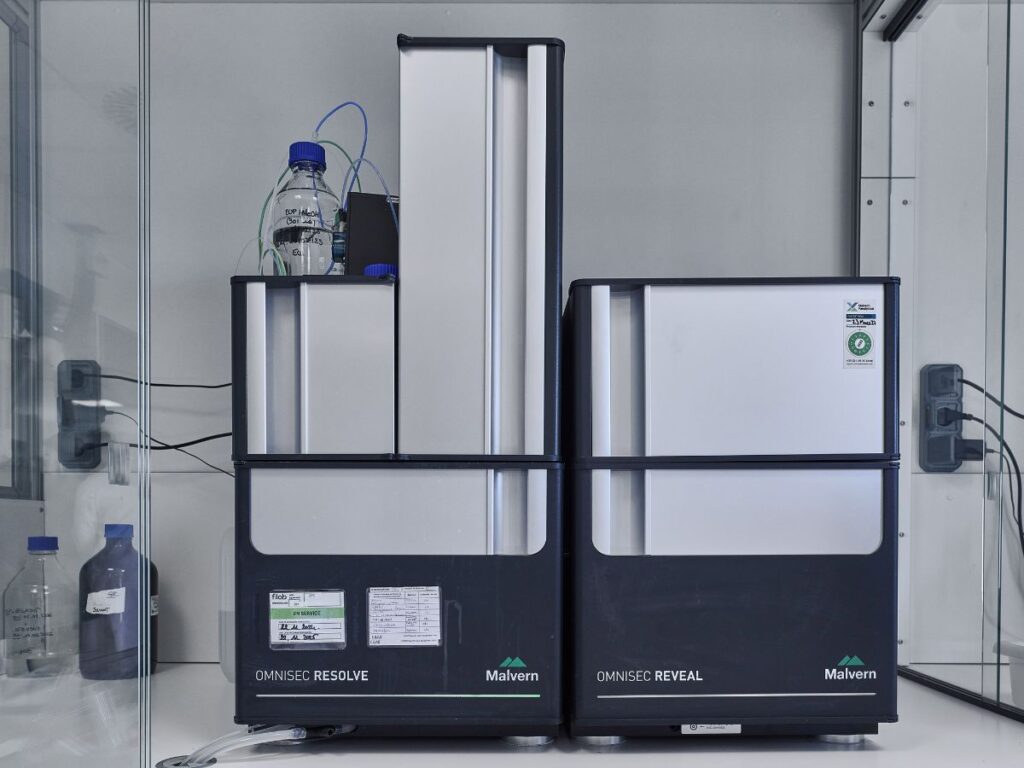
By using this form of size exclusion chromatography and combining a range of detectors (RI and UV concentration detectors, RALS/LALS light scattering, viscometer), steric exclusion analysis makes it possible to accurately determine molecular mass and size, as well as intrinsic viscosity and structure, particularly for polymers.
The principle of steric exclusion chromatography
Steric exclusion analysis is based on the separation of molecules according to their size, thanks to their ability to enter, or not, the pores of a porous material present in the chromatographic column.
- Large molecules (large molecules) cannot enter the pores, so they are excluded and elute quickly from the column
- Small molecules (small molecules) penetrate deeply into the pores, thereby delaying their elution time
This separation enables precise characterization of molecules according to their size and molecular weight without any chemical interaction with the column.
Why carry out a steric exclusion analysis?
SEC/GPC analysis addresses several industrial challenges:
- Characterize a synthetic or natural polymer
- Monitor the stability or degradation of an active ingredient
- Compare the structure of two samples (copolymers, formulations, batches)
- Validate a product’s compliance with specifications or a standard
- Study aging, oxidation or chemical modification phenomena
Our solutions: complete expertise in steric exclusion chromatography
Our laboratory services
Thanks to a strengthened analytical platform (aqueous and organic phase GPC, RI, UV, MALS detectors, etc.), we offer a tailored approach to your needs in:
Control of average molecular weights and molar mass distribution of polymer materials and other substances (Mn, Mw, Mp, polydispersity index). NF T 51-505 and the ISO 13885 series notably cover this type of service
Structural characterization, including the study of macromolecular chain branching (branching analysis, …)
Process optimization to validate synthesis, application or crosslinking conditions
Failure analysis of thermoplastic parts, which may notably be associated with degradation of the polymer fraction (shear of the material causing chain scission)
Polymer deformulation providing access to physicochemical information complementary to analytical techniques such as IRTF, ATG, Py-GCMS, GCMS, LCMS, …
Characterization of proteins and polysaccharides (sugars)
Coupling steric exclusion with other analytical techniques
Combining steric exclusion analysis (SEC/GPC) with other techniques – such as multi-angle light scattering (MALS), viscometry, or UV/RI detection – provides a more complete characterization of macromolecules. These combinations improve accuracy regarding molar mass, structure, and sample composition, delivering reliable diagnostics for quality control, formulation, or R&D.
Why use steric exclusion in industry?
Steric exclusion analysis are an analytical technique used to characterize a wide variety of polymers or other macromolecules in a mixture.
Used in quality control, process optimization (polymerization kinetics, for example), or expert analysis (search for pollution, contamination, etc.), this technique now meets a wide range of industrial needs across various sectors:
Polymer and plastics industry: precise control of mechanical and thermal properties through molecular weight control
Cosmetics: validation of polymers used in formulations to ensure the texture and stability of finished products.
Pharmaceutical and biotechnology industry: characterization of proteins and biomolecules to ensure therapeutic stability and efficacy.
Size exclusion chromatography for polymers
Size exclusion chromatography (SEC or GPC) is the reference method for analyzing polymers, whether synthetic or natural. It makes it possible to accurately determine their average molar mass (Mn, Mw), polydispersity, and molecular structure (linear, branched, etc.).
For professionals in plastics processing, composite materials, or resins, this technique is essential for:
Checking the quality of production batches
Comparing formulations or suppliers
Monitoring the impact of ageing or degradation
Optimize the mechanical and thermal properties of finished products
Why choose FILAB?
FAQ
These are two names for the same technique.
– SEC (Size Exclusion Chromatography) is the more general name.
– GPC (Gel Permeation Chromatography) is often used when working with organic solvents (e.g., THF, DMF).
SEC analysis can determine:
The average molar mass (Mn, Mw)
The polydispersity index (PDI = Mw/Mn)
The size distribution
Information about the molecular structure, depending on the detectors used (MALS, viscometer, etc.)
We analyze all types of synthetic or natural polymers, resins, proteins, polysaccharides, formulated products, raw materials, drugs, etc.
The sample must be soluble in a solvent compatible with the column and system (e.g., THF, DMF, water, NaNO3, etc.).
Size exclusion chromatography (SEC/GPC) is a molecular-size-based separation technique.
It enables the precise characterization of the molar mass and distribution of macromolecules.
Macromolecules are separated according to their ability to enter the pores of a column.
The largest molecules are excluded from the pores and elute quickly; the smaller ones diffuse through them for longer.
Size exclusion analysis refers to the general principle of separating molecules according to their size. GPC (Gel Permeation Chromatography) is a specific application of this technique, used with organic solvents, primarily to analyze synthetic polymers.
In other words, GPC is a form of size exclusion analysis adapted to certain materials and conditions.
Almost all polymers can be analyzed, provided that the appropriate solvent and suitable experimental conditions are identified. FILAB supports you in determining the appropriate protocols.
Typically, a few milligrams are sufficient, making this technique particularly valuable for precious or rare samples.
Size-exclusion analysis enables the precise determination of the molar mass distribution of synthetic polymers (PE, PP, PET, etc.). This characterization helps anticipate the material’s mechanical, thermal, and processing properties, thereby reducing the risk of non-compliance during production or performance defects in finished products.
Yes, size-exclusion analysis can detect and quantify changes in molar mass resulting from the thermal or oxidative degradation of industrial resins (epoxy, phenolic, polyesters) or exposure to UV radiation. This facilitates the rapid identification of the causes of alteration, directly guiding the corrective actions to be implemented.
SEC enables the size and aggregation state of therapeutic proteins (monoclonal antibodies, vaccines, enzymes) to be assessed. This analysis helps ensure their stability and therapeutic efficacy, as well as compliance with strict pharmaceutical regulations.
SEC analysis helps precisely characterize the size of polysaccharides (starch, cellulose, plant-derived compounds) used as thickeners, stabilizers, or texturing agents. It therefore enables manufacturers to optimize the sensory properties and stability of their food or cosmetic formulations, thereby improving quality and customer satisfaction.
Absolutely. Size-exclusion analysis is regularly used to verify the compliance of raw materials such as polymeric additives, active pharmaceutical ingredients, and excipients. By validating their molar mass and purity, this method ensures that the raw materials used fully meet the technical and regulatory specifications expected by manufacturers.
The analysis is carried out in several key stages:
- Sample preparation: appropriate dissolution according to the material being analyzed (organic or aqueous solvent).
- Injection into the chromatographic column: where the molecules are separated according to their size.
- Detection and characterization: using various detectors such as refractive index, light scattering (MALS, RALS, LALS), UV, or viscometric detectors.
- Data analysis: obtaining a precise distribution of molar masses (Mn, Mw, Mz) or molecular sizes.


