Case study

How can you identify the nature of a deposit at the bottom of a tank?

The customer called on FILAB to determine the nature of a deposit found at the bottom of an autoclave tank.
Home • News • How can you identify the nature of a deposit at the bottom of a tank?

The problem?

A deposit is an accumulation of substances or particles that can come from various sources, such as the precipitation of insoluble chemical components, the aggregation of suspended particles, corrosion, or contamination by foreign matter.

The customer called on FILAB, a laboratory specializing in material characterization and chemical analysis, to determine the nature of a deposit found at the bottom of an autoclave tank. The customer wanted to ensure the integrity of its equipment so as not to affect its performance.

Summary

01
Initial analysis performed by SEM-EDX
02
Additional analysis using FTIR
03
Conclusion of the study
01

Initial analysis performed by SEM-EDX

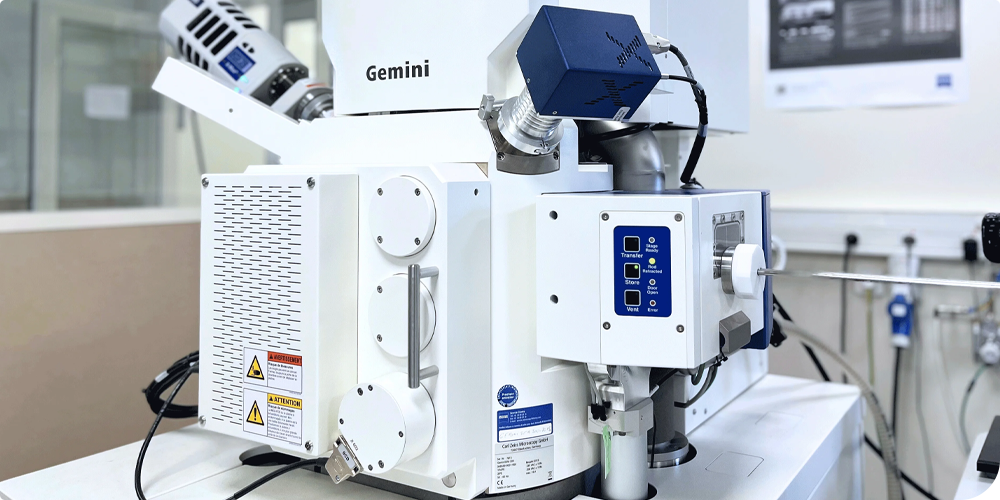
SEM-FEG observations and EDX analysis provided the following information. The deposit found in the tank is mainly composed of carbon (C), oxygen (O), calcium (Ca), and sodium (Na), with smaller amounts of magnesium (Mg) and silicon (Si), as well as traces of nitrogen (N), sulfur (S), chlorine (Cl), iron (Fe), and copper (Cu).
02

Additional analysis using FTIR

With FTIR analysis, the characteristic absorption bands observed are as follows:

  • A broad band around 1403 cm-1 characteristic of the elongation vibration mode of carbonate bonds;
  • Two narrow peaks around 871 and 712 cm-1 characteristic of the deformation vibration mode of carbonate bonds.

Based on these results, the spectrum of the observed deposit appears to correspond to the spectrum of a reference compound of the calcium carbonate type.


The results obtained...

The analysis carried out for this study revealed that the samples analyzed mainly contain carbon, oxygen, and calcium. Based on this elemental composition, the identification hypothesis concluded that calcium carbonate was present in the deposits analyzed.

03

Conclusion of the study

The discovery of calcium carbonate as the main component of the deposit analyzed provided our client with valuable insight into the origin of the blockages in their equipment. This analysis led to the development of a preventive maintenance program specifically tailored to counteract the effects of carbonate deposits, thereby improving equipment performance and durability.

Need help? Contact our team

Other case studies you may be interested in

Rouging phenomenon

With its excellent properties, stainless steel has become indispensable in many fields: everyday objects, medicine, surgery, automotive, aeronautics, mechanical industries, etc. However, many industrial stainless steel installations are affected by the phenomenon of rouging. Learn more +

Corrosion rate: the strategic choice of materials

One of our customers wanted to test the corrosion resistance of their heat exchangers. Learn more +

XPS weld passivation

Comparative study of two XPS weld passivation processes Learn more +

Services related to the case study

Analysis of particulate contamination on your powders by SEM-EDX

Calcium/Silicon (CaSi) Analysis and Expertise - Metallurgical Expertise

IRTF

SEM-FEG

Laboratory specializing in analysis and expertise for industrial companies

+140 employees
+140 employees here to listen to you
5,200 m² laboratory
5,200 m² laboratory +99% of services carried out in-house
Accredited laboratory
Accredited laboratory COFRAC ISO 17025
+2,200 clients
+2,200 clients in France and abroad

Contact us

Our services are reserved for professionals.

Frequently asked questions

How can an unknown deposit at the bottom of an autoclave vessel be identified?

Identifying an unknown deposit relies on complementary analysis of its elemental composition and chemical nature. In this study, FILAB combined SEM-EDX with FTIR infrared spectroscopy. Correlating the results pointed to a deposit mainly composed of calcium carbonate.

What does SEM-EDX analysis reveal about a tank deposit?

SEM makes it possible to observe the deposit’s morphology, while EDX provides information about the elements present in the analyzed areas. Here, carbon, oxygen, and calcium were predominant, along with sodium. This composition made it possible to formulate a mineral hypothesis, which was subsequently refined by infrared analysis.

Why use FTIR after SEM-EDX analysis?

FTIR provides information about chemical bonds, whereas EDX primarily indicates which elements are present. In this deposit, the bands observed near 1403, 871, and 712 cm⁻¹ were characteristic of carbonates. Comparing them with a reference spectrum supported the identification of calcium carbonate as the main constituent.

Is the presence of calcium sufficient to identify calcium carbonate?

The presence of calcium is not sufficient to identify calcium carbonate, since this element is found in the composition of many compounds. In this study, the interpretation is based on the elemental composition and the characteristic carbonate bands identified by FTIR. This analytical convergence supports the identification of the deposit.

How does identifying a deposit help adapt tank maintenance?

Knowing the nature of the deposit helps identify its origin and select appropriate maintenance actions. In the case presented, identifying calcium carbonate helped the client develop a suitable preventive maintenance program. The specific measures must then take into account the process, the fluids used and the equipment materials.