The problem?
As part of a change in methodology, one of our clients wishes to verify the effectiveness of a new passivation process in comparison with the old one. The percentage of oxidation of the iron and chromium elements is analyzed for each sample. The contribution of oxidized species within the oxygen element is also observed.
In order to carry out this study, FILAB developed an analytical approach using X-ray Photoelectron Spectroscopy (XPS) to perform an elemental, structural, and quantitative analysis of the extreme surface (a few nm deep) of a sample.
Comparison of surface passivation processes using XPS
Objective :
The objective of this study is to verify the effectiveness of a new passivation process (paste, Sample 2) in comparison with the old one (bath, Sample 1).
- The quantification and oxidation state of iron and chromium elements are characterized for each sample.
- The contribution of oxidized species within the oxygen element is also observed.
Approach :
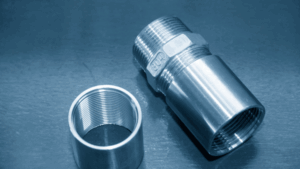
The study of the effectiveness of the two passivation processes for 316L stainless steel TIG welds is based on a nanoscale surface analysis using FILAB's analytical equipment. For this passivation study, FILAB drew on its dual expertise in materials and chemistry to determine the elemental composition of the 316L stainless steel TIG welds.
Here, an XPS spectroscopy study of the two passivation processes (paste and bath) determined that the outer surface of the two samples has essentially the same elemental composition.
In fact, they are composed mainly of oxygen, as well as iron and chromium. Other elements present in trace amounts are also observed.
Results :
XPS analysis therefore indicate that the surfaces of the two samples are well passivated. They also seem to indicate that these passivations are equivalent in terms of surface area.
Study of the passivation depth of the two types of processes using XPS
Objective:
Create a profile of the evolution of elemental concentrations present on the surface and at depth using several successive pulverizations through precise bombardment for each sample.
Approach :
The XPS analysis previously performed on the surface were repeated after each spraying process. The profiles of the evolution of the elemental composition according to depth in the sample for both processes were obtained. The following results were obtained.
Results :
Despite very similar passivation quality on the surface, the two processes appear to produce different passivation thicknesses.
Sample 2 (paste) has a thicker passivation layer (~15 nm vs. 8 nm for sample 1=bath), indicating better resistance to oxidation.
Higher chromium concentration in sample 2 (17-18% versus 10%), suggesting a difference in the composition or treatment of the material.
Oxygen diffusion is greater in sample 1, whereas it is severely limited at depth in sample 2.
Conclusion of the comparative study
The XPS spectroscopy analysis carried out as part of this comparative study yielded the following information:
- XPS analysis indicate that the surfaces of the two samples are well passivated.
- XPS analysis seem to indicate that these passivation layers are equivalent on the surface.
However, XPS profiles showed that the sample passivated with paste (new passivation) had a passivation layer three times thicker than the sample passivated with bath (old passivation). The diffusion of oxygen into the metal matrix beyond this passivation layer is also greater for the second sample. The newly developed passivation process, involving the application of a paste, therefore appears to be better because it is thicker.
Other case studies you may be interested in
Industrial marking
Conduct a cleaning process study in the context of industrial marking Learn more +Racket coverings
Indeed, the intensive use of table tennis rackets has revealed problems related to the durability of this equipment. Learn more +Laboratory specializing in analysis and expertise for industrial companies
Contact us
Our services are reserved for professionals.Frequently asked questions
How do you compare two passivation processes for stainless steel welds using XPS?
XPS makes it possible to compare the composition of the outermost surface layers and the chemical states of the detected elements. FILAB studied 316L stainless steel TIG welds passivated either by immersion bath or by applying a paste. The analysis focused in particular on iron, chromium, and oxygen, and was then supplemented with depth profiles. Discover XPS analysis.
Why can XPS analysis of the outermost surface produce similar results for two passivation treatments?
The initial layers of two samples may have similar compositions and chemical states, even though their passivation layers differ at greater depth. In the FILAB study, the surfaces appeared comparable at this initial level of analysis. Additional depth profiles were therefore performed to examine how the composition changed beneath the outermost surface.
How can an XPS depth profile of a passivation layer be produced?
The protocol combines XPS analysis with successive ion sputtering steps. Comparing the measurements makes it possible to track how the elements and their chemical states change with the depth examined. FILAB used this approach to compare the layers produced by the two processes and investigate differences concealed by initially similar surfaces.
What did the XPS profiles comparing paste and bath passivation reveal?
The profiles showed differences in thickness and composition between the passivation layers. The study describes a thicker layer for the paste-based process, as well as differences in the chromium and oxygen profiles. These observations provide a comparison of the samples within the scope of the XPS analysis performed.
Is a thicker passivation layer enough to validate all the performance of the new process?
The thickness and chemistry of the layer provide indicators for comparing processes, but they must be assessed against the application requirements. The FILAB study documents the differences in passivation using XPS. Validating a process change may require other checks suited to the operating conditions and the specifications for the parts.

